AI-generated answers can shape which brands buyers discover, compare, and shortlist before they visit a website. This makes competitive AI visibility an important measurement layer alongside rankings, traffic, and traditional search share. AI share of voice shows how much of that visibility your brand captures compared with selected competitors across relevant prompts and platforms.
Tracking AI share of voice helps teams see where a brand is consistently present and where competitors control important buyer conversations. The metric can compare mentions, citations, recommendations, or weighted placements across a fixed benchmark. Used carefully, it gives marketing teams a clearer basis for improving content, authority, and AI search share over time.
Key Takeaways:
|
What Does AI Share of Voice Mean?
AI share of voice measures your brand’s visibility relative to selected competitors in AI-generated answers. It can track mentions, citations, recommendations, or weighted placements. The metric shows competitive presence across a defined set of prompts, platform groups, markets, and reporting periods.
A 30% score means the brand owns 30% of the chosen visibility units across the benchmark. However, teams must define those units before calculation. Mention-based share differs from citation-based share because the former tracks recognition, while the latter tracks source ownership across the same questions, platforms, markets, and competitors.
The metric becomes useful when teams connect it with AI search visibility, answer accuracy, and buyer value. A high score can still hide negative descriptions or weak decision-stage presence. Strong reporting explains where the brand appears, how competitors perform, and why that visibility matters over a single reporting cycle.

How Should Teams Calculate AI Share of Voice?
Teams calculate AI share of voice by dividing one brand’s visibility units by total tracked brand visibility units. They then multiply the result by 100. Every report should define the method, eligible prompts, competitor group, platform scope, and observation period.
| Calculation Method | Visibility Unit | Best Use | Main Caution |
| Mention-based share | Answers naming each brand | Measures category recognition | Mentions may remain neutral |
| Citation-based share | Links tied to each brand | Measures source visibility | Citations may support background facts |
| Recommendation share | Shortlists containing each brand | Measures evaluation-stage inclusion | Recommendation strength can differ |
| First-position share | Answers placing a brand first | Measures leading recommendation presence | Ordering may change across runs |
| Top-three share | Brands appearing within three positions | Measures shortlist strength | Some answers lack ordered lists |
| Prompt-weighted share | Visibility adjusted by prompt value | Protects commercial relevance | Weak weights can distort results |
| Platform-weighted share | Visibility adjusted by platform importance | Reflects audience behavior | Platform assumptions need evidence |
| Decision-stage share | Mentions within high-intent prompts | Measures late-stage influence | Narrow scope misses educational value |
| Owned-source share | Citations pointing to owned pages | Measures website source ownership | External authority remains invisible |
| Accurate-mention share | Correct brand mentions only | Protects message quality | Manual review increases effort |
Teams should report the component scores before presenting one combined percentage. An AI visibility measurement framework keeps definitions, weighting rules, and review cycles consistent. This structure prevents dashboard changes from creating artificial gains or losses between reporting periods.
How Should Brands Choose Prompts and Competitors?
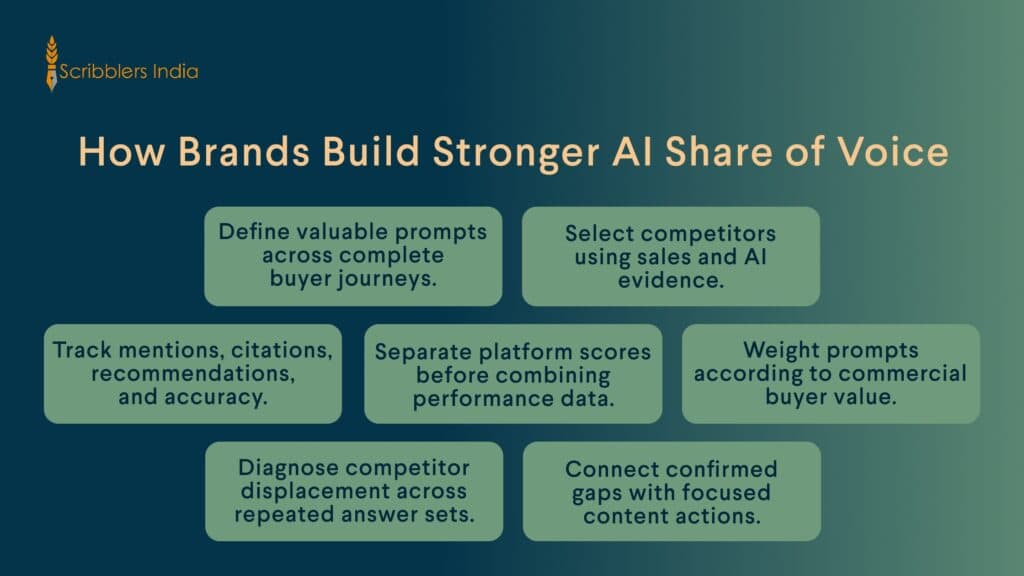
Brands should choose prompts and competitors that reflect real buyer decisions rather than internal assumptions. The benchmark needs category questions and commercial comparisons. It should include known sales rivals, AI-visible brands, adjacent options, and relevant regional providers within target markets.
A strong benchmark combines buyer research with observed AI behavior. Sales conversations reveal known rivals, while repeated testing surfaces brands that influence discovery before buyers contact sales. Our AI search benchmarking process keeps the core set stable while testing emerging questions separately.
- Map the buyer stages before testing: education, problem discovery, use cases, comparisons, objections, and final decision validation.
- Include brand-free category prompts to reveal which companies’ AI systems are introduced before buyers develop a shortlist or comparison set.
- Start with known commercial rivals appearing in sales conversations, procurement reviews, lost deals, or active customer comparisons.
- Add repeated AI-visible competitors when unfamiliar brands consistently appear across several sessions, platforms, or commercially important prompt groups.
- Freeze prompts during reporting cycles and test new language separately before changing the formal benchmark or historical comparison base.
How Does AI Share of Voice Reveal Category Ownership?
Category ownership indicates whether a brand appears frequently enough to become a default AI recommendation within a defined market. AI share of voice provides a starting measure. Teams should examine concentration, prompt breadth, recommendation order, and repeated inclusion across platforms.
A June 2026 study analyzed 3,750 responses across 50 brands, five industries, and three AI models. It proposed category ownership, competitive vacuum, and displacement metrics. The study found a moderate concentration of recommendations, challenging the idea that every AI category follows a winner-takes-all pattern.
Brands should treat category ownership as a pattern rather than a permanent title. Strong ownership requires visibility across buyer stages, repeat runs, and relevant markets. A focused prompt-coverage program shows whether the brand addresses a single narrow question or supports the broader journey across industries and decision contexts.
Why Should Platform Agreement and Brand Displacement Stay Separate?
AI platforms can recommend different leaders for the same category question. Teams should keep platform results separate before combining them into a single score. They should also track whether one brand repeatedly replaces another across comparable recommendation sets during evaluation journeys.
- Platform agreement: Compare which brand leads on ChatGPT, Gemini, Perplexity, and Google AI features. The 2026 category ownership study found only 41.6% agreement on the leading brand across its three tested models.
- Brand displacement: Record when one competitor appears after another disappears from repeated answers. This pattern can reveal asymmetric competition, where one brand replaces another more often than the reverse across specific prompt groups.
- Prompt paraphrases: Test natural wording variations outside the fixed benchmark. A 2026 study found recommendation overlap changed more across paraphrases than repeated runs of the same prompt, making wording a major visibility variable.
- Market differences: Separate countries, languages, and service regions when availability or regulation changes the set of relevant competitors. Combined reporting can hide local leaders or make global brands appear stronger than buyers experience.
- Decision context: Compare educational prompts with recommendation prompts because competitive order may change across buyer stages. A brand can lead category explanations while losing provider shortlists where proof or implementation fit matters.
Our GEO services examine platform and displacement patterns before recommending authority work. This analysis helps brands strengthen the sources, proof, and public expertise supporting competitive inclusion across priority prompts and markets over time.

Which Mistakes Distort AI Share of Voice Reporting?
AI share-of-voice becomes misleading when teams change methods, use weak samples, or combine different visibility units. A dependable report preserves comparable inputs. It also explains uncertainty before leaders interpret small movements as strategic wins, losses, or category changes.
Most reporting errors come from inconsistent benchmark design rather than the formula itself. Teams need fixed prompts, documented competitors, repeated tests, and clear visibility units. Our content strategy services connect identified gaps with planned editorial action rather than reactive publishing.
- Avoid single-answer conclusions, as repeated AI responses can vary across sessions, dates, models, and source-retrieval conditions.
- Separate mentions from citations because brand recognition, source ownership, recommendations, and ordered placements answer different performance questions.
- Protect the benchmark denominator by documenting every change to prompts, competitors, platforms, and markets before comparing reporting periods.
- Weight prompts with transparent rules so broad education questions do not hide weak visibility during commercial evaluation stages.
- Report platforms before combining scores because strong results on one engine can conceal poor competitive presence elsewhere.
How Can Scribblers India Improve AI Share of Voice?
Scribblers India turns competitive AI visibility data into focused content and authority priorities. We establish reliable baselines, identify where rivals lead, and connect findings with AEO, GEO, content strategy, personal branding, and thought leadership actions across important buyer journeys.
- Competitive visibility audits: We compare your brand against competitors that actually appear in priority AI prompts. The review shows where you gain mentions, citations, or recommendations and where another brand consistently takes that visibility.
- Prompt benchmark development: A useful benchmark starts with buyer questions, not a long list of keyword variations. We build a stable prompt set around discovery, comparisons, use cases, objections, and buying decisions so future results remain comparable.
- AEO content planning: Weak prompt groups often point to missing or unclear content. Our AEO services help improve direct answers, comparison sections, FAQs, and existing pages by adding stronger information to close those gaps.
- GEO authority development: Some visibility gaps come from weak source authority rather than missing pages. We use research, expert-led content, case-based resources, and credible external contributions to strengthen the wider information environment around priority topics.
- Founder authority programs: Founder expertise can support company visibility when buyers research a category, provider, or specialist. Our thought leadership services and personal branding services turn that expertise into credible public content around relevant themes.
Get in touch with our team to build a repeatable AI share-of-voice program that connects reliable measurement to stronger content, credible authority, and measurable commercial priorities across key buyer prompts.
Frequently Asked Questions
What Do Brands Ask About AI Share of Voice?
These FAQs answer common questions teams face when comparing AI visibility against competitors. Each response clarifies one practical measurement concern. They also show why brands should avoid universal benchmarks, unstable prompt sets, or conclusions drawn from one platform or answer.
Is AI Share of Voice the Same as AI Visibility?
No, AI visibility measures whether and how a brand appears across generated answers. AI share of voice compares that presence with selected competitors across the same benchmark. Share of voice adds competitive context, while wider visibility reporting includes citations, accuracy, prompt coverage, stability, referrals, and other business outcomes across platforms over time.
What Is a Good AI Share of Voice Percentage?
No universal percentage defines the strong AI share of voice across all categories. Targets depend on the number of competitors, prompt value, market scope, platform mix, and calculation method. Brands should compare movement against a stable baseline, leading competitors, and decision-stage prompts, rather than applying a single, unsupported benchmark across all reporting programs or markets.
How Often Should Teams Measure AI Share of Voice?
Teams should monitor high-value prompts each month and complete broader benchmark reviews every quarter. Fast-moving categories may require more frequent checks after launches or platform changes. Keep prompts, competitors, markets, and scoring rules stable so reported movements reflect competitive performance rather than changes in the measurement method or denominator.
Does a Citation Count Toward AI Share of Voice?
Yes, teams can calculate citation-based AI share of voice by defining citations as the visibility unit. However, citation share differs from mention share because platforms may name one brand while citing another publisher. Reports should label both calculations clearly and explain whether they measure recognition, source ownership, or recommendation influence.
Can One Tool Accurately Measure AI Share of Voice?
One tool can support consistent tracking, yet no product captures every answer experience, market, or user context. Teams should review its prompt design, sampling method, platform coverage, and scoring rules. Manual checks and business data can confirm whether the reported score reflects useful visibility across the selected category and buyer journey.