AI search visibility rarely depends on appearing for one high-value question. Brands need to surface across the prompts buyers use to discover a category, compare providers, assess concerns, and validate decisions. Prompt coverage measures how broadly a brand appears across that defined set of AI search queries and buyer conversations.
Tracking prompt coverage helps teams see whether visibility extends across the research journey or remains concentrated around prompts. It reveals missing topics, buyer-stage support, and content gaps that may limit AI search visibility. Used consistently, the metric gives brands a basis for prioritizing content, authority, and measurement efforts more effectively.
Key Takeaways
|
What Does Prompt Coverage Mean For AI Search Visibility?
Prompt coverage measures the percentage of tracked prompts in which a brand appears in AI-generated answers. It shows breadth of visibility across buyer questions. The metric helps teams identify missing conversations before planning content, authority, or measurement improvements around those gaps today.
If a brand appears in 40 of 100 tracked prompts, its prompt coverage equals 40%. The calculation uses prompt inclusion instead of total mention volume across repeated tests. Teams must define an appearance before testing, such as a mention, recommendation, citation, or approved signal for each platform and review cycle.
Coverage becomes useful when the prompt library reflects buyer research across education, comparisons, use cases, objections, and decisions. Our content strategy services connect missing prompt groups with suitable pages, expert assets, refresh priorities, and measurable visibility goals at each buyer stage to drive sustained growth.

How Is Prompt Coverage Different From Mention Frequency?
Prompt coverage measures the breadth across the tracked prompt library, while mention frequency measures how often a term appears within individual prompts. Both support AI visibility reporting. However, each reveals a different weakness and requires a different content or authority response from marketing teams.
- Metric focus: Coverage counts prompts where the brand appears at least once during testing. Frequency counts repeated appearances for the same prompt under comparable conditions. This difference separates visibility breadth from repeat inclusion within the chosen measurement framework.
- Question answered: Coverage asks whether the brand appears across the wider category journey. Frequency asks whether the brand maintains visibility when teams repeat prompts that already include it. Both questions need consistent testing throughout every planned reporting period.
- Content signal: Low coverage points toward missing topics, weak buyer-stage support, or absent use cases. Low frequency suggests fragile authority within topics the brand already addresses. Teams should examine existing content and external references across the complete buyer journey.
- Improvement approach: Coverage improves through new pages, cluster expansion, comparison assets, and objection content. Frequency improves through stronger evidence, clearer positioning, content refreshes, and external validation. These actions should follow confirmed gaps across future review cycles and markets.
- Review cadence: Teams can assess full coverage quarterly after preserving a stable prompt library. They should review frequency monthly for priority questions where recommendations or citations change often. This cadence supports stronger decisions across platforms and competitive categories.
Both metrics belong inside a complete AI visibility program. Our AEO services improve coverage through broader question support. They strengthen frequency through clearer answers, structured pages, stronger evidence, and reliable authority signals across priority buyer topics.
How Should Brands Build a Prompt List for Coverage Tracking?
Brands should build prompt lists around buyer language, research stages, market context, and commercial priorities. The list should include branded and nonbranded questions. It must remain stable for comparisons while allowing separate tests for emerging language and new buyer concerns.
| Prompt source | Example prompt | Coverage purpose |
| Category education | What is generative engine optimization? | Tests foundational topic visibility |
| Problem discovery | How can brands appear in AI answers? | Measures unaided brand discovery |
| Use-case research | Which agencies support B2B AI visibility? | Tests contextual service relevance |
| Feature evaluation | Which agencies offer AEO services in India? | Checks capability recognition |
| Vendor comparison | Best agencies for AI search content | Measures competitive presence |
| Alternative research | Alternatives to traditional SEO agencies | Tests adjacent category visibility |
| Objection handling | Is AI search worth investing in? | Measures trust and category confidence |
| Implementation planning | How should brands start AI optimization? | Tests process authority |
| Founder research | Who leads Scribblers India? | Checks founder entity recognition |
| Decision validation | Which AI visibility agency should I choose? | Measures shortlist inclusion |
Google explains that AI features may use query fan-out across related subtopics and data sources. This behavior supports prompt libraries that cover connected questions. Our content strategy services map those questions to suitable pages and authority assets for future measurement.
How Should Brands Weight Prompts by Business Value?
Prompt weighting gives greater influence to questions that matter more for qualified discovery or buyer decisions. It prevents broad educational prompts from dominating the score. Teams should document every weight before reporting results or comparing performance across future review periods.
Start by grouping prompts according to buyer stage and expected commercial value. A vendor recommendation may deserve more influence than a broad definition. However, education prompts still matter because they shape awareness and category understanding before buyers compare providers across the complete research journey.
Report unweighted coverage beside weighted coverage so leaders can see both breadth and business relevance. Document every rule before testing begins. Review weights when services or buyer behavior change, then preserve them throughout the next reporting period across quarterly and annual reviews.
Our AI search benchmarking process documents prompt groups and scoring rules before testing begins. This discipline prevents changing business priorities or internal preferences from distorting historical comparisons.
How Can Brands Accurately Calculate Prompt Coverage?
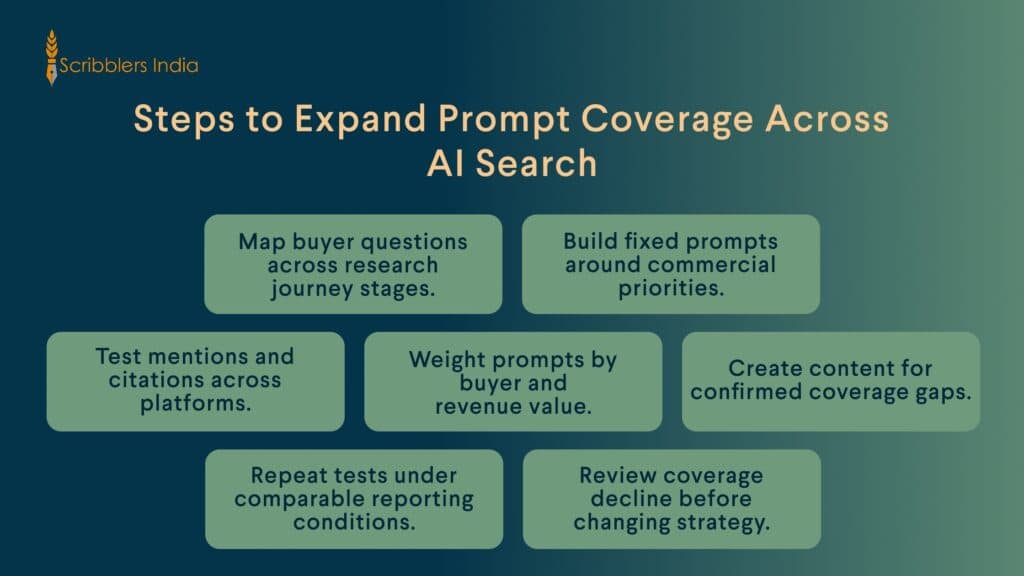
Brands calculate prompt coverage by dividing the number of prompts with an approved brand appearance by the total number of eligible tracked prompts. They then multiply the result by 100. Reliable reporting requires fixed definitions, repeated tests, and separate platform views throughout every planned reporting period.
First, define the appearance rule before collecting data. Teams may count direct brand mentions, owned citations, shortlist inclusion, or another approved signal. They should label these outcomes because each describes a distinct visibility behavior across all in-scope platforms and reporting periods.
Next, repeat important prompts across comparable sessions or dates and record platform conditions. A 2026 study found meaningful variation across repeated AI search observations, making one-time checks unreliable. Platform-level reporting also prevents strong results on one system from hiding weak coverage in another market.
This method should form part of a wider AI visibility measurement framework. Coverage explains breadth, while accuracy, citation stability, recommendation context, and referral quality explain the value of that presence.
Why Can Prompt Coverage Decline After Earlier Gains?
Prompt coverage can decline when buyer language, platform behavior, source selection, or brand information changes. A falling score does not always prove weaker content. Teams should diagnose the affected prompt group and testing conditions before changing pages or authority programs.
- Prompt drift: Buyers may adopt new terms, constraints, or comparison language that the fixed library no longer captures. Review emerging questions separately before replacing core prompts used for historical reporting. This protects comparisons across previous measurement periods.
- Source competition: Competitors may publish fresher research, clearer comparisons, or stronger expert content. Their new sources can replace pages that supported earlier visibility within the same prompt group. Carefully compare their evidence, structure, freshness, and source authority.
- Platform changes: Retrieval systems and answer behavior can change without preserving earlier source patterns. A decline may affect ChatGPT while remaining absent from Google or Perplexity. Compare platforms before diagnosing broader trends across the complete visibility program.
- Entity inconsistency: Updated services, leadership changes, or conflicting public descriptions can weaken brand understanding. Teams should review owned pages and credible profiles when answers become inaccurate. This protects the accuracy of the description across future reporting periods.
- Testing inconsistency: Changes in wording, account context, location, language, or session setup can create artificial movement. Repeat the original conditions before classifying a decline as persistent. This confirmation prevents unnecessary rewrites and misleading conclusions.
Regular tracking should separate coverage decline from normal response variation. Our AI search visibility scorecard connects confirmed losses with specific content or authority gaps. This approach protects strong assets while correcting persistent weaknesses across priority questions and platforms today.
What Content Actions Improve Weak Prompt Coverage?
Brands improve weak coverage by creating content that addresses missing buyer questions and strengthens authority on existing topics. The right action depends on the confirmed gap. Teams should avoid new pages when a focused refresh or credible external contribution can solve the problem over time.
- Build missing pillar pages when the brand lacks a useful foundation for an important category or cluster of problems.
- Expand supporting content clusters with explainers, implementation guides, objection content, and use-case pages around existing pillar resources today.
- Create fair-comparison assets that cover fit, limitations, deployment factors, support, pricing drivers, and practical selection criteria for buyers.
- Refresh weak authority pages with direct answers, current evidence, stronger examples, improved links, and accurate brand positioning throughout.
- Strengthen external expert signals through founder bylines, interviews, research commentary, and credible contributions across relevant industry channels today.
Our GEO services connect these actions with source authority and entity clarity across each priority cluster. Teams can then measure whether each new asset, refresh, or external contribution expands coverage across targeted questions and selected platforms.
How Can Scribblers India Help Brands Improve Prompt Coverage?
Scribblers India turns prompt coverage gaps into focused content and authority priorities. We build reliable prompt libraries, map missing buyer questions, strengthen answer-ready pages, and measure changes. Each service connects broader discovery with practical AEO, GEO, and brand-building work today.
- Prompt coverage audits: We check where your brand appears across priority AI prompts and where it does not. The audit highlights missed buyer questions, weak stages in the journey, and areas that need stronger content or authority.
- Prompt library development: We build prompt sets based on the questions buyers actually ask as they research, compare, and choose providers. A stable core also makes it easier to track changes in visibility over time.
- AEO content planning: Missing prompts often point to missing answers. We use those gaps to improve existing pages, add useful FAQs, strengthen comparisons, or create new content where there is a clear need.
- GEO authority development: Some visibility gaps require more than another webpage. We strengthen weak topic areas with original research, expert-led content, case-based insights, and credible external contributions that AI platforms can reference.
- Founder visibility programs: Founder expertise can boost visibility when buyers research the people behind a company. Our personal branding services build that presence through bylines, LinkedIn content, interviews, and expert commentary.
Talk to our team today to build an evidence-led prompt-coverage program that connects buyer questions with stronger content, credible authority, and repeatable AI visibility measurement across priority platforms and markets over time.
Frequently Asked Questions
What Do Brands Ask About Prompt Coverage?
These FAQs address common decisions teams face when tracking prompt coverage across AI platforms. Each answer clarifies one measurement concern. They also show where brands should avoid universal benchmarks, unsupported timelines, or prompt lists disconnected from actual buyer research behavior.
How Many Prompts Should a Coverage Program Track?
There is no universal prompt count for every brand. Start with enough questions to represent priority buyer stages, audiences, services, and markets without creating repetitive tests. Expand the library when research reveals missing journeys. A balanced set provides stronger insight than a large list built solely from minor wording variations.
What Prompt Coverage Percentage Should Brands Target?
No fixed percentage defines strong prompt coverage across every category. Targets depend on platform scope, competitor strength, buyer stages, and the appearance rule used. Brands should compare progress against a stable baseline, priority competitors, and weighted commercial prompts rather than adopting an unsupported universal benchmark for every market or reporting period.
Can Small Brands Build Strong Prompt Coverage?
Yes, smaller brands can build strong coverage within focused topic clusters. Clear service positioning, original expertise, useful examples, and credible external mentions can support visibility. They should begin with narrow questions tied to genuine strengths, then expand once testing confirms reliable coverage across the first chosen cluster and platform set.
How Often Should Brands Update Their Prompt List?
Brands should maintain a fixed core set of prompts for reliable trend reporting and review emerging language every quarter. Fast-moving categories may need more frequent exploratory checks. Add prompts when buyer research, sales feedback, platform behavior, or category changes show that the existing library misses meaningful questions or decisions.
Does Prompt Coverage Replace Traditional Keyword Tracking?
No, prompt coverage complements keyword tracking rather than replacing it. Keywords measure visibility across conventional search demand, while prompts capture inclusion within generated answers. Teams should connect both views with citations, referral quality, answer accuracy, conversions, and branded demand to understand how search discovery influences the wider buyer journey today.