
AI search visibility is changing how customers discover, compare and trust brands. Search is no longer limited to blue links, featured snippets and organic rankings. Buyers now ask Google AI Overviews, AI Mode, ChatGPT, Perplexity, Gemini and Copilot for recommendations, summaries and shortlists.
Google said in 2026 that AI Overviews had crossed 2.5 billion monthly active users, while AI Mode had crossed 1 billion monthly active users. This matters because AI systems do not simply “rank” websites. They interpret entities, compare sources, retrieve supporting evidence and generate answers. A brand can rank on Google and remain invisible inside AI-generated recommendations.
The Scribblers India AI Visibility Scorecard helps founders, marketing teams, consultants, agencies and B2B service firms evaluate whether their brand is ready for AI-led discovery. You will learn how to assess entity clarity, content depth, answer readiness, third-party trust, expert authority and conversion infrastructure.
At Scribblers India, we use this framework to integrate SEO, AEO, GEO, thought leadership, ghostwriting, and personal branding into a single measurable visibility system.
TL;DR
|
Executive Summary
AI search has created a new layer of visibility between brands and buyers. Traditional SEO still matters, but it no longer explains the full discovery journey. A brand must now be findable, understandable, and trustworthy across search engines, AI answer engines, and generative assistants.
This shift is already visible. OpenAI reported that ChatGPT had 700 million weekly active users by mid-2025, based on a privacy-preserving analysis of 1.5 million conversations. The same study found that three-quarters of ChatGPT conversations focus on practical guidance, information seeking and writing.
For businesses, this means prospects may form opinions before visiting the website. They may ask AI search visibility tools which agency, consultant, SaaS platform, service provider or expert they should consider. If the brand lacks structured content, credible proof and external validation, AI systems may ignore it.
This resource provides a practical scoring model for AI visibility readiness. It does not claim to predict exact LLM rankings. Instead, it helps teams identify where their brand is weak across the signals that commonly support AI discovery.
Scribblers India recommends that brands move from “keyword-first SEO” to “entity-first authority building.” This means clear positioning, answer-led pages, expert authorship, original insights, comparison assets, third-party mentions and measurable prompt testing.
The scorecard can support content planning, AEO audits, GEO strategy, personal branding, founder-led visibility and lead-generation campaigns.
Why does AI search visibility matter now?
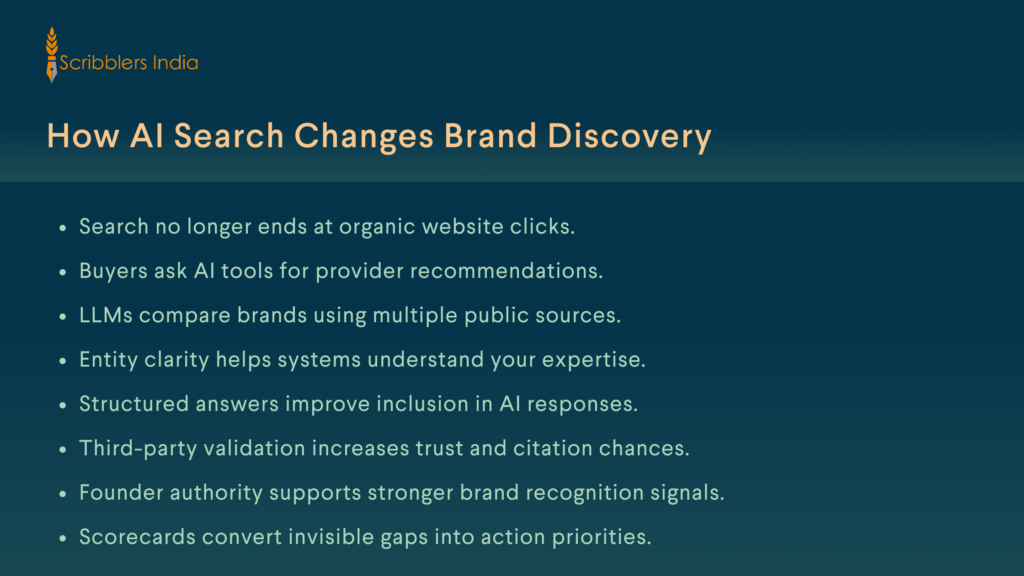
AI search visibility matters because buyers increasingly receive answers before they reach a website. Brands must now influence what AI systems understand, summarize and recommend, not only where their pages rank in search results.
- McKinsey’s 2025 global AI survey found that nearly nine out of ten respondents said their organizations regularly use AI, although adoption depth remains uneven. [McKinsey, 2025]
- HubSpot reported that more than 92% of marketers plan to use or already use SEO optimization for traditional and AI-powered search engines. [HubSpot, 2026]
- Statcounter’s May 2026 AI chatbot market share showed ChatGPT at 79.08%, Perplexity at 7.67%, Gemini at 7.03%, Copilot at 3.23% and Claude at 2.98%. [Statcounter, 2026]
Key Finding: AI visibility is not a future SEO trend. It is already part of how customers ask, compare, and shortlist.

How is AI search visibility different from traditional SEO?
AI search visibility differs from traditional SEO because it retrieves, compares and synthesizes information across multiple sources. A brand does not win only by ranking. It wins by being easy to understand, verify and cite.
- Google says AI Overviews and AI Mode may use query fan-out, in which multiple related searches are run across subtopics and data sources to develop a response. [Google Search Central, 2026]
- Semrush analyzed more than 10 million keywords and found that AI Overviews appeared for 6.49% of keywords in January 2025, peaked near 25% in July and stood at 15.69% in November. [Semrush, 2025]
- Semrush also found that informational queries fell from 91.3% of AI Overview-triggering queries in January to 57.1% by October, while commercial and transactional AI Overviews increased. [Semrush, 2025]
- Ahrefs re-ran its AI Overview CTR study using December 2025 data and found a 58% lower average click-through rate for the top-ranking page when an AI Overview appeared. [Ahrefs, 2026]
Scribblers India Takeaway: SEO still forms the foundation, but AEO and GEO determine whether a brand is visible within answer-led environments. Brands need content that answers sharply, cites credible sources, builds entity confidence and gives AI systems enough context to describe them correctly.
What do LLMs need to trust a brand?
LLMs need consistent brand identity, expert authorship, clear service pages, credible third-party mentions and source-backed content. If a brand appears differently across its website, social profiles and external mentions, AI systems may struggle to classify it.
- Google’s structured data guidance says structured data gives explicit clues about the meaning of a page and helps Google understand people, companies and content. [Google Search Central, 2026]
- Google’s helpful content guidance says ranking systems prioritize reliable, people-first content created for users, not content created mainly to manipulate rankings. [Google Search Central, 2026]
- Similarweb launched AI chatbot traffic as a distinct analytics source in 2025, covering traffic from platforms such as ChatGPT, Perplexity and Claude. [Similarweb, 2025]
- LinkedIn Ads says the platform reaches more than 1 billion professionals worldwide. [LinkedIn, 2026]
| What LLMs Need to Trust a Brand
AI systems need repeated, verifiable signals. These include a clear organization entity, expert profiles, detailed service pages, structured answers, external mentions, source-backed articles, public reviews, case studies and consistent language across platforms. |
Which content assets improve AI search visibility?
The strongest AI search visibility assets answer buyer questions, define category expertise, compare options and show proof. Thin blogs and generic service pages are less useful because they do not provide AI systems with sufficiently reliable context.
- Edelman and LinkedIn’s 2024 B2B Thought Leadership Impact Report surveyed nearly 3,500 management-level professionals across seven countries. It found that 95% of business clients are not actively seeking goods or services at any given moment. [Edelman-LinkedIn, 2024]
- The same Edelman-LinkedIn report notes that nearly 90% of global buyers said their purchase process was stalled the previous year. [Edelman-LinkedIn, 2024]
- HubSpot reported that website, blog and SEO remained the number-one ROI-generating channel for marketers in 2026. [HubSpot, 2026]
| Content Asset Type | AI Citation Value | Best Use Case |
| Original research | Very high | Earn citations and backlinks |
| Comparison pages | High | Recommendation-style prompts |
| Glossaries | Medium to high | Definitions and AEO answers |
| Case studies | High | Trust and proof signals |
| Founder articles | Medium to high | Expert entity building |
| Generic blogs | Low to medium | Topic coverage only |
Scribblers India Takeaway: Brands should create fewer generic blogs and more citation-worthy assets. The strongest mix includes research reports, frameworks, case studies, comparison pages, expert explainers, and founder-led thought leadership, all connected through internal links.
How should brands score their AI search visibility readiness?
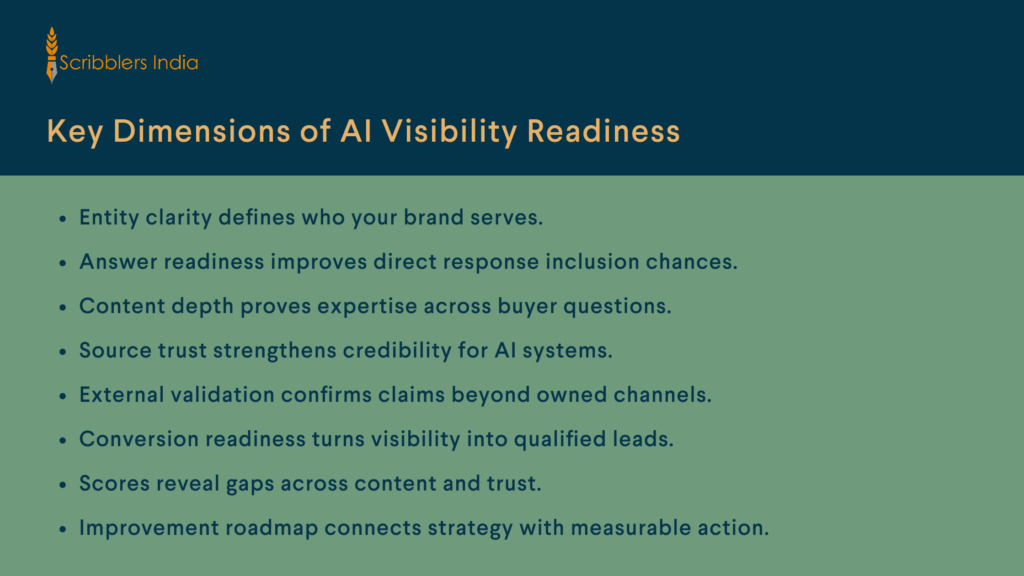
Brands should score AI search visibility across six dimensions: entity clarity, answer readiness, content depth, source trust, external validation and conversion readiness. A single ranking metric cannot capture this shift.
The Scribblers India AI Search Visibility Readiness Score
Score each dimension from 0 to 5. The maximum score is 30.
| Dimension | What It Measures | Score 0 | Score 5 |
| Entity clarity | Brand, services, experts and audience | Confusing positioning | Clear across all pages |
| Answer readiness | Direct answers for key questions | Long, vague pages | Structured answer-led pages |
| Content depth | Authority assets and topic coverage | Thin blogs | Guides, reports, case studies |
| Source trust | Citations, schema and proof | Unsupported claims | Verifiable evidence |
| External validation | Third-party mentions and reviews | Mostly self-owned content | Strong off-site validation |
| Conversion readiness | Lead capture and nurture | No clear CTA | Scorecards, forms and follow-up |
AI Search Visibility Readiness Template for Brands
Use this AI search visibility template to score your brand before planning SEO, AEO or GEO updates. Review each dimension honestly, add evidence from your website and external sources, then assign a score from 0 to 5. The goal is to identify visibility gaps that affect how AI systems understand and recommend your brand.
| Dimension | Audit Question | Evidence to Check | Score 0 to 5 | Priority Action |
| Entity clarity | Can AI understand who you are, what you offer and who you serve? | Homepage, About page, service pages, founder bios, schema, LinkedIn profiles | Rewrite positioning and align all key pages | |
| Answer readiness | Do your pages answer buyer questions directly and clearly? | H2s, FAQs, definitions, tables, direct answers, People Also Ask coverage | Add answer-led sections to priority pages | |
| Content depth | Do you have enough authority assets around your category? | Guides, reports, frameworks, comparison pages, glossary pages, case studies | Build topic clusters and citation-worthy assets | |
| Source trust | Are your claims supported by reliable data and expert context? | External citations, author bios, methodology notes, structured data, proof points | Replace unsupported claims with sourced evidence | |
| External validation | Do trusted third-party sources mention your brand? | Directories, media mentions, podcast features, guest posts, reviews, partner pages | Build off-site authority and credible mentions | |
| Conversion readiness | Can AI-discovered visitors understand the next step? | CTAs, forms, lead magnets, consultation pages, scorecards, nurture emails | Add relevant CTAs and lead-capture assets |
Prompt Testing Sheet
Use this sheet once a month to check how AI systems describe your brand in response to high-intent prompts.
| Prompt Tested | Platform | Did Brand Appear? | Was It Cited? | Competitors Mentioned | Accuracy of Description | Next Action |
| Best [service] agencies in India | ChatGPT | |||||
| Top [category] companies for [audience] | Perplexity | |||||
| Which agency helps with [problem]? | Gemini | |||||
| [Brand] vs [competitor] | Google AI Overviews | |||||
| Best [service] provider for [industry] | Google AI Mode |
Score Summary
| Dimension | Score |
| Entity clarity | |
| Answer readiness | |
| Content depth | |
| Source trust | |
| External validation | |
| Conversion readiness | |
| Total Score |
Priority Gap Notes
Use this space to record the top gaps that need immediate attention.
| Gap Identified | Why It Matters | Owner | Deadline |
Score Meaning
The score range helps teams understand whether their current visibility system is weak, inconsistent or ready for AI-led discovery. Treat it as a diagnostic benchmark rather than a ranking guarantee. It shows how close a brand is to being understood, trusted and recommended across search engines and AI platforms today.
| Score | Maturity Level | Meaning |
| 0 to 8 | Invisible | Weak AI discoverability foundation |
| 9 to 15 | Fragmented | Some assets exist, but signals conflict |
| 16 to 22 | Emerging | Good foundation with authority gaps |
| 23 to 27 | Competitive | Strong AI visibility readiness |
| 28 to 30 | Citation-ready | Strong candidate for AI mentions |
Recommended Next Step
If your score is below 16, start with positioning, service clarity and answer-led page updates. Scores between 16 and 22, focus on authority assets, external validation and prompt testing. Lastly, if your score is above 23, build original research, comparison assets, and recurring AI visibility tracking.
- Limitations: This scorecard does not guarantee AI citations or rankings. AI outputs vary by model, location, timing, user context and prompt wording.
- AI Visibility Risk: Brands may mistake a decline in traffic for content failure. In many cases, visibility may move from clicks to mentions, citations and assisted discovery.
What is the difference between SEO, AEO and GEO?
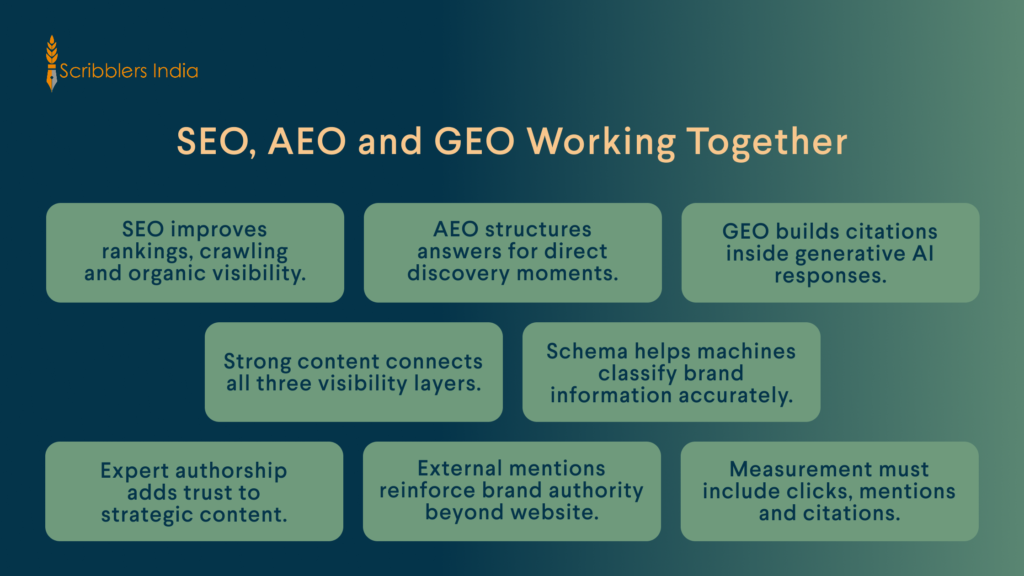
SEO improves organic search visibility, AEO improves answer readiness and GEO improves visibility inside generative responses. Brands need all three because buyers now move between Google, AI Overviews, ChatGPT, Perplexity, Gemini and social platforms.
| Discipline | Primary Goal | Main Asset Types | Measurement |
| SEO | Rank and drive traffic | Landing pages, blogs, technical SEO | Rankings, clicks, traffic |
| AEO | Win direct answers | FAQs, glossaries, answer-led guides | Featured answers, AI Overviews |
| GEO | Earn AI mentions | Research, frameworks, comparisons, citations | Mentions, citations, sentiment |
- HubSpot reported that nearly 24% of marketers are exploring SEO updates for generative AI in search, including ChatGPT, Gemini and Claude. [HubSpot, 2026]
- HubSpot also reported that nearly 30% of marketers saw decreased search traffic as consumers turned to AI tools. [HubSpot, 2026]
- Google reported in 2025 that AI Overviews reached 1.5 billion monthly users across 200 countries and territories. [Google, 2025]
Scribblers India Takeaway: AEO and GEO should not replace SEO. They should extend it. Brands need technical health, clear entities, structured answers, credible sources and external validation to perform across both traditional and AI-led discovery.
Scribblers India AI Search Visibility Scorecard Checklist
Our AI search visibility checklist helps teams convert the scorecard into a practical audit. Each question highlights a signal that can influence how search engines and AI systems understand a brand. Use it to review service clarity, content proof, expert authority, structured data, external validation and conversion readiness before planning content updates.
| Area | Question to Ask | Priority |
| Positioning | Can AI describe the brand in one sentence? | High |
| Service clarity | Are services mapped to buyer prompts? | High |
| Expert signals | Are founder and author profiles strong? | High |
| Content proof | Are claims supported with reliable sources? | High |
| External validation | Do other sites mention the brand credibly? | Very high |
| Schema | Does structured data support entity clarity? | Medium |
| Lead capture | Does the page convert AI-discovered visitors? | High |
Action Plan
Once the scorecard reveals visibility gaps, brands need a phased plan to fix them. The action plan moves from audit and page-level improvements to prompt testing, authority asset creation and recurring measurement. This sequence helps teams improve AI visibility without disrupting existing SEO and content operations.
First 30 Days
- Audit all service pages for entity clarity and answer-led structure.
- Create a prompt list covering brand, category and competitor queries.
- Fix missing schema for Organization, Person, Service, Article and FAQ pages.
- Add source-backed FAQs to key service pages.
- Build one AI Visibility Scorecard lead-capture page.
60 Days
- Publish comparison pages for high-intent categories.
- Create founder bio pages with expertise, services and proof.
- Refresh old blogs with 2026 AI search context.
- Add internal links between SEO, AEO, GEO, ghostwriting and personal branding pages.
- Start weekly prompt testing across ChatGPT, Gemini and Perplexity.
90 Days
- Publish two original frameworks and three case studies.
- Secure third-party directory listings and expert mentions.
- Repurpose major assets into LinkedIn documents and founder posts.
- Create a monthly AI visibility dashboard.
- Add conversion banners to relevant educational assets.
6 Months
- Publish an original AI Search Visibility Benchmark.
- Build a resource hub for reports, guides and tools.
- Launch a founder-led newsletter around AI search visibility.
- Create quarterly prompt-testing reports.
- Use content performance to refine service positioning.
How can Scribblers India help improve your AI search visibility?
We help brands build visibility across Google, AI Overviews, ChatGPT, Perplexity, Gemini and LinkedIn through strategy-led content systems. Our work integrates SEO, AEO, GEO, thought leadership, ghostwriting, personal branding, and conversion planning into a single measurable authority-building roadmap.
- AI Search Visibility Audits: We review your website, service pages, content assets, schema, external mentions and prompt visibility. The audit identifies why AI systems may miss, misclassify or under-recommend your brand across search and answer platforms.
- AEO and GEO Content Strategy: We create answer-led content plans for Google AI Overviews, AI Mode and generative engines. This includes FAQs, glossaries, comparison pages, service pages, reports and frameworks designed for clarity, usefulness and citation potential.
- Thought Leadership and Ghostwriting: We help founders and CXOs publish sharper ideas across LinkedIn, websites, newsletters and industry platforms. The goal is to build expert authority that supports both human trust and AI-led brand understanding.
- Personal Branding for AI Search: We structure founder positioning, profile content, expert bios, and visibility assets so that AI systems can connect the person with the brand, category, services, and audience. This improves entity clarity across channels.
- Reports, Frameworks, and Lead Magnets: We create research-backed guides, scorecards, benchmarks, and authority assets that attract prospects and boost AI visibility. These assets help turn expertise into discoverable, cite-worthy and conversion-ready content.
Book an AI Visibility Audit with Scribblers India and find your biggest discoverability gaps.
FAQs
What is an AI search visibility scorecard?
An AI visibility scorecard is a structured way to assess whether AI systems can understand, trust and mention a brand. It reviews factors such as entity clarity, content depth, answer readiness, external validation and conversion readiness. Brands can use it to prioritize SEO, AEO and GEO improvements.
How is AI search visibility different from SEO?
SEO focuses on rankings, crawling, keywords, content and website authority. AI search visibility also considers whether generative systems can accurately summarize, cite, and recommend a brand. A strong AI visibility strategy uses SEO as the foundation, then adds answer-led content, entity clarity and third-party proof.
Can a brand appear in ChatGPT or Perplexity without ranking first on Google?
Yes, but strong search visibility still helps. AI systems may use different retrieval methods, citations, and sources depending on the platform, prompt, and context. Brands improve their chances by creating clear service pages, trusted content, expert profiles, comparison assets and credible external mentions.
What content works best for AEO and GEO?
Research reports, comparison pages, glossaries, expert guides, case studies, FAQs and frameworks work well when they answer real questions clearly. These formats give AI systems structured information to summarize or cite. Generic blogs with unsupported advice usually have weaker AI visibility value.
How often should brands test AI search visibility?
Brands should test AI visibility at least monthly for priority prompts. Fast-moving categories may need weekly checks because AI outputs can change with new content, model updates and source shifts. Testing should track mentions, citations, sentiment, accuracy, competitor names and missing brand associations.
Does structured data improve AI search visibility?
Structured data helps search engines understand page meaning, entities and content types more clearly. It does not guarantee AI mentions, but it improves machine readability. Brands should combine schema with helpful content, expert authorship, internal linking, external validation and clear service positioning.
Why does founder authority matter for AI search?
Founder authority gives AI systems more context about expertise, credibility and category relevance. Strong founder profiles, LinkedIn content, expert articles and media mentions reinforce the brand entity. This is especially useful for service businesses where trust depends on people, not only company claims.