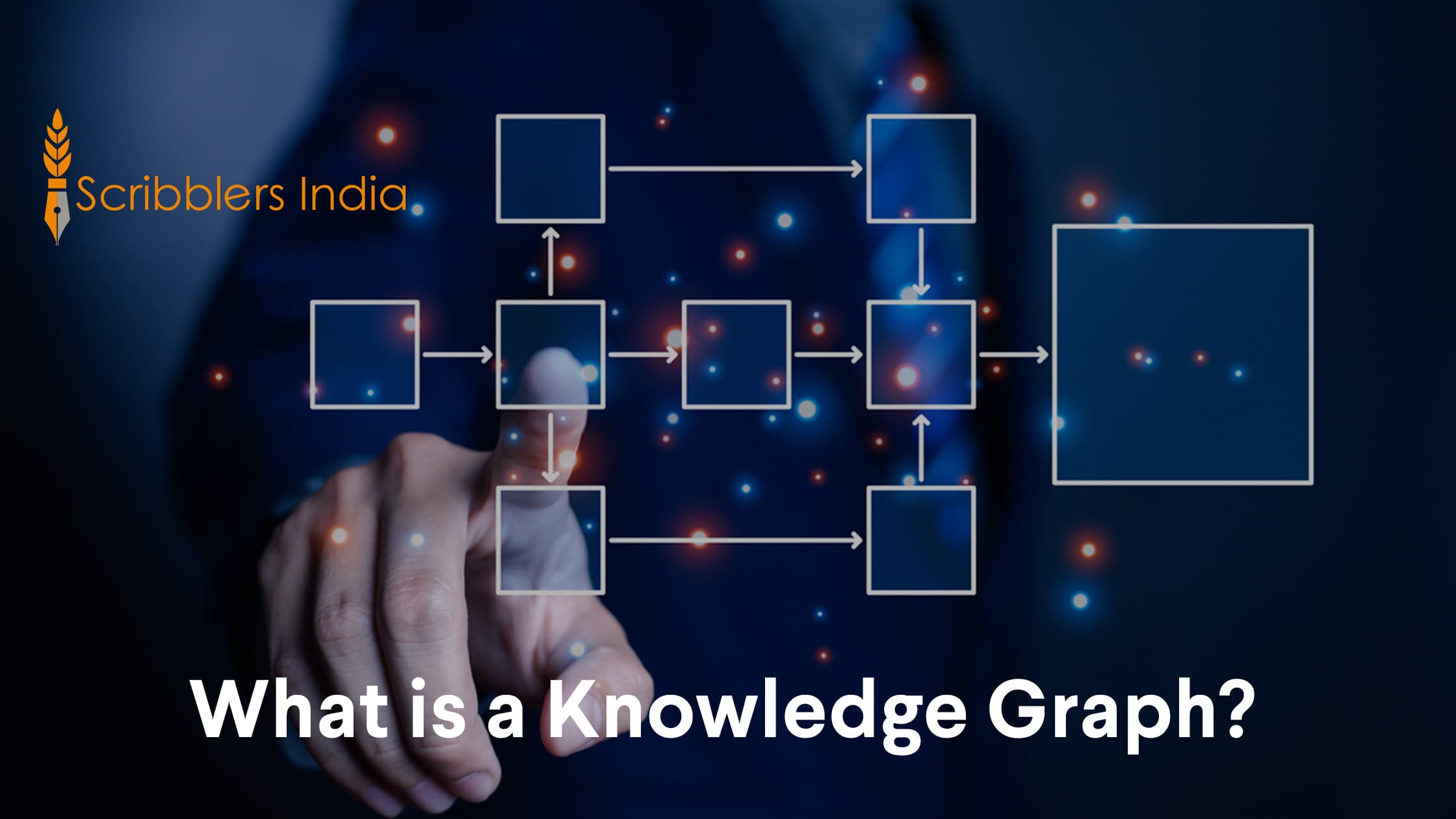
A knowledge graph organizes information by connecting identifiable entities with their attributes and relationships. Instead of storing facts as isolated records, it shows how people, organizations, products, places, concepts, and events relate. This structure provides search systems with more context when they need to understand subjects with similar names or related meanings.
Google uses its Knowledge Graph to understand facts about real-world entities and the relationships between them. This information can support several Search experiences, including Knowledge Panels. For brands, knowledge graph SEO therefore focuses on consistent entity information, clear relationships, useful content, and supporting signals rather than chasing one search feature.
Key Takeaways
|
What Is a Knowledge Graph and How Does It Organize Information?
A knowledge graph organizes information as connected entities rather than isolated records, giving systems more context for each subject. An entity may represent a person, company, product, place, event, or concept, while relationships show how those subjects connect.
Google introduced its Knowledge Graph around the idea of understanding real-world “things” and their relationships instead of matching words alone. This shift also supports broader AI search optimization, where systems increasingly need to interpret subjects, contexts, and relationships across diverse discovery experiences.
For example, a graph can connect a founder with a company, that company with a product, and the product with its category. These connected facts provide more useful context than separate records because each relationship explains how one identifiable subject relates to another.
What Are Entities, Attributes, and Relationships in a Knowledge Graph?
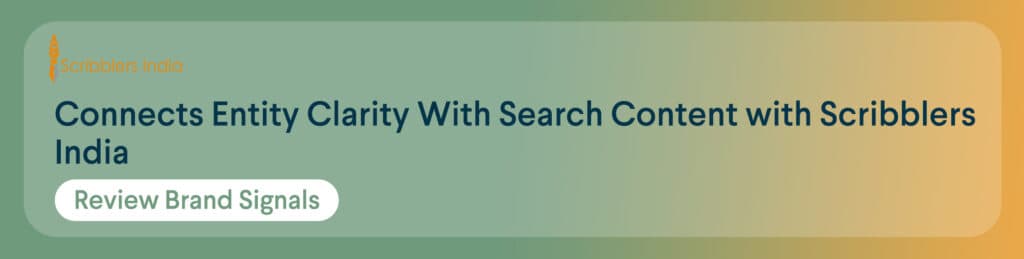
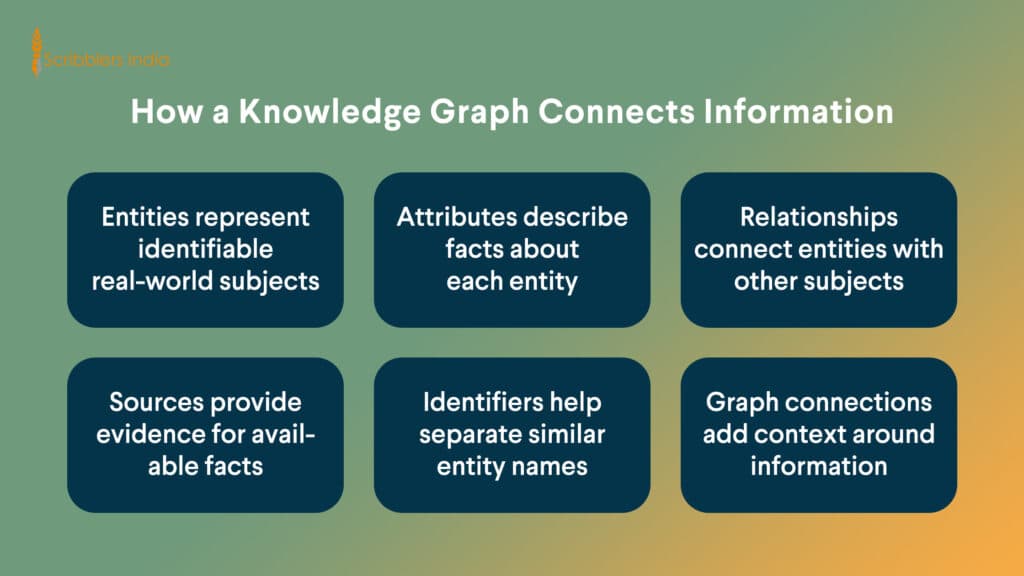
Knowledge graphs become easier to understand when their structure is reduced to three elements. Entities represent the subjects being described, attributes add facts about those subjects, and relationships connect one entity with another. Together, these elements turn separate information into a connected model.
| Element | What It Represents | Simple Example | Why It Adds Context |
| Entity | An identifiable person, company, product, place, event, or concept | Scribblers India is an organization entity | Establishes the subject being described |
| Attribute | A fact or characteristic connected with a specific entity | The organization provides content strategy services | Adds descriptive information about the entity |
| Relationship | A connection showing how two separate entities relate | A founder works for an organization | Connects subjects within a wider information network |
| Identifier | Information that helps distinguish one entity from another | Official website or recognized database identifier | Reduces confusion between entities sharing similar names |
Consider a simple entity relationship: Scribblers India → provides → content strategy services. Another relationship could connect Scribblers India → operates in → India. A founder entity could then connect with the same organization through a professional role.
These relationships do not create Google Knowledge Graph inclusion by themselves. They demonstrate how connected information provides more meaning than an isolated company name, service phrase, or person reference.
How Is Google’s Knowledge Graph Different From a Knowledge Panel?
Google’s Knowledge Graph and Knowledge Panels are closely connected, although they describe different parts of the search experience. The Knowledge Graph is Google’s underlying system for organizing entity information, while a Knowledge Panel is a visible search feature that can display selected facts.
| Area | Google Knowledge Graph | Knowledge Panel | What Brands Should Understand |
| What it is | Stores connected facts and relationships about identifiable real-world entities | Displays selected entity information directly within Google Search results | A panel represents one possible use of graph information |
| Where it appears | Works behind several Search systems and entity understanding processes | Appears visibly beside or within relevant search result pages | Entity recognition does not guarantee a visible panel |
| What it contains | Connects entities, attributes, identifiers, facts, and related subjects | Shows selected facts, images, links, summaries, and related details | Panel content reflects only part of available entity information |
| How it develops | Google builds entity understanding from multiple available information sources | Google generates panels automatically when systems consider them useful | Businesses cannot create panels through one SEO action |
Knowledge Panels therefore represent one answer-led search surface rather than the complete Knowledge Graph itself. This distinction also matters for Answer Engine Optimization, which encompasses broader opportunities to improve visibility across direct-answer experiences rather than focusing on a single Google feature.
Where Does Google Get Knowledge Graph Information From?
Google builds its Knowledge Graph understanding from several source types rather than relying on a single website or database. Google says its systems gather facts from information shared across the web, as well as open-source resources, licensed databases, structured information, and other sources specific to specific subject areas.
- Google can use information found across webpages when its systems identify facts about people, places, organizations, and other entities.
- Open-source knowledge resources can provide established facts and relationships that support understanding of entities across widely documented public subjects.
- Licensed data sources can supply structured information for areas such as music, sports, television, and other specialized search categories.
- Structured data on websites can provide explicit clues about organizations, people, products, events, and relationships represented within visible page content.
- Official business information can help Google understand names, logos, contact details, locations, and other attributes connected with organizations.
- Google can also use feedback from verified representatives when eligible entity owners report inaccurate information appearing within supported Search features.
This mix explains why brands cannot build knowledge graph visibility from a single website field or database listing. Strong entity information needs agreement across owned content, suitable structured data, and credible external sources that have a real reason to describe the organization.
Knowledge graph understanding can also support answer-led search when systems need to identify the organization, person, or concept behind a response. Our Answer Engine Optimization services address the broader visibility problem by linking entity clarity to useful answers, source quality, and search-ready content.
Why Does Consistent Entity Information Matter for Knowledge Graph SEO?
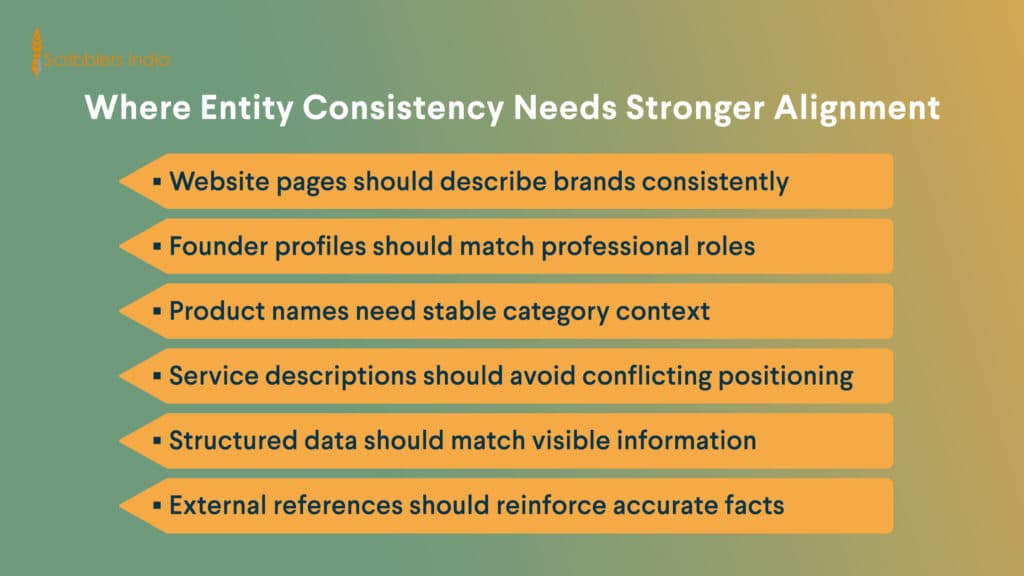
Knowledge graph SEO is less about inserting a specific keyword and more about reducing ambiguity around important entities. When company names, product details, founder roles, locations, or service descriptions conflict across sources, search systems face a more difficult information-reconciliation problem.
- Consistent organization names reduce ambiguity when search systems encounter abbreviations, legal names, brand names, or businesses with similar identities.
- Clear founder and leadership relationships help connect people with the right organization, role, expertise, and publicly available professional information.
- Stable product and service descriptions provide context for what a company offers and which categories those offerings fall into.
- Accurate location and contact information supports identity when organizations operate across several offices, markets, business units, or regional websites.
- Credible external references strengthen corroboration when independent sources describe the same entity using compatible facts and meaningful business context.
Entity consistency still does not guarantee a ranking or a panel outcome. The goal is to reduce conflicting signals and provide search systems with sufficiently reliable context to identify the organization being described. This is also where Entity SEO becomes relevant, since it focuses on strengthening the information and relationships that help search systems identify distinct entities.
How Does Schema Markup Support Knowledge Graph Clarity?
Schema markup can help search systems interpret entities by providing structured clues about webpage information. Google states that Organization structured data can help its systems understand administrative details and distinguish an organization from other organizations within Search results.
| Schema Element | What It Can Clarify | Useful Example | Important Limitation |
| Organization | Company identity, contact details, logo, location, and identifiers | Describing the organization on an About page | It does not guarantee Knowledge Graph inclusion |
| Person | Name, role, affiliation, and related identity information | Describing an author or company founder | Visible content should support the marked information |
| sameAs | URLs that identify the same entity elsewhere | Official profile or recognized reference page | The property should connect the same entity |
| mainEntity | The primary subject described by a page | Identifying the person featured on a profile page | It should reflect the actual page purpose |
Schema.org defines sameAs as a URL that identifies the same item, while mainEntity helps express the primary subject of a page. These properties can make relationships more explicit within machine-readable information.
Schema markup can make some of these relationships more explicit within page code, provided the markup reflects information users can already find on the page. Our guide to schema markup for AI search explains how structured data can reinforce visible entity information without becoming a shortcut to authority, rankings, or AI citations.
How Do Knowledge Graphs Connect With AEO, GEO, and AI Search?
Knowledge graphs help search systems organize facts and relationships, while AEO and GEO focus on how information becomes visible across answer-led and generated experiences. These disciplines overlap when accurate entity understanding supports the interpretation of companies, people, products, concepts, and their relationships.
Google’s current guidance says generative Search remains grounded in its core Search systems. AI Overviews and AI Mode retrieve information from the Search index while using established ranking and quality systems. No special structured data or knowledge graph tactic guarantees inclusion.
For brands, the useful connection is clarity of information. AI systems may need to distinguish between similar organizations, connect experts with relevant companies, understand product ownership, or reconcile facts across sources before representing a brand within a generated response.
The same need for consistent entity information extends into generated search experiences. AI systems may need to distinguish similar organizations, connect experts with companies, or verify product ownership before representing a brand. Our Generative Engine Optimization services therefore review entity clarity alongside content coverage, source visibility, citations, and external representation.
How Does Scribblers India Strengthen Knowledge Graph Readiness?
At Scribblers India, we treat knowledge graph readiness as an information-consistency and content-architecture problem. We cannot place a business inside Google’s Knowledge Graph on demand. We can strengthen the content, relationships, and supporting evidence that help search systems understand important brand entities.
- Define the important entity set: We first identify which entities genuinely matter to the brand and its search visibility. This usually includes the organization and the people closely connected with it. The goal is to focus on relationships that deserve stronger representation across owned content.
- Audit factual consistency across owned pages: Priority pages are reviewed to see whether they describe the same entity in compatible ways. Conflicting roles or outdated information are flagged early. This prevents new content from spreading inconsistencies across a larger part of the website.
- Map meaningful relationships through content: Important entities should connect through content that readers can understand without extra explanation. We review whether service pages and expert content clearly show those relationships. Internal links are then used where they genuinely help readers move between connected subjects.
- Review structured information with content context: Schema works best when the visible content already communicates the relationship clearly. We therefore review the page before recommending technical changes. If the content is vague, structured data alone will not fix the underlying information problem.
- Assess external representation that affects discovery: Public references can reveal whether a brand is being described consistently outside its own website. We review relevant mentions for outdated or conflicting information. Credible corroboration is valued more than low-quality placements created only to produce additional search signals.
This approach connects knowledge graph readiness with SEO, AEO, GEO, content strategy, and personal branding when those areas share the same entity problem.
Get in touch with our team to build a clearer entity footprint that helps search systems understand your organization, expertise, relationships, and supporting information.
Frequently Asked Questions
Can a Small Business Appear in Google’s Knowledge Graph?
A small business does not need global recognition for Google to recognize it as an entity. Google gathers entity information from many web and structured sources. Consistent business details, an accessible official website, well-structured data, and credible external references can support a clearer understanding without guaranteeing inclusion in a Knowledge Graph.
Is it possible for a Business to Edit Google’s Knowledge Graph Directly?
Businesses cannot open Google’s Knowledge Graph and edit entity records as they can in a public company database. Eligible representatives can claim certain Knowledge Panels and suggest corrections to displayed information. Businesses can also improve official website information and suitable structured data that Google may use when interpreting entities.
Is Wikidata Required for Knowledge Graph SEO?
Wikidata can provide useful entity information, but businesses do not need Wikidata entries for search systems to understand their organizations. Google draws from the wider web, structured sources, licensed databases, and other information resources. Creating database entries without meeting their inclusion standards is not a sound SEO strategy.
Can Scribblers India Help Create a Google Knowledge Panel?
We do not promise Knowledge Panel creation because Google determines when these panels appear. We can improve entity consistency across owned content, professional profiles, structured information requirements, and relevant external sources. This work strengthens the underlying information environment without presenting one Search feature as a guaranteed outcome.
How Does Scribblers India Find Knowledge Graph Content Gaps?
We map important brand entities and compare their appearance across priority website pages and relevant public sources. The review identifies missing relationships, conflicting descriptions, thin profiles, weak topic connections, and content gaps. Recommendations can include page updates, new resources, stronger internal links, or profile improvements.