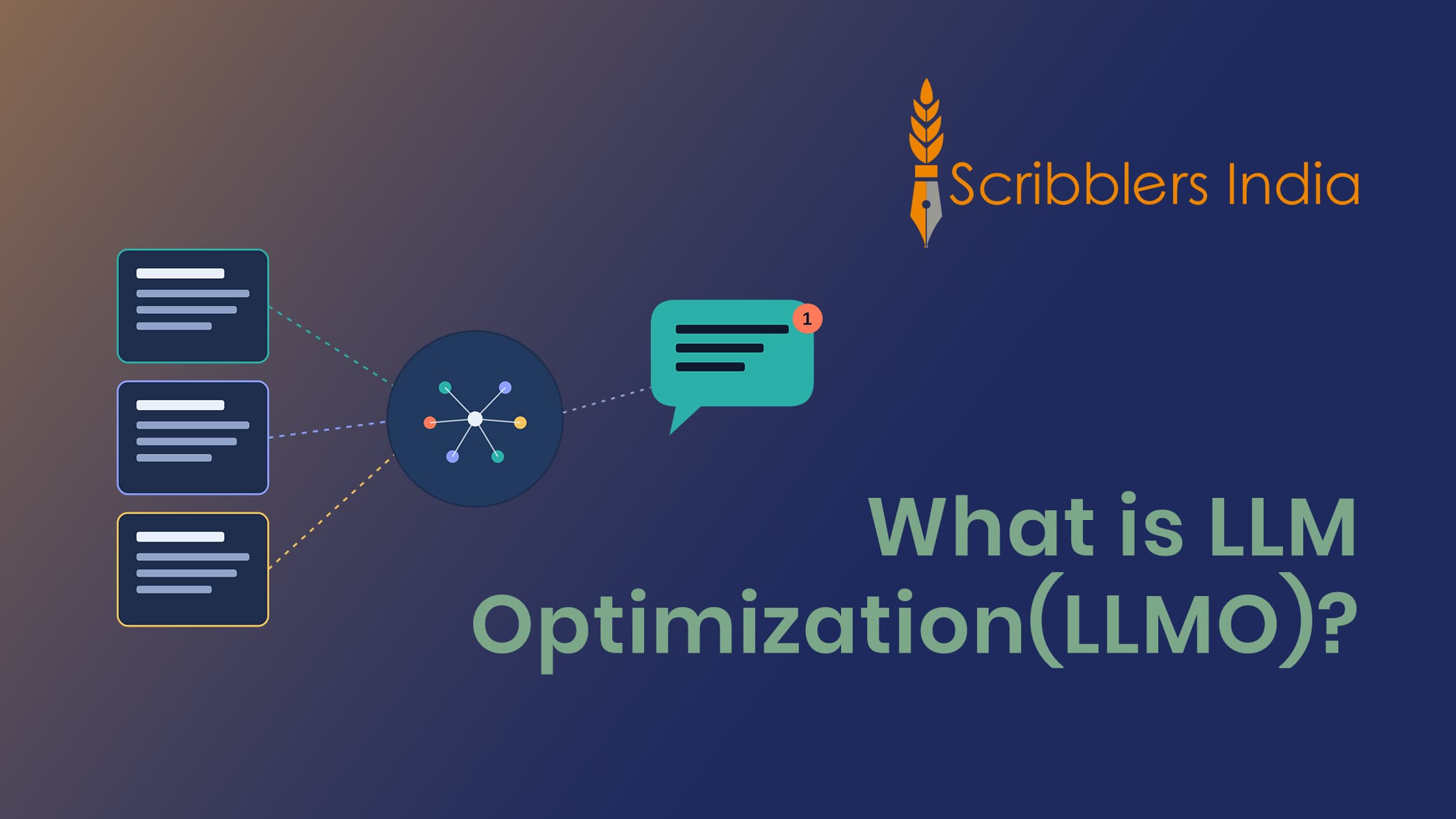
LLM optimization, or LLMO, improves how content and brand information can appear across LLM-powered search experiences. It focuses on what these systems can retrieve from the web and understand about a brand. The work also considers whether available sources provide enough context for accurate mentions, citations, comparisons, and generated answers.
LLMO overlaps with SEO, AEO, and GEO, although each term emphasizes a different part of search visibility. The goal is not to manipulate a model or control what enters its training data. Instead, LLM optimization strengthens the discoverable information environment that can support accurate representation across relevant AI search experiences.
Key Takeaways:
|
Why is LLM Optimization Crucial in AI Search?
LLM optimization describes work that helps LLM-powered systems find, interpret, and represent useful information when responding to relevant prompts. The term often appears alongside LLM SEO, GEO, and AEO. There is no platform-defined LLMO standard, so definitions vary across search and marketing discussions.
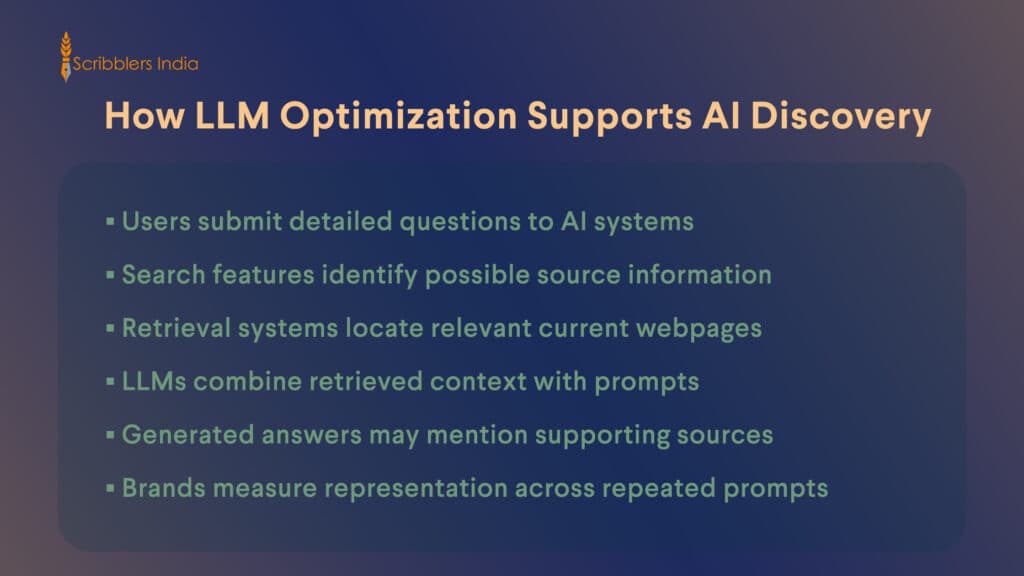
The core focus sits on the information environment available to an AI search experience. A model may answer based on learned information, retrieve current web sources, or combine both approaches, depending on the product and query.
For brands, the more actionable layer is current web discovery. Search-enabled systems can retrieve pages and supporting sources when answering questions that require current information, comparisons, recommendations, or evidence.
This means LLM optimization should focus on discoverable content instead of attempts to influence model weights. Search foundations, entity clarity, useful information, source credibility, and external references create a more defensible strategy.
Readers unfamiliar with the underlying technology can first review our Large Language Model glossary before exploring the optimization layer in more depth.

How Is LLM Optimization Different From SEO, GEO, and AEO?
LLM optimization shares many foundations with other search disciplines, so treating every acronym as a separate strategy creates unnecessary complexity. Their main difference lies in the aspect of discovery each term emphasizes, rather than in a completely different set of content requirements.
| Term | Main Focus | Typical Outcome | Core Question |
| SEO | Visibility across search engine results | Rankings, impressions, clicks, conversions | Can search engines discover and rank the page? |
| AEO | Selection within direct-answer experiences | Answers, snippets, citations, mentions | Can the content answer the question well? |
| GEO | Visibility within generated search responses | Citations, mentions, recommendations | Can generative systems use the brand as a source? |
| LLMO | Findability and representation across LLM-powered systems | Accurate mentions, citations, comparisons | Can LLM-based systems retrieve and understand the information? |
| AI search optimization | Broader visibility across AI-led discovery | Cross-platform visibility and assisted discovery | Is the brand discoverable across relevant AI search experiences? |
Google now states that standard SEO practices remain foundational for visibility across its generative Search experiences. Its guidance advises publishers to focus on useful content and sound technical foundations rather than on separate optimization shortcuts.
This overlap means a company rarely needs four independent content programs. A stronger approach connects search foundations with Answer Engine Optimization, GEO, entity clarity, and LLM visibility measurement.
Can Brands Optimize LLM Training Data and Live Retrieval the Same Way?
Training and retrieval are often discussed together under LLM optimization, although businesses have different levels of influence over each layer. Current retrieval offers a more observable optimization surface because published information can become available without waiting for a future model training cycle.
- Training data influence: Model providers determine how training datasets are assembled, filtered, licensed, and processed for each model generation. Brands cannot assume that publishing a page guarantees training inclusion or controls how learned information will later appear in model responses.
- Pretrained model knowledge: An LLM can sometimes answer from information learned before deployment without retrieving a current webpage. That knowledge may become outdated when organizations change products, pricing, positioning, leadership, services, or other information after the model’s training period.
- Live web retrieval: Search-enabled AI experiences can find up-to-date web pages when a user asks questions requiring up-to-date information or supporting evidence. OpenAI states that public websites can appear in ChatGPT search when OAI-SearchBot can access eligible content, although placement is never guaranteed.
- Retrieval-augmented generation: RAG combines retrieved information with an LLM before an answer is generated. Retrieval-Augmented Generation (RAG) is a grounding technique that uses Search systems to retrieve relevant, up-to-date webpages for generative Search experiences.
For this reason, brands gain more actionable opportunities from current content, crawl access, entity clarity, and source quality than speculative attempts to enter future training datasets.
What Makes Content Easier for LLM Systems to Retrieve and Use?
LLM optimization does not require a special writing formula that guarantees citations. Strong content still needs to answer genuine questions and provide information worth retrieving. Google now warns publishers against unnecessary AI-specific tactics, including forced content chunking designed around assumed generative search behavior.
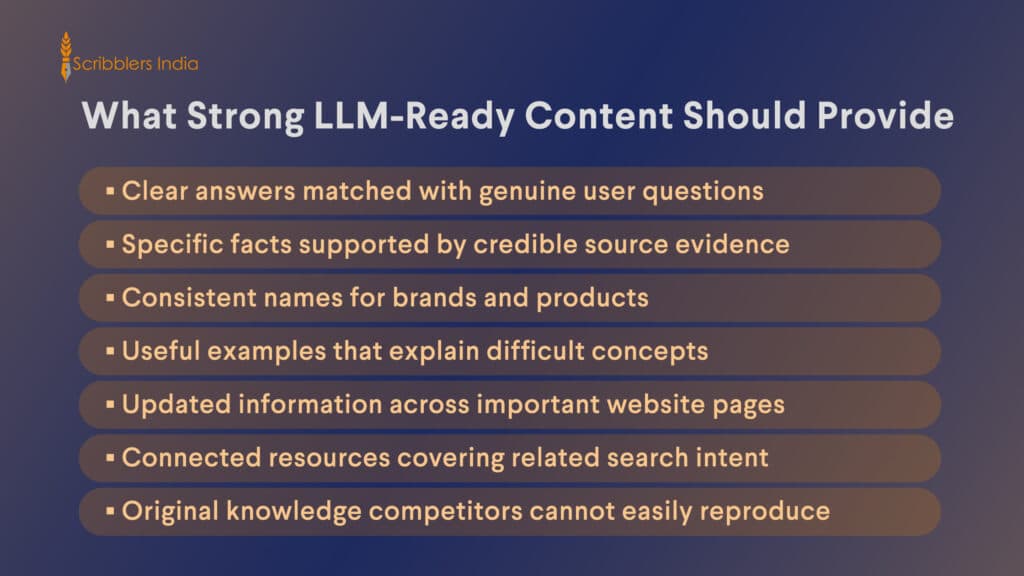
- Cover the question with enough depth: A page should resolve the main query while answering the natural questions that follow. Useful examples, limitations, comparisons, definitions, and implementation details give retrieval systems more relevant information for different user intents.
- Make important facts easy to identify: Names, dates, products, services, definitions, pricing details, methodologies, and claims should appear in clear language. Readers and machines should not need several paragraphs of promotional copy before understanding the core information being communicated.
- Add evidence where claims require support: Original research, named sources, product documentation, methodologies, expert input, and verifiable examples make an explanation easier to evaluate. Unsupported statements weaken source material when an answer requires factual evidence or comparative context.
- Keep information current across key pages: Old service descriptions, pricing information, biographies, statistics, or feature details can create conflicts across a company’s website. Content audits should correct outdated information before teams create more pages covering the same entity or topic.
- Build useful topic relationships: Internal links can connect supporting definitions, deeper guides, service information, frameworks, and related questions. They should help readers move through the topic rather than create repetitive anchors intended solely for search engines or AI crawlers.
Google’s 2026 guidance emphasizes unique, expert-led, non-commodity information instead of content designed around assumed AI extraction patterns. That principle gives brands a stronger foundation than trying to reverse-engineer one answer format.
How Do Entities and External Sources Influence LLM Visibility?
LLM visibility depends on more than information published on a company website. Generated answers can draw context from owned pages, third-party references, and retrievable sources. Brands therefore need consistent descriptions, sufficient first-party detail, credible corroboration, and accessible content across the wider information environment.
| Visibility Factor | What It Contributes | What Brands Should Do | Why It Matters for LLMs |
| Entity clarity | Consistent names and relationships reduce confusion between similar organizations or products. | Keep company, product, founder, and service descriptions aligned across key pages. | Clear identities help systems connect references with the correct real-world entity. |
| First-party source depth | Detailed owned content gives systems stronger context for answering specific questions. | Explain offerings, audiences, processes, claims, and supporting evidence across priority pages. | Thin pages provide fewer reliable details for comparisons or recommendation prompts. |
| Independent corroboration | Credible external references can confirm how a brand is described elsewhere. | Build relevant coverage through reviews, interviews, partnerships, research, and publications. | Third-party context can support stronger information agreement across generated search responses. |
| Technical accessibility | Crawlable pages remain available for retrieval through supported search and AI systems. | Maintain crawler access, indexability, working links, and technically accessible page content. | Inaccessible pages cannot contribute to systems’ retrieval of current information from websites. |
This broader source environment explains why Generative Engine Optimization services often examine owned content alongside external representations rather than limiting analysis to individual website pages.
How Should Brands Measure LLM Optimization Performance?
LLM optimization cannot be measured by a single universal ranking position because generated responses vary across prompts, platforms, contexts, and over time. Measurement should therefore separate discoverability, brand representation, source citations, website impact, and changes within a controlled set of prompts.
| Measurement Area | What Teams Should Check | What It Can Reveal |
| Prompt coverage | Brand presence across relevant prompt categories | Where visibility exists or remains absent |
| Brand mentions | Whether the brand appears without a citation | Broader representation across generated answers |
| Source citations | Which owned or external pages support responses | Sources influencing current AI visibility |
| Description accuracy | Whether products, services, and positioning appear correctly | Entity or information conflicts requiring correction |
| Competitor presence | Which alternatives appear across the same prompt set | Gaps in category and comparison visibility |
| Referral traffic | Visits arriving from AI-powered discovery platforms | Direct website engagement from AI search |
| Google generative visibility | Impressions within supported Search generative features | Google-specific exposure across AI Search |
Google introduced dedicated Generative AI performance reporting in Search Console in 2026, with the worldwide rollout completed in August. This provides first-party visibility data for Google’s generative Search features, rather than relying on estimates from external monitoring platforms.
Brands still need cross-platform prompt testing because Search Console does not measure every LLM-powered discovery environment. Our AI Search Visibility Scorecard provides a broader framework for reviewing entity clarity, content depth, answer readiness, trust, and measurement.

What Common LLM Optimization Mistakes Should Brands Avoid?
Many LLM optimization problems begin when teams treat uncertain industry theories as established platform requirements. A stronger program separates documented guidance from experiments and assumptions. This keeps resources focused on content quality, discoverability, brand accuracy, and evidence instead of speculative technical shortcuts.
- No legitimate optimization method can guarantee that an LLM will cite a single brand for every relevant user prompt.
- Search-enabled AI systems still depend on crawlability, indexing, relevance, source quality, and useful web content.
- Repetitive definitions and forced-answer blocks can reduce usefulness without providing any guarantee of improved retrieval.
- Google states that llms.txt does not affect Search visibility, rankings, or inclusion within generative Search experiences.
- One prompt provides weak evidence because wording, context, platform behavior, and available sources can change generated answers.
LLMO should therefore operate as an evidence-led extension of search and content strategy. Teams should test assumptions, document changes, monitor visibility, and avoid turning emerging terminology into unsupported ranking rules.
How Does Scribblers India Approach LLM Optimization?
At Scribblers India, we treat LLM optimization as a connected visibility problem rather than a separate content-writing formula. We examine what users ask, what systems currently surface, which sources influence those answers, and where a brand’s existing information fails to support accurate discovery.
- Establish a baseline for prompts and visibility: We identify commercial, informational, comparison, and category prompts relevant to the business. Current mentions, citations, competitor appearances, and description accuracy create a baseline that guides priorities instead of relying on assumptions about LLM behavior.
- Audit the existing information environment: Our team reviews priority website pages, topical coverage, entity descriptions, expert content, evidence, internal relationships, and important external references. This helps identify whether the main weakness involves missing content, weak positioning, inconsistent information, or limited supporting authority.
- Create content around identifiable gaps: Scribblers India develops glossary pages, guides, comparisons, service content, research-led assets, thought leadership content, and supporting articles where the evidence shows missing coverage. Each asset has a defined search purpose rather than adding content volume without a visibility rationale.
- Review changes through recurring measurement: We compare prompt coverage, citations, brand representation, search visibility, and source patterns after content updates. Results guide later revisions, while platform changes are reviewed against current documentation before new tactics become part of the strategy.
Our approach connects LLM optimization with SEO, AEO, GEO, authority building, and content strategy, where these disciplines address the same discovery problem. Get in touch with our team to build an evidence-led LLM visibility program that improves how your brand is found, understood, and represented across AI search.
FAQs
Does LLM Optimization Require a Separate Website From an SEO Website?
LLM optimization does not require a separate website or parallel content library. The same crawlable website can support traditional search and LLM-powered discovery when its information is useful and accessible. Separate AI versions can create maintenance problems when descriptions, facts, or service information begin diverging across different content environments.
Is LLM Optimization the Same as Prompt Engineering?
LLM optimization and prompt engineering solve different problems. Prompt engineering changes instructions given to an AI system to influence a specific output. LLM optimization improves the information environment available to AI-powered systems as they discover, retrieve, interpret, or represent a company, topic, product, service, or expert in user-facing answers.
Can Small Businesses Use LLM Optimization Without Specialized Tools?
Small businesses can begin with manual prompt testing, Search Console, analytics, crawler checks, and structured content audits before adopting specialist platforms. A controlled prompt sheet can reveal brand mentions, citations, competitor appearances, and accuracy issues. Tools become more useful when monitoring expands across many topics, markets, products, or platforms.
How Can Scribblers India Help When a Brand Appears Incorrectly in AI Answers?
We first identify where the incorrect description appears and which available sources may support that interpretation. We then review owned content, entity descriptions, external references, and missing context. The recommended work may involve correcting core pages, strengthening explanatory content, or addressing inconsistencies across relevant public sources.
Does Scribblers India Treat LLMO as a Replacement for SEO?
We do not treat LLMO as a replacement for SEO because the foundations of search remain important across many AI discovery experiences. Our approach connects technical discoverability, useful content, entity clarity, AEO, GEO, and visibility measurement. The mix depends on where the brand currently loses discovery opportunities across search and generated answers.