Schema markup is machine-readable code that helps search engines understand what a webpage contains and what its information represents. It can identify articles, products, organizations, people, events, reviews, and other entities in a consistent format. This added context can support richer search appearances when systems recognize and use the markup.
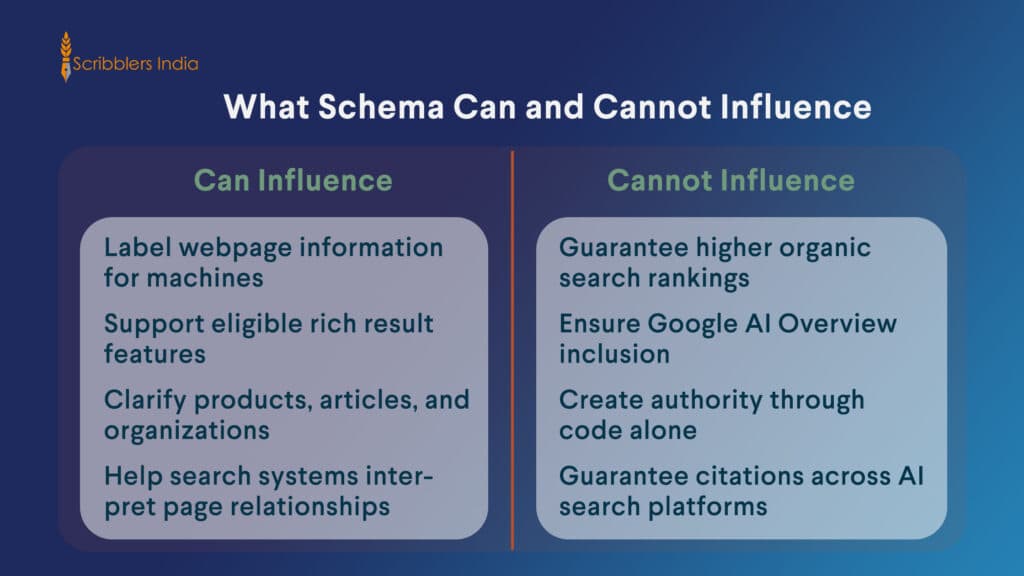
However, schema markup does not guarantee higher rankings, AI citations, or inclusion in Google AI Overviews. Its main role is to make page information easier for machines to interpret across search experiences. Used correctly, it strengthens technical clarity while supporting SEO, AEO, and GEO efforts built around useful, well-structured content.
Key Takeaways
|
What Is Schema Markup and How Does It Work?
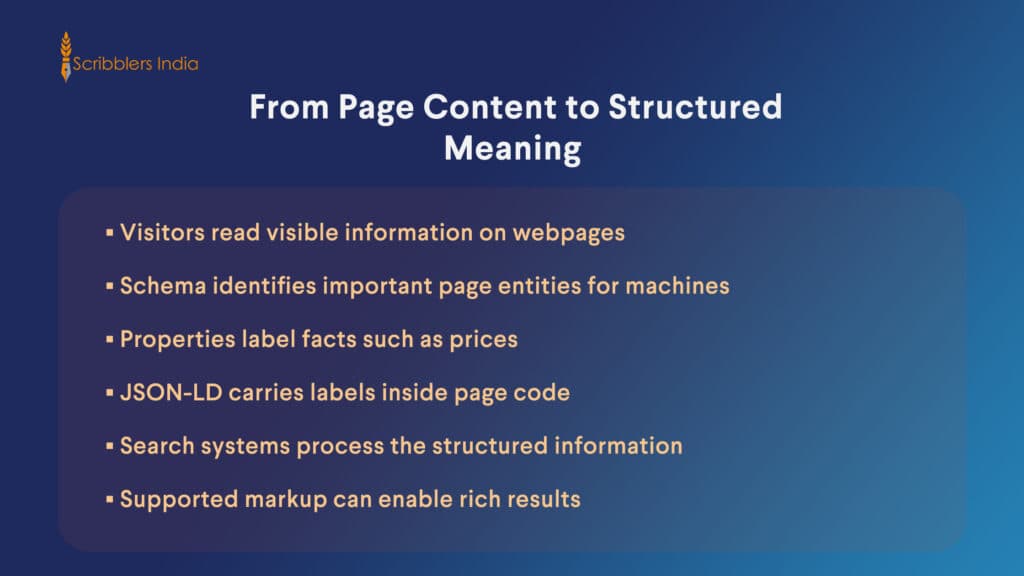
Schema markup adds standardized labels to information that people can already understand from visible webpage content. A product page may show a name, price, brand, availability, and review score. Schema connects those details with machine-readable properties that explain what each value represents.
Search engines can then use those labels when processing the page and deciding whether supported search features apply. Google describes structured data as a standardized format for classifying page information, while most Search implementations use Schema.org vocabulary.
The markup should describe the same information that is visible to readers, rather than creating a second version of the page. Accurate implementation enhances clarity, while misleading or hidden information can render a page ineligible for rich-results features under Google guidelines.

How Is Schema Markup Different From Structured Data and Schema.org?
These terms appear together so often that they can sound interchangeable, although each describes a different part of the system. The difference helps content teams discuss requirements with SEO specialists and developers without treating each technical layer as the same thing.
| Term | What It Means | Simple Example | Main Role |
| Structured data | Information organized in a standard machine-readable format | A product price identified as a price | Gives machines labeled information |
| Schema.org | A shared vocabulary containing types and properties | Product, Person, Organization | Defines what labels mean |
| Schema markup | Schema.org vocabulary added to webpage code | Product details expressed through JSON-LD | Applies structured meaning to a page |
| JSON-LD | One supported format for writing structured data | A script containing @type and properties | Provides an implementation method |
Google supports JSON-LD, Microdata, and RDFa for Search structured data, while Schema.org provides a much wider vocabulary. Teams should therefore check Google documentation before expecting every valid Schema.org type to create a supported Search feature.
Which Schema Markup Types Should a Website Use?
A website should use schema types that match each page’s actual purpose and visible content, rather than adding unrelated markup. Teams should start with important page templates, identify the entities or content being described, and select supported types that fit those pages.
- Organization: Organization markup can describe a company name, logo, URL, address, contact details, and related information when applicable. Google recommends placing organizational information on the home page or on another page that describes the organization to reduce conflicting details across templates.
- Article: Article markup identifies information such as the headline, images, publication dates, and author details. Publishers can use it on suitable article pages when the marked information matches the visible byline, publication date, main image, and page content.
- Product: Product structured data can describe price, availability, ratings, shipping details, and other product attributes shown on a page. Google separates product snippets from merchant listings because direct-purchase pages may require different information than editorial pages that review products.
- LocalBusiness: LocalBusiness markup can describe a physical business location through information such as its address, telephone number, opening hours, and business subtype. The chosen subtype should align with the business represented on the page, and the markup should match the visible location information.
- Breadcrumb: Breadcrumb structured data describes a page’s position within the website hierarchy and the path leading toward it. Google can use this information in supported Search appearances to show how deeper pages connect with broader categories and website sections.
A SaaS website may emphasize Organization, Article, Breadcrumb, and SoftwareApplication information, while ecommerce sites may require Product markup across catalogs.
How Do You Add and Validate Schema Markup?
Adding schema markup is not limited to generating code and pasting it into a page template. The markup should match visible content, use the correct type, contain required properties, pass validation, and remain accurate after website changes.
- Choose the page purpose first: Teams should identify what the page represents before selecting markup for its content. A home page, article, product page, author profile, event page, and location page describe different entities that can require different supported schema types.
- Select an implementation format: Google supports three structured data implementation formats for Search: JSON-LD, Microdata, and RDFa. Google recommends JSON-LD in most situations because teams can maintain it without placing every property throughout visible HTML, although the chosen format should fit the website setup.
- Map visible information to properties: Required and recommended properties should describe information readers can verify on the page. A product price in markup should match the displayed price, while an article author should match the person shown to readers and the published byline.
- Validate before deployment: Google’s Rich Results Test checks whether page markup supports eligible Google Search features. The Schema Markup Validator checks broader Schema.org markup for general vocabulary errors. This separates general vocabulary validity from Google-specific rich-result eligibility during implementation reviews.
- Monitor after publishing: A valid implementation can break when templates, plugins, prices, business details, or page layouts change. Search Console enhancement reports, URL Inspection, and recurring technical reviews can identify stale, broken, or conflicting structured information across affected pages.
Google states that correct structured data does not guarantee a rich result. The search system can still choose a standard result based on query context, device, location, page quality, and other Search considerations.
Can Schema Markup Improve SEO Rankings and Rich Results?
Schema markup can make qualifying pages eligible for supported rich results displaying product prices, ratings, breadcrumbs, recipe details, or other enhanced elements. These appearances can give searchers more context before they click, though Google decides whether a rich result appears for each search.
Schema markup should not be treated as a direct ranking switch across Google Search results or other search experiences. Google’s guidelines separate rich-result eligibility from web search rankings, since manual actions on structured data can remove rich results without changing normal ranking positions.
The stronger use case combines machine-readable clarity with eligibility for supported search features. A useful page still needs crawlability, relevance, accurate information, sound technical SEO, and content that satisfies the query. Our AEO glossary explains how these technical and content layers work together.
Does Schema Markup Help AI Overviews, AEO, and GEO?
Schema markup can support a sound SEO foundation, although Google does not require structured data for AI Overviews or AI Mode. Google’s 2026 guidance says no special Schema.org markup is needed for generative Search. Pages still need Search eligibility, crawlability, relevance, and useful content that answers the user’s question.
| Question | What Current Guidance Supports | What Should Be Avoided |
| Does schema guarantee AI Overview inclusion? | No. Google requires no special schema for generative Search. | Promising AI citations from markup alone |
| Can schema help describe page information? | Yes. Structured data provides explicit machine-readable information. | Replacing weak visible content with code |
| Should AEO programs ignore schema? | No. Relevant structured data remains part of sound SEO implementation. | Treating every schema type as an AEO signal |
| Should GEO teams add experimental markup? | Only when a supported use case and evidence justify it. | Inventing “GEO schema” without platform support |
A detailed schema markup for AI search guide examines this distinction further. Schema supports technical clarity, while AI visibility still depends on useful content, retrieval relevance, entity clarity, authority, and source quality.

How Should Teams Prioritize Schema Markup Across a Website?
Schema markup creates the most value when teams prioritize pages where structured information supports a clear search or business use case. Instead of adding markup across every template, teams should review the page’s purpose, supported search features, content consistency, maintenance needs, and implementation effort before deciding where schema should receive focused priority.
- Product, service, event, and local pages should receive priority when supported schema aligns closely with their visible content.
- Teams should focus first on markup related to active Google Search features rather than on unsupported Schema.org vocabulary.
- Important schema properties should match information that users can confirm directly from the visible content on each page.
- Reusable templates can improve implementation consistency across similar pages while reducing repeated development and long-term maintenance effort.
- Dynamic details such as prices, availability, dates, and business information need reliable sources that keep markup current.
- Validation checks and Search Console monitoring should be planned before rollout so teams can review implementation quality over time.
A priority-based approach keeps schema work connected with genuine search opportunities and manageable website processes. It also helps content, SEO, and development teams direct resources toward implementations that support users and current platform requirements.
How Does Scribblers India Handle Schema-Related Content Requirements?
At Scribblers India, we treat schema markup as one part of search readiness rather than a standalone visibility tactic. Our work starts with page purpose, visible information, search intent, and content quality. We then assess whether structured data supports the page purpose or its recurring content template.
- Map schema to real page content: We review what each priority page represents before recommending markup-related content changes. This prevents schema from describing entities, claims, authors, services, or page types that the visible copy does not support with enough clarity.
- Separate technical eligibility from content quality: A page can pass structured data validation and still provide an incomplete answer. Our Answer Engine Optimization services examine question coverage, source depth, evidence, and technical conditions that support search discovery across priority pages.
- Connect schema with wider entity clarity: Organization details, author information, service descriptions, and topical relationships should agree across visible content and related pages. Our Generative Engine Optimization services review these connections within a broader AI-search program rather than treating markup as an isolated fix.
- Keep claims aligned with platform guidance: Search documentation changes, so implementation advice should change with it. We avoid presenting experimental markup as proven ranking logic when platform evidence is missing, and we separate supported rich-result requirements from assumptions about AI citations or generated answers.
Get in touch with our team to build clearer content foundations before adding technical layers that cannot solve the underlying information gaps.
Frequently Asked Questions
Is Schema Markup the Same as Metadata?
Schema markup and metadata overlap in purpose, although they are not the same concept. Metadata covers information about a resource, while schema markup uses defined types and properties to describe webpage entities and relationships. A title tag is metadata, for example, although it is not Schema.org markup.
Can a Website Use More Than One Schema Type on a Page?
A page can contain multiple schema types when each type describes real content and the relationships make sense. That connection can include Person, Organization, ImageObject, and Breadcrumb information on a suitable article page. Adding several unrelated types for extra search exposure can create confusion without adding useful machine-readable context.
Does Every Webpage Need Schema Markup?
Not every webpage needs its own collection of schema types or page-specific structured data. Teams should prioritize templates and pages where structured information supports a valid business or Search use case. Basic site-level markup can cover recurring entities, while page-specific markup should reflect content users can see.
Can Scribblers India Implement Schema Code on a Client Website?
Our role centers on content strategy, AEO, GEO, research, and content execution rather than replacing a client’s development team. We can identify content-to-schema requirements, flag mismatches, and prepare implementation guidance for the client’s technical team. Developers or technical SEO specialists can deploy and test the final code.
Does Scribblers India Recommend FAQ Schema for Every Glossary Page?
We do not recommend adding FAQ markup as a default across every glossary page. Google removed the FAQ rich-result feature from Search in 2026, so the markup decision should depend on other platform or technical needs. Useful FAQs can still serve readers without promising a Google rich result.