
AI search benchmarking creates a structured baseline for measuring brand visibility across generated answers. Google said AI Overviews had more than 2.5 billion monthly active users at I/O 2026, underscoring why brands need controlled tracking rather than occasional manual checks.
The process measures more than whether an answer mentions the brand. It examines citations, description accuracy, recommendation context, prompt coverage, competitor presence, AI search visibility, and changes over time. A useful AI discovery benchmark also records the testing conditions behind every prompt, platform, and review period.
Key Takeaways:
|
What is AI search benchmarking?
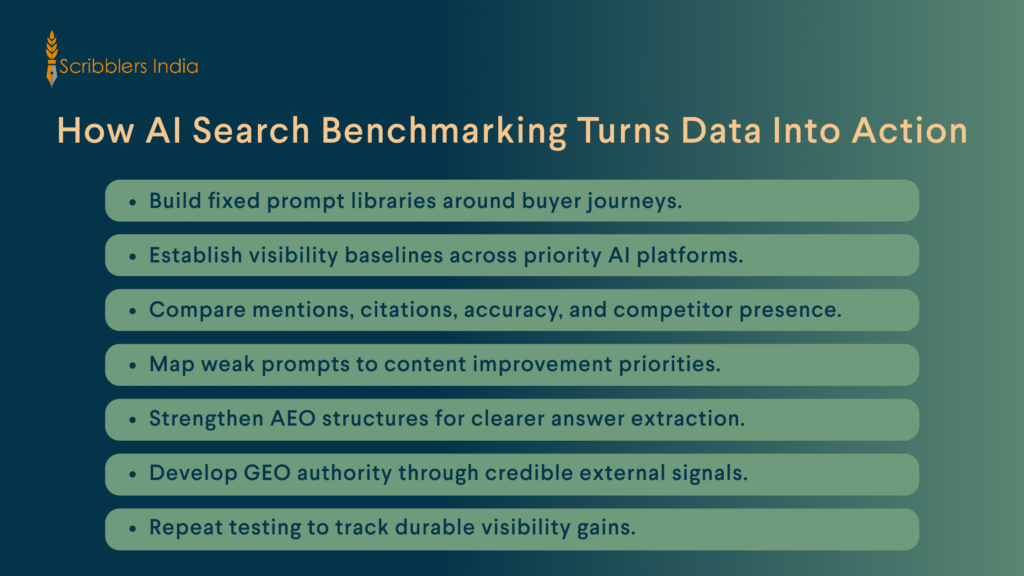
AI search benchmarking measures a brand’s starting position across selected answer engines, prompts, competitors, and visibility metrics. The benchmark creates a reference point for later comparisons. It helps teams understand whether content and authority work improve discovery or produce temporary changes across repeated reviews.
A benchmark should use stable inputs and documented scoring rules. Teams must record the prompt, platform, date, location, result, cited sources, and competitor appearances. This structure turns scattered observations into comparable evidence. AI search benchmarking also supports the latest AI search visibility trends. Visibility describes the outcome, while benchmarking establishes the controlled method for measuring that outcome over time.
AI visibility measurement frameworks increasingly compare brand presence across topic-led prompts, personas, competitors, and answer engines. They use benchmarking to reveal gaps that isolated ranking reports may miss.

Why do brands need AI search benchmarking?
AI answers can vary across platforms or over repeated sessions, making isolated searches difficult to interpret. A benchmark creates a consistent starting point for decisions and future reviews. It also helps teams explain progress with evidence rather than with isolated screenshots at every major decision stage.
- Baseline clarity: The first benchmark records current mentions, citations, answer accuracy, and competitor presence. Teams can measure later movement against evidence rather than memory or screenshots.
- Priority setting: The findings show which valuable prompt groups have weak coverage. This focus helps teams plan a targeted AI content gap analysis instead of rewriting unrelated pages.
- Competitive context: A benchmark reveals whether direct rivals or unexpected brands dominate important answers. It also shows which sources support their stronger visibility across the tracked prompt set.
- Investment decisions: Marketing leaders can connect content budgets with specific visibility gaps. The benchmark helps them choose between page updates, original research, founder content, or external authority development.
- Performance review: Repeated benchmarks show whether gains persist across reporting periods. Teams can distinguish sustained improvement from short-term changes due to retrieval updates or answer variation.
Research on generative search measurement has found meaningful variation in citations across repeated samples. This variation makes single-answer conclusions appear more precise than the underlying responses support.
What should AI search benchmarking include?
A useful AI search benchmark needs enough structure to support fair comparisons across time. It should capture the questions, testing conditions, answer outcomes, and business importance behind every observation. This shared framework ensures consistent later reviews across teams and reporting periods throughout each planned measurement cycle.
- Defined business topics keep testing relevant by connecting prompts with services, products, customer problems, and important decision stages.
- A fixed prompt library enables comparison by allowing teams to repeat the same questions across platforms and reporting periods.
- Selected AI platforms reflect audience behavior rather than treating every assistant as equally important for each business category.
- Documented competitors create context by including direct rivals, category leaders, and brands that appear often within AI answers.
- Clear scoring rules reduce interpretation gaps when different reviewers assess mentions, citations, recommendations, accuracy, and sentiment.
- Recorded test conditions improve repeatability through dates, locations, account settings, model details, and session information.
- Business weighting protects strategic focus by assigning greater value to prompts connected with evaluation, purchase, or qualified demand.
The benchmark should remain understandable for people outside the search team. A clear method helps leadership trust the findings and approve focused content action.
How should teams build an AI search benchmarking prompt set?
A strong AI search benchmarking prompt set reflects real buyer questions rather than convenient keyword variations. It should cover the journey, audience differences, and wording patterns that influence generated answers. Balanced coverage prevents one intent type from distorting the wider visibility picture across the full buying journey.
- Category prompts: These questions ask what a category means or when someone should use it. They measure whether the brand appears during early education.
- Problem prompts: These prompts describe a business challenge before naming any solution. They reveal which brands enter discovery before buyers understand the available category.
- Comparison prompts: They compare named providers or possible approaches. They show recommendation context, positioning accuracy, and which decision factors AI systems emphasize.
- Use-case prompts: They include an industry, team size, workflow, or constraint. They test whether the brand appears for specific situations rather than broad category questions.
- Objection prompts: These questions explore costs, risks, implementation concerns, or limitations. They reveal whether useful content supports buyers during later evaluation.
- Brand prompts: These prompts ask about the company, services, expertise, or alternatives. They help teams identify incorrect descriptions and weak brand associations.
Teams should use customer interviews, sales questions, search data, and support conversations to build the library. Content marketing services can then turn uncovered gaps in prompts into useful assets. Small wording changes may alter the brands recommended for the same underlying intent. Therefore, teams should balance fixed prompts with carefully selected natural variations during separate testing phases.
Which competitors should AI search benchmarking track?
An AI search benchmark should include competitors that shape buyer choices or dominate AI-generated answers. Limiting the review to familiar sales rivals may hide important visibility threats. The final group should reflect both commercial competition and observed answer behavior within the chosen category and market.
- Direct competitors influence active deals because buyers compare them with the brand during evaluation or procurement.
- Category leaders shape default recommendations through established recognition, broad coverage, or strong third-party validation.
- AI-visible competitors require attention when answer engines frequently mention them, despite limited overlap in current sales conversations.
- Adjacent solutions compete with the problem by offering an alternative that could replace the brand’s category or service.
- Publisher domains shape answer framing when review sites, media outlets, or educational resources guide recommendations without selling the service.
Competitor benchmarking frameworks often distinguish direct rivals from category leaders and unexpected AI-visible competitors. This wider view prevents sales assumptions from limiting the analysis. This wider competitor set helps teams understand the complete answer environment. It can also guide GEO content strategy across owned pages and external authority sources.
How can teams run a repeatable AI search benchmark?
Repeatable benchmarking requires consistent inputs, careful logging, and enough observations to reduce noise. The process should preserve comparable conditions without pretending that AI answers remain fixed. Clear documentation makes every later comparison easier to review and explain throughout the full reporting cycle.
- Set the test rules: Define the platforms, prompts, location, dates, account conditions, and scoring method before running the benchmark. Keep these rules unchanged during the comparison period.
- Run repeated observations: Test each prompt more than once across separate sessions or dates. Emerging research shows that identical prompts can produce different citations, while paraphrased questions may change recommended brands.
- Save the full answers: Record response text, citations, brand mentions, competitor names, and recommendation order. A screenshot alone may omit source details or the context for later review.
- Review accuracy manually: Human reviewers should verify that the answer accurately describes the brand. Automated matching can find names, yet it may miss misleading context or incorrect positioning.
- Separate platforms: Report Google AI features, ChatGPT, Gemini, and Perplexity independently before creating a combined view. Each platform can retrieve or present information differently.
Google also provides dedicated generative AI impression reporting in Search Console for selected websites. Teams can review pages that are appearing, countries, devices, and visibility changes over time. Teams can combine that first-party data with controlled prompt testing and analytics.
Which metrics should an AI search benchmark report?
The benchmark should report metrics that explain visibility, source selection, accuracy, competition, and stability. One combined score can simplify reporting, yet teams still need the underlying measures. This detail shows which part of performance changed during each review across platforms and prompt groups.
- Mention rate: This shows how often the brand appears across the tracked answer set. It provides the clearest starting measure for basic presence.
- Citation rate: This measures how often AI answers link to owned pages. Strong AEO content planning can improve answer clarity without guaranteeing citations.
- AI share of voice: This compares brand mentions with competitor mentions across the same prompt library. It shows relative presence within the selected category.
- Answer accuracy: Reviewers assess whether answers correctly describe the company, services, audience, and proof. This measure prevents teams from celebrating harmful visibility.
- Prompt coverage: This measures the share of prompt groups in which the brand appears. It reveals gaps across education, comparison, use cases, objections, or purchase research.
- Citation diversity: This measures the range of owned and external domains that support brand inclusion. A narrow source base may create fragile visibility.
- Recommendation position: This captures whether the brand appears first, later, or without endorsement. The context matters when answers present shortlists or comparisons.
- Visibility stability: Repeated tests show whether mentions and citations remain consistent. This measure helps teams report uncertainty rather than treating every change as a strategic outcome.

How should teams use AI search benchmarking findings?
Benchmark findings should guide focused content action rather than produce another isolated dashboard. Each gap should connect to a page, an authority signal, an owner, a timeline, and a review measure. This connection turns measurement into work that supports clear business priorities across the wider content program.
Content gaps may require new service pages, comparisons, explainers, or implementation resources. Weak citations may require stronger evidence, original research, clearer sourcing, or better technical access.
Incorrect descriptions may need consistent positioning across the website and trusted external profiles. Thought leadership content can strengthen topic ownership when founders or experts have credible experience to share.
Teams should rerun the benchmark after meaningful changes and compare results with the original baseline. The Scribblers India content process connects gap-led research with structured production, editorial review, and ongoing refinement.
How can Scribblers India support AI search benchmarking?
Scribblers India turns AI search benchmarking data into practical content and authority actions. We establish clear baselines, identify visibility gaps, and connect findings with measurable improvements across AEO, GEO, content strategy, personal branding, and thought leadership programs for growing brands.
- AI visibility audits: Scribblers India tests priority prompts, cited sources, brand mentions, competitor appearances, and answer accuracy across relevant platforms. The findings create a reliable baseline and show where brands lose visibility during important research and evaluation journeys.
- Prompt library development: Structured prompt sets help teams measure visibility across category education, comparisons, objections, use cases, and buying situations. This approach keeps future reviews consistent while aligning AI search benchmarking with the questions buyers actually ask.
- AEO content planning: Benchmark gaps become direct answers, question-led sections, definitions, FAQs, and comparison content. Each recommendation improves extraction potential while preserving editorial depth, factual accuracy, readability, and logical flow across priority pages.
- GEO authority development: Original research, expert articles, case-led resources, and external contribution plans strengthen visibility around priority topics. These assets improve entity clarity and expand citation opportunities across owned pages, partner channels, and earned media.
- Founder authority programs: Founder profiles, LinkedIn content, bylines, interviews, and recurring themes work best when they reflect proven expertise. This consistency strengthens brand recognition and helps AI systems connect people with relevant categories, services, and market conversations.
Contact our team to connect your AI search benchmarking insights with practical priorities for AEO, GEO, and authority-building.
Frequently asked questions
How many prompts should an AI search benchmark include?
The right number depends on the category, audience, and decision journey. Start with enough prompts to cover important intent groups without creating an unmanageable review. A smaller balanced library provides more value than hundreds of repetitive questions with weak business relevance.
How often should brands repeat AI search benchmarking?
Most brands can run a full benchmark quarterly and monitor priority prompts more often. Faster cycles may suit competitive launches or major content changes. Keep the method stable so that changes reflect performance rather than differences in the prompt library or scoring process.
Can teams benchmark AI visibility without paid tools?
Yes, teams can use spreadsheets and manual testing with a focused set of prompts. They must record conditions, full answers, citations, and dates with care. Paid tools become useful when the program requires larger coverage, automation, repeated runs, or multi-market reporting.
Why do identical AI prompts produce different benchmark results?
AI systems may retrieve different sources or generate another response during repeated sessions. Model updates, source freshness, geography, and user context can also affect results. Therefore, teams should rely on repeated observations and report patterns rather than treating a single answer as definitive.
Should AI search benchmarks include branded prompts?
Yes, branded prompts reveal how platforms describe the company, services, strengths, and alternatives. However, they should not replace non-branded category or problem prompts. Buyers often discover providers before they know which brand names deserve consideration.