
Google’s AI Overviews have changed how people discover information across search results. Users can now receive detailed answers before opening a website. This shift towards a growing need for AI Overview visibility makes source inclusion, brand accuracy, and answer relevance important aspects.
For marketing teams, visibility inside AI Overviews creates an opportunity to influence research earlier. Brands need clear pages, strong evidence, and consistent expertise across owned and external sources. A focused strategy can strengthen citations while supporting organic traffic and later buyer actions.
Key Takeaways:
|
What Does AI Overview Visibility Mean for Brands?
AI Overview visibility measures how often a brand appears inside Google’s AI-generated answer boxes. It tracks citation frequency and source position across search results. Strong AI search visibility helps brands reach users before any organic click happens.
Google built AI Overviews to summarize answers using large language models trained on web content. The feature pulls information from many sources and cites specific pages within its summary. Brands with clear, useful content earn placement inside these boxes more often.
AI Overview visibility differs from traditional rankings because it depends on content clarity and structure. Pages must answer questions directly and offer extractable value on the first read. Our AEO content services help brands build pages that AI systems can read and cite with confidence.

How Does Google Choose Sources for AI Overviews?
Google picks sources based on relevance, clarity, authority signals, and structured formatting. Its models scan pages for extractable answers that match the user query. Trust signals also influence which brands appear inside the summary box.
- Topical relevance: Pages must cover the exact question the user asked with focused content. Off-topic sections reduce the odds of extraction because Google prefers pages that stay on point. Content depth also improves selection chances during answer generation across query types.
- Content clarity: Google favours direct answers written in simple language that its models can summarise cleanly. Complex phrasing reduces extraction reliability across query types. Clear sentences and short paragraphs give AI systems the clean text chunks they need.
- Authority signals: Domain trust, author credentials, and citation history shape source selection heavily. Google rewards pages that show verifiable expertise on the topic. Recognized brands with strong backlink profiles earn more consistent placement inside AI Overviews.
- Structured formatting: Headings, lists, and tables help Google parse content into extractable pieces. Well-structured pages fit the AI Overview summary format naturally. This structure also supports faster extraction during Google’s answer generation cycle.
- Freshness signals: Recently updated pages carry weight when queries relate to changing topics. Technology, policy, and industry news queries strongly reward current content. Regular refreshes help brands hold visibility across time-sensitive search categories.
These AI Overview visibility signals work best when brands apply them via a single connected content system. Our AEO services combine answer-ready structure, source quality, entity consistency, and content refresh planning so priority pages support stronger AI Overview citation opportunities over time for brands.
Why Is AI Overview Visibility Important for Modern SEO?
AI Overviews occupy prominent space above many conventional results. They can shape understanding before users open another page. Brands therefore need to measure source inclusion beside rankings, clicks, conversions, and assisted outcomes across searches that influence discovery and evaluation decisions.
A 2026 Semrush research study found AI Overview appearances rose from 6.49% of tracked searches in January 2025 to 13.1% in March 2025. This growth changes how users interact with search results across categories. The trend also reshapes what SEO teams should measure each month.
These changes show why strong organic rankings cannot provide a complete picture of visibility. Teams should compare AI Overview citations with landing-page engagement, branded demand, lead quality, and later conversions. Our content strategy services help brands connect those findings with focused editorial priorities throughout every planned quarterly review cycle for growth.
What Should Brands Do When AI Overview Citations Disappear?
AI Overview citations can disappear after content changes, indexing shifts, source updates, or changes in generated responses. One lost citation does not confirm a lasting decline. Teams should diagnose the page, prompt, competitors, and reporting conditions before rewriting valuable content to improve AI Overviews’ visibility.
- Check indexing and eligibility: Confirm that Google can find, crawl, index, and display the page in search results with a search snippet. Review technical changes, canonical settings, robots directives, page availability, and snippet eligibility before assuming content caused the lost citation across search.
- Repeat the original query: Test the same query across dates, devices, locations, and clean sessions where possible. Record whether the citation loss repeats or another page replaces it. Also note whether the AI Overview still appears in search over time.
- Compare competing source changes: Review the pages that now support the answer and identify what changed. Look for fresher evidence, clearer passages, stronger relevance, or better coverage of the supporting question Google may have prioritized during retrieval for that result.
- Refresh only confirmed gaps: Update the page when evidence shows outdated facts, weak answers, missing context, or poor structure. Avoid rewriting strong sections after one observation because citation variation can occur without a meaningful quality decline during the review cycle.
Our AI search visibility strategy separates temporary citation changes from persistent performance gaps. We review page eligibility, prompt stability, competing sources, and answer context, then recommend focused content refreshes that protect strong pages while addressing confirmed visibility weaknesses across search.
Which Content Formats Perform Best Inside AI Overview Citations?
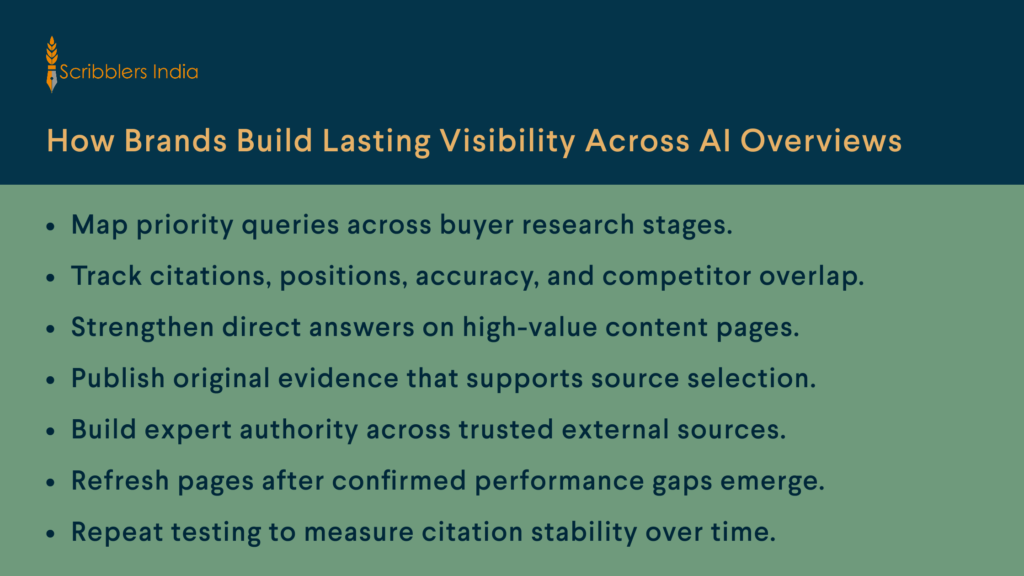
The strongest content formats for AI search include question-led headings, direct answer paragraphs, comparison sections, and clear definition blocks. These structures give Google clean text chunks it can extract. Format choice often determines whether a page earns a citation.
- Question-led H2s: Headings written as complete questions help Google match content to user queries. This alignment improves the odds of extraction across informational searches. The question format also mirrors how users phrase their prompts in AI-powered search tools.
- Direct answer paragraphs: A 40 to 50 word direct answer placed below each heading gives Google an extractable block. This structure signals the answer clearly. It also matches the summary format that AI Overviews prefer during generation.
- Comparison sections: Well-structured comparisons earn citations for versus-style queries that AI Overviews handle often. Clear feature differences help Google reliably summarize the contrast. Comparison content also supports mid-funnel buyer research inside AI systems.
- Definition blocks: Short, precise definitions work well for informational queries where users want quick explanations of concepts. Google often pulls the opening lines. Clear definitions also strengthen entity signals that AI systems use during answer selection.
- Short paragraphs: Concise paragraphs under 50 words naturally match the AI Overview summary format. Long blocks reduce the odds of extraction because they mix multiple ideas. Compact paragraphs also improve overall readability across mobile devices.
These formats perform best when they follow one editorial plan across priority topics. Our thought leadership content services combine expert insight, original evidence, and answer-ready structure so each asset supports extraction, credible authority, and stronger AI Overview visibility over time.
How Can Brands Measure Their AI Overview Visibility Performance?
Brands can measure AI search visibility through prompt tracking, citation analysis, referral data, and competitive comparisons. Each method reveals a different performance layer. Combined tracking gives teams a clearer picture of visibility quality, stability, accuracy, and commercial influence.
| Measurement Method | What It Shows | Review Frequency |
| Prompt tracking | Brand appearances across fixed search query sets | Monthly |
| Citation logs | Pages cited within AI Overview responses | Weekly |
| Search Console AI reporting | Impressions generated through AI-driven search features | Monthly |
| AI share of voice | Brand citation frequency compared with competitors | Monthly |
| Description accuracy | How accurately AI Overviews describe the brand | Monthly |
| Source position | Where cited pages appear within AI responses | Monthly |
| Query coverage | Which priority searches trigger brand visibility | Quarterly |
| Competitor overlap | How often rival brands appear beside yours | Monthly |
| Referral quality | Visits and conversions influenced by cited pages | Quarterly |
| Citation stability | How consistently the same pages remain cited | Monthly |
Regular measurement helps teams turn AI search stats into practical benchmarks and identify weak areas before visibility losses affect wider search performance. Our AI content gap analysis establishes baselines across all 10 methods and connects the findings with focused content, citation, and authority priorities.
How Does Query Fan-Out Expand AI Overviews Source Discovery?
Query fan-out lets Google explore related searches behind a single user’s question. It can surface supporting pages beyond the obvious keyword target. Brands need coverage across the main topic, connected subtopics, buyer constraints, and decision questions that shape the final answer.
Google states that AI Overviews may issue multiple related searches across subtopics and data sources. Its systems then identify supporting pages as it builds the response. This process means a specialist article can earn visibility for a single supporting question, even when the broader pillar page targets a different part of the topic.
Brands should map every priority query into definitions, comparisons, implementation needs, objections, and follow-up questions. A connected content cluster helps Google find useful passages across that wider research path. Our GEO services can organize those assets around clear entities and source-worthy evidence for stronger citation opportunities across future search journeys.
How Can Brands Improve AI Overview Visibility Over Time?
Improving visibility requires structured content refreshes, entity clarity work, external authority signals, and consistent measurement over months. Each step compounds when done together. Brands that remain patient often see their visibility rise over two or three review cycles.
Content refreshes should focus on adding direct answers, updating stats, and improving the structure of sections across priority pages. This work supports both extraction and reader value. Regular updates also signal freshness that AI systems reward during source selection.
Entity clarity comes from consistent brand descriptions, structured schema markup, and clear author credentials across the site. These signals help AI systems place the brand accurately. External authority builds through mentions, bylines, and citations from recognized third-party sources across the industry.
How Scribblers India Helps Brands Build AI Overview Visibility
Scribblers India turns AI Overview visibility findings into focused content and authority actions. We identify citation gaps and strengthen priority pages. Each service connects measurable search performance with AEO, SEO, GEO, content strategy, personal branding, and thought leadership goals for brands.
- AI Overview visibility audits: We test priority queries, cited pages, source positions, competitor appearances, and description accuracy across Google Search. Our audits establish a baseline and reveal where content, evidence, structure, or authority needs improvement.
- AEO content planning: Our team restructures priority pages to focus on direct answers, question-led headings, definitions, comparisons, and FAQs. Our AEO content planning improves extractability while preserving editorial depth, factual accuracy, readability, and a coherent journey from search to decision.
- GEO authority development: We create original research, expert explainers, case-led resources, and external contribution plans around high-value topics. Our GEO strategy strengthens source credibility and entity clarity while expanding citation opportunities across trusted channels today.
- Strategic content refreshes: Our experts update older pages to provide clearer answers, up-to-date evidence, stronger examples, and improved internal links. Each strategic content refresh protects existing search value while aligning the page with AI Overview triggers and buyer needs.
- Founder authority programs: We turn founder expertise into articles, reports, interviews, and platform-ready commentary. Our personal branding and thought leadership services strengthen topic authority, improve entity recognition, and support citation opportunities across trusted public sources.
Talk with our team to build an evidence-led AI Overview visibility program that connects stronger content, credible authority, accurate brand positioning, and repeatable measurement with priority search queries and commercial goals.
Frequently Asked Questions
How Fast Do AI Overviews Update After Content Changes?
AI Overviews can change after Google recrawls and reprocesses an updated page, but Google provides no fixed timeline. Some changes appear quickly, while others take longer across different query types. Teams should monitor indexing, citations, answer wording, and competing sources across several checks before deciding whether the refresh influenced visibility.
Do AI Overviews Appear for All Search Queries?
AI Overviews do not appear for every search because Google shows them only when its systems consider the summary useful. Triggering patterns vary across topics, intent, location, and time. Brands should therefore track priority queries directly rather than assuming that every informational or comparison search will consistently produce an Overview.
Can Small Brands Compete Inside AI Overviews?
Small brands can earn AI Overview citations when their pages answer focused questions with clear evidence and useful detail. Strong relevance can create opportunities beyond broad brand recognition. Niche companies should target specific buyer needs, publish original expertise, strengthen external validation, and monitor repeated citations before expanding into wider category queries.
Does Schema Markup Improve AI Overview Visibility?
Schema markup can help Google understand page elements and entities, but it does not guarantee inclusion in AI Overview. Google states that pages need no special AI markup. Brands should use valid structured data where relevant while prioritizing indexable content, direct answers, accurate evidence, and helpful page experiences for users everywhere.
How Often Should Brands Audit AI Overview Visibility?
Brands should review priority AI Overview queries monthly and complete broader audits every quarter. Faster checks may suit launches, competitive changes, or fast-moving topics. Each audit should track citations, source position, answer accuracy, competitor overlap, and landing-page outcomes so teams can distinguish temporary movement from persistent visibility changes.