Citation volatility has become a practical concern as brands compete for visibility across AI-generated answers. A citation can appear consistently for weeks, then disappear or shift to another source even when the underlying page, messaging, and authority signals remain unchanged. That makes short-term citation gains difficult to interpret as durable performance.
The scale of this movement is significant. Profound recorded 40.5% to 59.3% domain drift across four AI platforms between June and July 2025, showing how quickly cited source sets can change. For teams tracking AI search visibility, the challenge is separating routine source movement from patterns that may require investigation.
Key Takeaways
|
What is Citation Volatility in AI Search?
Citation volatility measures how often the sources cited in AI answers change when the same prompt is tested repeatedly. Low volatility means similar pages or domains keep appearing. High volatility means sources move in and out of answers more often.
However, not every citation change signals a problem with AI search discovery. An AI platform may replace one source while still mentioning the same brand. It may also choose a newer or more relevant page from the same domain. Teams should therefore track changes at both the URL and domain level before drawing conclusions.
AI citations can also vary more than traditional search rankings do because generated answers may draw on different sources in repeated responses. A single test provides only a snapshot. Testing the same prompts regularly makes it easier to identify normal variation and spot meaningful changes in citation visibility over time.

Why Does Citation Volatility Happen Across AI Platforms?
Citation volatility happens because AI platforms retrieve and synthesize information under changing conditions. Their systems do not return one permanent source set. Model behavior, index updates, prompt context, and competing content can all change which pages support a generated answer.
- Retrieval variation: AI platforms search large source pools and score possible pages for each request. Small differences in retrieval can change the selected set. Repeated runs may therefore cite another page, even when the underlying question remains unchanged online.
- Index and freshness changes: New pages enter search indexes, while older pages are updated or removed. Google AI features may use query fan-out across related searches. This process expands the supporting source pool and can change citations as available evidence changes.
- Model and product updates: Platforms can adjust retrieval systems, ranking logic, source presentation, or answer generation. These changes may alter source selection without any change from the publisher. Brands should compare platform-level trends before blaming one content asset for losses.
- Prompt and session context: Small wording changes can shift intent, while conversation history can change the information an assistant retrieves. Location or language may also affect source availability. Stable test conditions reduce noise when teams compare citation sets across repeated observations.
Our GEO services help brands analyze these drivers before making content changes. We compare prompts, platforms, source sets, and competitor movement, then prioritize authority or refresh actions when repeated evidence confirms a persistent citation weakness across important buyer questions today online.
How Is Citation Volatility Different From Citation Loss?
Citation volatility and citation loss describe different visibility patterns in AI answers. Volatility reflects temporary movement of sources across repeated tests, while citation loss signals sustained disappearance without comparable replacement visibility. Distinguishing between them helps teams avoid reacting to normal variation and focus attention on changes that indicate a visibility problem.
| Difference | Citation Volatility | Citation Loss |
|---|---|---|
| Pattern | Sources move in and out across repeated comparable tests. | Brand or page remains absent across repeated comparable tests. |
| Duration | Movement may reverse during the next scheduled observation. | Absence continues across dates, sessions, and similar prompts. |
| Interpretation | Often reflects normal retrieval variation within generated AI answers. | More strongly suggests a sustained decline in citation visibility. |
| Required action | Monitor repeated tests before making major content changes. | Investigate causes and prioritize corrective action when confirmed. |
| Replacement visibility | Another page or source may preserve overall brand visibility. | Comparable replacement visibility does not appear elsewhere in answers. |
The key difference is persistence. Temporary citation movement can be a normal AI search trend, but repeated absence deserves attention. Tracking several comparable tests helps teams separate routine source variation from visibility problems that require action.
How Should Brands Measure Citation Volatility Over Time?
Brands should measure citation volatility using multiple related metrics rather than a single headline percentage. Each metric explains a different movement pattern. Together, they show whether sources change at the URL, domain, position, platform, or answer-context level during repeated testing cycles.
| Metric | What It Reveals | Review Cycle | Business Question |
| Citation overlap | Shared URLs across repeated runs | Weekly | How much of the source set remains? |
| URL churn | Pages entering or leaving answers | Weekly | Which exact pages changed? |
| Domain churn | Publisher-level source movement | Monthly | Are different domains replacing earlier sources? |
| Citation persistence | Repeated survival of one URL | Monthly | Which pages remain visible? |
| Citation entry rate | New sources appearing | Weekly | Which sources are gaining visibility? |
| Citation exit rate | Earlier sources disappearing | Weekly | Which sources are losing visibility? |
| Position drift | Changes in source placement | Monthly | Does the citation move within answers? |
| Source concentration | Dependence on leading sources | Quarterly | Is visibility too dependent on one source? |
| Cross-platform divergence | Source differences across engines | Monthly | Do platforms cite different evidence? |
| Accuracy after drift | Brand description after source changes | Monthly | Does changing evidence alter brand accuracy? |
Our AI search visibility audits combine these metrics across fixed prompts and comparable sessions. We document source movement, answer context, competitor replacement, and business importance so teams can distinguish normal volatility from persistent citation weakness across priority platforms and markets.
How Should Brands Design a Reliable Citation Volatility Test?
Reliable volatility testing needs stable prompts, repeated observations, documented conditions, and clear comparison rules. One search cannot establish a pattern. Teams should define the test before collecting data so later changes reflect source movement rather than inconsistent methods across reviews.
- Preserve core prompts: Keep the wording of priority prompts unchanged during each reporting period. Test natural variations in another separate prompt set. This separation protects historical comparisons while allowing teams to study how changes in wording affect retrieved sources and citations.
- Repeat observations: Run important prompts across several dates or sessions before reporting movement. Research shows that single-run visibility estimates can create misleadingly high precision today. Repeated sampling helps teams understand the normal response range and identify changes that exceed routine variation.
- Record test conditions: Log platform, product mode, location, language, date, and account context for every observation. Comparable conditions reduce avoidable measurement noise overall. Teams can then explain whether a citation shift followed a platform difference or a genuine source change.
- Use confidence ranges: Report citation volatility as a pattern rather than one fixed truth. Confidence intervals or observation ranges show uncertainty around the result. This approach prevents senior marketing leaders from too soon treating small movements as meaningful gains or losses.
A comprehensive AI search benchmarking process standardizes prompts, platforms, observation windows, and scoring rules before analysis. This discipline gives teams a dependable baseline and helps content leaders act on sustained citation changes rather than the normal variation across individual responses over time.
How Does Source Concentration Increase Citation Volatility Risk?
Source concentration increases volatility risk when a single page, domain, or publisher accounts for most of the AI citations for a brand. A single source change can then remove substantial visibility. Diversified authority creates more routes for AI systems to confirm the brand’s expertise.
Teams should measure how much citation visibility depends on the leading owned page and the leading external source. Heavy concentration may appear efficient during stable periods, yet it creates serious long-term fragility when retrieval systems refresh, or a competing source replaces that evidence in an important answer online today.
A stronger source mix includes useful owned pages, independent expert coverage, research assets, and credible founder content. Diversification should support one consistent brand position rather than scattered messaging across public channels. Professional thought leadership services can help brands expand authority while preserving clear expertise across priority topics for future reviews and campaigns.

What Content Actions Can Improve Citation Stability?
Brands cannot eliminate citation volatility because AI systems rely on shifting source pools and probabilistic generation. They can still improve stability by strengthening source value, refreshing priority pages, broadening external validation, and tracking repeated answers. The strongest programs reduce avoidable risk without promising permanent ownership of citations across every major platform today.
- Refresh priority evidence pages with up-to-date facts, direct answers, strong examples, and source links that support key buyer claims.
- Publish original authority assets through research, case findings, expert frameworks, and detailed comparisons across priority topic clusters today.
- Diversify credible external signals through bylines, interviews, partner contributions, and relevant coverage across trusted industry sources over time.
- Strengthen entity consistency everywhere by aligning service descriptions, author bios, founder profiles, and category language across public channels.
- Track citation replacement patterns to identify which competitors or publishers often displace owned pages across high-value buyer prompts.
Proper synchronization of AEO services and content strategy services can connect these actions with specific prompt gaps and citation patterns. We strengthen priority pages, plan authority assets, and schedule evidence-led refreshes so brands can improve source resilience without reacting to every routine change in online answers.
How Can Scribblers India Help Brands Manage Citation Volatility?
Scribblers India helps brands understand citation movement before they change strategy. We combine structured testing with content and authority action. Each service connects volatility data to practical priorities in AEO, GEO, content strategy, personal branding, and thought leadership to drive measurable growth.
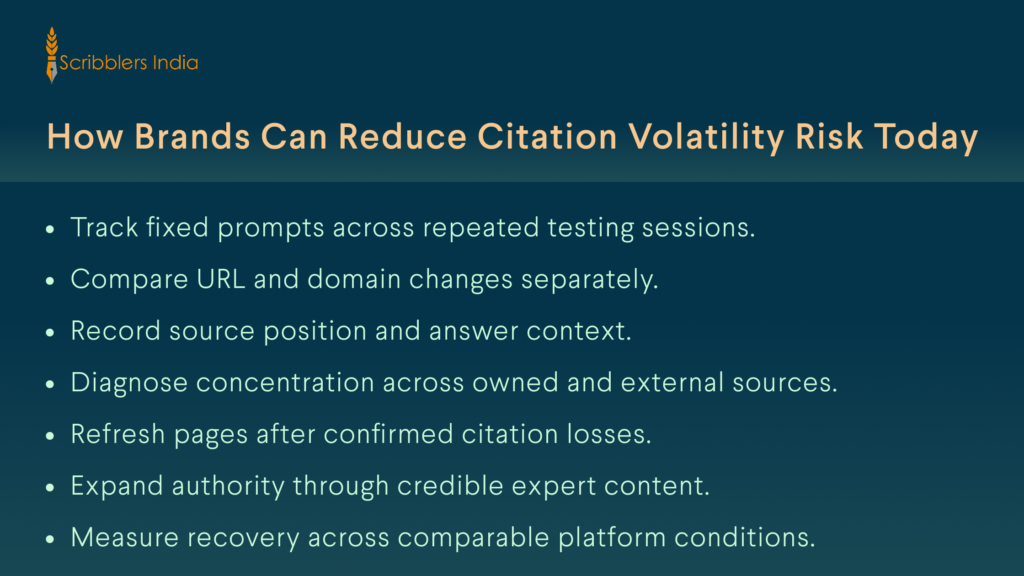
- Citation volatility audits: We test fixed prompts across repeated sessions and record URL changes, domain changes, source position, and answer context. Our findings separate routine variation from persistent visibility weakness across priority platforms and markets.
- AEO content stabilization: Scribblers India strengthens direct answers, evidence blocks, definitions, and source links across priority pages. Our work improves extraction quality while preserving accuracy, readability, and useful context for readers across changing AI answers today.
- GEO authority development: Our team creates original research, expert explainers, comparison assets, and external contribution plans. These assets diversify credible evidence and reduce dependence on one page, publisher, or authority signal across important prompts over time.
- Content refresh planning: We schedule updates based on confirmed citation losses, facts, weak-source passages, and competitor movement. Each refresh protects useful content while addressing evidence gaps that create avoidable volatility across priority pages and topics.
- Founder branding programs: Our experts strengthen founders’ personal brand with bylines, interviews, commentary, and recurring thought-leadership themes. This wider authority strengthens entity recognition and creates additional source pathways across professional research prompts and platforms over time.
Connect with our experts to build an evidence-led citation stability program that links reliable measurement to stronger content, broader authority, accurate brand positioning, and focused action across priority AI search platforms.
Frequently Asked Questions
What Do Brands Ask About Citation Volatility?
These FAQs address common decisions teams face when monitoring citation changes across AI platforms. Each answer explains one practical measurement concern. They also show where brands should avoid universal thresholds, unsupported timelines, and conclusions based on isolated observations during reviews.
How Often Should Brands Measure Citation Volatility Across Platforms?
Brands should monitor high-value prompts weekly and complete broader reviews each month. Fast-moving categories may need more frequent checks after platform updates or major competitor launches. Teams should preserve prompt wording, platform settings, and observation rules so each review supports a fair comparison with earlier citation patterns across the selected market.
What Citation Volatility Rate Should Brands Consider Concerning?
No universal volatility percentage signals weakness across all platforms or categories. Teams should compare current movement with their own baseline, prompt value, source concentration, and repeated observation range. A sustained increase matters more when important buyer prompts lose owned citations, accurate mentions, or dependable supporting sources across several review cycles.
Can Strong SEO Rankings Prevent AI Citation Changes?
Strong rankings can support discoverability, yet they cannot prevent citation changes inside generated answers. AI platforms may retrieve additional pages to support questions, provide fresher evidence, or offer different response contexts. Brands should protect SEO foundations while measuring citations across repeated prompts, platforms, dates, and source sets for a complete visibility view.
Does Updating Content Immediately Restore Lost AI Citations?
Content updates do not guarantee an immediate citation return because platforms must recrawl, retrieve, and select the revised page. Teams should refresh confirmed weaknesses, then monitor repeated prompts over several observations. Technical access, competing sources, query intent, and platform behavior can still affect whether the page returns within generated answers.
Should Brands Track Domains or Individual Cited URLs?
Brands should track both domains and individual URLs because each reveals a different stability pattern. Domain tracking shows whether a publisher remains influential, while URL tracking shows which exact page supports the answer. Combining both views helps teams identify page replacement, broader shifts in authority, and source concentration across repeated prompt tests.