
Supriya Jain
Supriya Jain works on content strategy, editorial planning, founder personal branding, and ghostwriting for brands that want stronger search and AI visibility. Her experience covers SEO, AEO, GEO, thought leadership content, and AI search-focused content development. She helps founders and leaders shape clear narratives, improve content quality, and create useful resources for readers and answer engines. At Scribblers India, she supports content planning, content gap analysis, editorial quality, and authority-led positioning. Her views on trending topics such as AI, content, and ghostwriting are regularly featured in leading publications.
Articles by Supriya Jain
How Can AI Content Editing Improve AI-Generated Content?
AI content editing has become the difference between publishing a fast draft and publishing a credible content asset. AI tools can help teams move faster, but raw drafts often need sharper facts, stronger voice, clearer structure, and better search alignment before they deserve a place on your website. That gap matters more in 2026 because search engines, AI Overviews, and readers now reward content that feels useful, original, and trustworthy. A draft that sounds polished but says nothing new can still weaken engagement, rankings, and brand credibility. This is why editing can no longer be treated as a quick grammar check. This guide shares twelve practical editing tips to help you turn AI-assisted writing into publishable content. You will learn how to verify claims, remove predictable AI phrasing, add first-hand expertise, improve brand voice, restructure sections for answer-first SEO, and strengthen E-E-A-T signals before publication. TL;DR: AI content editing helps convert raw AI drafts into accurate, useful, and brand-ready content. Fact-check every AI-generated claim against a verifiable primary source. Remove predictable AI vocabulary patterns that make content sound generic. Add first-hand examples, expert inputs, and real professional experiences. Rewrite distant third-person AI voice into clearer first- or second-person. Align every section with your documented brand voice and tone. Vary sentence length and structure to create a natural reading rhythm. Add original data, proprietary insights, and expert perspectives where possible. Restructure each section with an answer-first SEO and AEO format. Add author credentials, updated timestamps, and E-E-A-T signals throughout. Remove redundant paragraphs, repeated ideas, and unnecessary structural bloat. Review logical flow so the article builds a coherent argument. Use AI detection tools as a final quality check, not as the only editorial standard. How To Improve AI Content With a Genuine Human Voice? AI content editing turns a fast machine-written draft into content that feels clear, credible, and genuinely human. AI tools can produce a starting point in minutes, but speed alone does not make a draft ready for readers, search engines, or brand-led publication. The issue is quality. Content Marketing Institute reports that only 17% of B2B marketers rate AI-generated content as excellent or very good, while 44% call it good. That gap shows why human review must go beyond grammar and surface-level cleanup. A strong editing process verifies claims, removes predictable AI phrasing, adds first-hand insight, and restores brand voice. This guide shares twelve practical ways to make AI-assisted content more useful, original, and publication-ready for serious content marketing teams today. Why Is AI Content Editing Important Before Publishing? The importance of AI content editing comes down to one commercial reality. Raw AI drafts consistently fall short across four dimensions: factual accuracy, brand voice, original insight, and audience trust. Publishing them without review creates quality debt that accumulates across a content library over time. The failure is not in the AI tool. It is in the workflow that bypasses the editorial layer that separates a working draft from a publishable asset. AI content lacks verifiable accuracy by default: AI language models generate confident-sounding claims that are sometimes factually incorrect. They fabricate statistics, attribute quotes to the wrong people, and state outdated information as current fact. Without human verification, these errors reach your audience and damage the credibility your brand has built through its entire content history. Raw AI drafts carry no brand personality or genuine voice: AI tools produce a generalized professional register that sounds competent and impersonal in equal measure. According to experts, consistency in tone determines whether audiences stay or dismiss a brand. A draft that reads like no one wrote it fails to build the relationship your audience is looking for with your brand. Unedited AI content actively reduces user engagement signals: When readers encounter generic AI vocabulary patterns, they bounce. When Google’s quality systems register that bounce, they demote the page. The importance of AI content editing is therefore both a brand-quality argument and a direct SEO argument that affects every page on the domain. AI cannot contribute genuine first-hand experience: E-E-A-T requires demonstrable experience. AI tools synthesize publicly available information but cannot describe real professional outcomes, genuine client results, or lessons learned through direct work in a field. Only human editing AI writing can add the experience layer that Google’s quality raters look for when evaluating content authority. What Are the Biggest Challenges with AI Content Editing? The biggest challenges with AI content editing fall into four categories. These are: factual hallucinations, generic vocabulary, missing first-hand experience, and structural bloat. Identifying these four problem categories before you edit AI content helps you prioritize editing passes that deliver the highest quality improvement per hour of editorial effort. Knowing the specific failure patterns significantly speeds up every editing session. Predictable vocabulary patterns that signal AI generation AI tools overuse a recognizable set of words and phrases across nearly every draft they produce. These include “delve into,” “it is worth noting,” “comprehensive,” “leverage,” “seamlessly,” and “it is important to understand.” Readers recognize these patterns quickly and associate them with low-effort content production. Replacing them with direct, specific, conversational alternatives during the editing pass is one of the highest-impact improvements available per minute of editorial time spent. Hallucinated statistics and fabricated source attributions AI models generate plausible-sounding facts with complete confidence regardless of their accuracy. A statistical claim that cannot be traced to a verifiable primary source should be removed or replaced during every editing pass. This is the most consequential category of problems with AI-generated content. A single published hallucination can trigger a Google quality demotion that affects the entire domain rather than just the page in question. Structural bloat that delays the actual answer AI drafts frequently open sections with multiple context-setting paragraphs before reaching the main point the reader came to find. According to a February 2026 industry analysis, 44% of AI citations in search responses come from the first 30% of a content piece. Restructuring AI drafts so that every section leads with the direct answer rather than building
AI content editing has become the difference between publishing a fast draft and publishing a credible content asset. AI tools can help teams move faster, but raw drafts often need sharper facts, stronger voice, clearer structure, and better search alignment before they deserve a place on your website. That gap matters more in 2026 because search engines, AI Overviews, and readers now reward content that feels useful, original, and trustworthy. A draft that sounds polished but says nothing new can still weaken engagement, rankings, and brand credibility. This is why editing can no longer be treated as a quick grammar check. This guide shares twelve practical editing tips to help you turn AI-assisted writing into publishable content. You will learn how to verify claims, remove predictable AI phrasing, add first-hand expertise, improve brand voice, restructure sections for answer-first SEO, and strengthen E-E-A-T signals before publication. TL;DR: AI content editing helps convert raw AI drafts into accurate, useful, and brand-ready content. Fact-check every AI-generated claim against a verifiable primary source. Remove predictable AI vocabulary patterns that make content sound generic. Add first-hand examples, expert inputs, and real professional experiences. Rewrite distant third-person AI voice into clearer first- or second-person. Align every section with your documented brand voice and tone. Vary sentence length and structure to create a natural reading rhythm. Add original data, proprietary insights, and expert perspectives where possible. Restructure each section with an answer-first SEO and AEO format. Add author credentials, updated timestamps, and E-E-A-T signals throughout. Remove redundant paragraphs, repeated ideas, and unnecessary structural bloat. Review logical flow so the article builds a coherent argument. Use AI detection tools as a final quality check, not as the only editorial standard. How To Improve AI Content With a Genuine Human Voice? AI content editing turns a fast machine-written draft into content that feels clear, credible, and genuinely human. AI tools can produce a starting point in minutes, but speed alone does not make a draft ready for readers, search engines, or brand-led publication. The issue is quality. Content Marketing Institute reports that only 17% of B2B marketers rate AI-generated content as excellent or very good, while 44% call it good. That gap shows why human review must go beyond grammar and surface-level cleanup. A strong editing process verifies claims, removes predictable AI phrasing, adds first-hand insight, and restores brand voice. This guide shares twelve practical ways to make AI-assisted content more useful, original, and publication-ready for serious content marketing teams today. Why Is AI Content Editing Important Before Publishing? The importance of AI content editing comes down to one commercial reality. Raw AI drafts consistently fall short across four dimensions: factual accuracy, brand voice, original insight, and audience trust. Publishing them without review creates quality debt that accumulates across a content library over time. The failure is not in the AI tool. It is in the workflow that bypasses the editorial layer that separates a working draft from a publishable asset. AI content lacks verifiable accuracy by default: AI language models generate confident-sounding claims that are sometimes factually incorrect. They fabricate statistics, attribute quotes to the wrong people, and state outdated information as current fact. Without human verification, these errors reach your audience and damage the credibility your brand has built through its entire content history. Raw AI drafts carry no brand personality or genuine voice: AI tools produce a generalized professional register that sounds competent and impersonal in equal measure. According to experts, consistency in tone determines whether audiences stay or dismiss a brand. A draft that reads like no one wrote it fails to build the relationship your audience is looking for with your brand. Unedited AI content actively reduces user engagement signals: When readers encounter generic AI vocabulary patterns, they bounce. When Google’s quality systems register that bounce, they demote the page. The importance of AI content editing is therefore both a brand-quality argument and a direct SEO argument that affects every page on the domain. AI cannot contribute genuine first-hand experience: E-E-A-T requires demonstrable experience. AI tools synthesize publicly available information but cannot describe real professional outcomes, genuine client results, or lessons learned through direct work in a field. Only human editing AI writing can add the experience layer that Google’s quality raters look for when evaluating content authority. What Are the Biggest Challenges with AI Content Editing? The biggest challenges with AI content editing fall into four categories. These are: factual hallucinations, generic vocabulary, missing first-hand experience, and structural bloat. Identifying these four problem categories before you edit AI content helps you prioritize editing passes that deliver the highest quality improvement per hour of editorial effort. Knowing the specific failure patterns significantly speeds up every editing session. Predictable vocabulary patterns that signal AI generation AI tools overuse a recognizable set of words and phrases across nearly every draft they produce. These include “delve into,” “it is worth noting,” “comprehensive,” “leverage,” “seamlessly,” and “it is important to understand.” Readers recognize these patterns quickly and associate them with low-effort content production. Replacing them with direct, specific, conversational alternatives during the editing pass is one of the highest-impact improvements available per minute of editorial time spent. Hallucinated statistics and fabricated source attributions AI models generate plausible-sounding facts with complete confidence regardless of their accuracy. A statistical claim that cannot be traced to a verifiable primary source should be removed or replaced during every editing pass. This is the most consequential category of problems with AI-generated content. A single published hallucination can trigger a Google quality demotion that affects the entire domain rather than just the page in question. Structural bloat that delays the actual answer AI drafts frequently open sections with multiple context-setting paragraphs before reaching the main point the reader came to find. According to a February 2026 industry analysis, 44% of AI citations in search responses come from the first 30% of a content piece. Restructuring AI drafts so that every section leads with the direct answer rather than building
Scribblers India AI Visibility Scorecard
AI search visibility is changing how customers discover, compare and trust brands. Search is no longer limited to blue links, featured snippets and organic rankings. Buyers now ask Google AI Overviews, AI Mode, ChatGPT, Perplexity, Gemini and Copilot for recommendations, summaries and shortlists. Google said in 2026 that AI Overviews had crossed 2.5 billion monthly active users, while AI Mode had crossed 1 billion monthly active users. This matters because AI systems do not simply “rank” websites. They interpret entities, compare sources, retrieve supporting evidence and generate answers. A brand can rank on Google and remain invisible inside AI-generated recommendations. The Scribblers India AI Visibility Scorecard helps founders, marketing teams, consultants, agencies and B2B service firms evaluate whether their brand is ready for AI-led discovery. You will learn how to assess entity clarity, content depth, answer readiness, third-party trust, expert authority and conversion infrastructure. At Scribblers India, we use this framework to integrate SEO, AEO, GEO, thought leadership, ghostwriting, and personal branding into a single measurable visibility system. TL;DR AI visibility now extends beyond Google rankings. LLMs need clear, consistent brand entities. Thin content weakens answer engine inclusion chances. Third-party validation improves brand citation readiness. Founder authority supports trust and recommendation signals. Structured answers improve AEO and GEO performance. Measurement must include prompts, mentions and citations. Scorecard gaps should guide content priorities. Executive Summary AI search has created a new layer of visibility between brands and buyers. Traditional SEO still matters, but it no longer explains the full discovery journey. A brand must now be findable, understandable, and trustworthy across search engines, AI answer engines, and generative assistants. This shift is already visible. OpenAI reported that ChatGPT had 700 million weekly active users by mid-2025, based on a privacy-preserving analysis of 1.5 million conversations. The same study found that three-quarters of ChatGPT conversations focus on practical guidance, information seeking and writing. For businesses, this means prospects may form opinions before visiting the website. They may ask AI search visibility tools which agency, consultant, SaaS platform, service provider or expert they should consider. If the brand lacks structured content, credible proof and external validation, AI systems may ignore it. This resource provides a practical scoring model for AI visibility readiness. It does not claim to predict exact LLM rankings. Instead, it helps teams identify where their brand is weak across the signals that commonly support AI discovery. Scribblers India recommends that brands move from “keyword-first SEO” to “entity-first authority building.” This means clear positioning, answer-led pages, expert authorship, original insights, comparison assets, third-party mentions and measurable prompt testing. The scorecard can support content planning, AEO audits, GEO strategy, personal branding, founder-led visibility and lead-generation campaigns. Why does AI search visibility matter now? AI search visibility matters because buyers increasingly receive answers before they reach a website. Brands must now influence what AI systems understand, summarize and recommend, not only where their pages rank in search results. McKinsey’s 2025 global AI survey found that nearly nine out of ten respondents said their organizations regularly use AI, although adoption depth remains uneven. [McKinsey, 2025] HubSpot reported that more than 92% of marketers plan to use or already use SEO optimization for traditional and AI-powered search engines. [HubSpot, 2026] Statcounter’s May 2026 AI chatbot market share showed ChatGPT at 79.08%, Perplexity at 7.67%, Gemini at 7.03%, Copilot at 3.23% and Claude at 2.98%. [Statcounter, 2026] Key Finding: AI visibility is not a future SEO trend. It is already part of how customers ask, compare, and shortlist. How is AI search visibility different from traditional SEO? AI search visibility differs from traditional SEO because it retrieves, compares and synthesizes information across multiple sources. A brand does not win only by ranking. It wins by being easy to understand, verify and cite. Google says AI Overviews and AI Mode may use query fan-out, in which multiple related searches are run across subtopics and data sources to develop a response. [Google Search Central, 2026] Semrush analyzed more than 10 million keywords and found that AI Overviews appeared for 6.49% of keywords in January 2025, peaked near 25% in July and stood at 15.69% in November. [Semrush, 2025] Semrush also found that informational queries fell from 91.3% of AI Overview-triggering queries in January to 57.1% by October, while commercial and transactional AI Overviews increased. [Semrush, 2025] Ahrefs re-ran its AI Overview CTR study using December 2025 data and found a 58% lower average click-through rate for the top-ranking page when an AI Overview appeared. [Ahrefs, 2026] Scribblers India Takeaway: SEO still forms the foundation, but AEO and GEO determine whether a brand is visible within answer-led environments. Brands need content that answers sharply, cites credible sources, builds entity confidence and gives AI systems enough context to describe them correctly. What do LLMs need to trust a brand? LLMs need consistent brand identity, expert authorship, clear service pages, credible third-party mentions and source-backed content. If a brand appears differently across its website, social profiles and external mentions, AI systems may struggle to classify it. Google’s structured data guidance says structured data gives explicit clues about the meaning of a page and helps Google understand people, companies and content. [Google Search Central, 2026] Google’s helpful content guidance says ranking systems prioritize reliable, people-first content created for users, not content created mainly to manipulate rankings. [Google Search Central, 2026] Similarweb launched AI chatbot traffic as a distinct analytics source in 2025, covering traffic from platforms such as ChatGPT, Perplexity and Claude. [Similarweb, 2025] LinkedIn Ads says the platform reaches more than 1 billion professionals worldwide. [LinkedIn, 2026] What LLMs Need to Trust a Brand AI systems need repeated, verifiable signals. These include a clear organization entity, expert profiles, detailed service pages, structured answers, external mentions, source-backed articles, public reviews, case studies and consistent language across platforms. Which content assets improve AI search visibility? The strongest AI search visibility assets answer buyer questions, define category expertise, compare options and show proof.
AI search visibility is changing how customers discover, compare and trust brands. Search is no longer limited to blue links, featured snippets and organic rankings. Buyers now ask Google AI Overviews, AI Mode, ChatGPT, Perplexity, Gemini and Copilot for recommendations, summaries and shortlists. Google said in 2026 that AI Overviews had crossed 2.5 billion monthly active users, while AI Mode had crossed 1 billion monthly active users. This matters because AI systems do not simply “rank” websites. They interpret entities, compare sources, retrieve supporting evidence and generate answers. A brand can rank on Google and remain invisible inside AI-generated recommendations. The Scribblers India AI Visibility Scorecard helps founders, marketing teams, consultants, agencies and B2B service firms evaluate whether their brand is ready for AI-led discovery. You will learn how to assess entity clarity, content depth, answer readiness, third-party trust, expert authority and conversion infrastructure. At Scribblers India, we use this framework to integrate SEO, AEO, GEO, thought leadership, ghostwriting, and personal branding into a single measurable visibility system. TL;DR AI visibility now extends beyond Google rankings. LLMs need clear, consistent brand entities. Thin content weakens answer engine inclusion chances. Third-party validation improves brand citation readiness. Founder authority supports trust and recommendation signals. Structured answers improve AEO and GEO performance. Measurement must include prompts, mentions and citations. Scorecard gaps should guide content priorities. Executive Summary AI search has created a new layer of visibility between brands and buyers. Traditional SEO still matters, but it no longer explains the full discovery journey. A brand must now be findable, understandable, and trustworthy across search engines, AI answer engines, and generative assistants. This shift is already visible. OpenAI reported that ChatGPT had 700 million weekly active users by mid-2025, based on a privacy-preserving analysis of 1.5 million conversations. The same study found that three-quarters of ChatGPT conversations focus on practical guidance, information seeking and writing. For businesses, this means prospects may form opinions before visiting the website. They may ask AI search visibility tools which agency, consultant, SaaS platform, service provider or expert they should consider. If the brand lacks structured content, credible proof and external validation, AI systems may ignore it. This resource provides a practical scoring model for AI visibility readiness. It does not claim to predict exact LLM rankings. Instead, it helps teams identify where their brand is weak across the signals that commonly support AI discovery. Scribblers India recommends that brands move from “keyword-first SEO” to “entity-first authority building.” This means clear positioning, answer-led pages, expert authorship, original insights, comparison assets, third-party mentions and measurable prompt testing. The scorecard can support content planning, AEO audits, GEO strategy, personal branding, founder-led visibility and lead-generation campaigns. Why does AI search visibility matter now? AI search visibility matters because buyers increasingly receive answers before they reach a website. Brands must now influence what AI systems understand, summarize and recommend, not only where their pages rank in search results. McKinsey’s 2025 global AI survey found that nearly nine out of ten respondents said their organizations regularly use AI, although adoption depth remains uneven. [McKinsey, 2025] HubSpot reported that more than 92% of marketers plan to use or already use SEO optimization for traditional and AI-powered search engines. [HubSpot, 2026] Statcounter’s May 2026 AI chatbot market share showed ChatGPT at 79.08%, Perplexity at 7.67%, Gemini at 7.03%, Copilot at 3.23% and Claude at 2.98%. [Statcounter, 2026] Key Finding: AI visibility is not a future SEO trend. It is already part of how customers ask, compare, and shortlist. How is AI search visibility different from traditional SEO? AI search visibility differs from traditional SEO because it retrieves, compares and synthesizes information across multiple sources. A brand does not win only by ranking. It wins by being easy to understand, verify and cite. Google says AI Overviews and AI Mode may use query fan-out, in which multiple related searches are run across subtopics and data sources to develop a response. [Google Search Central, 2026] Semrush analyzed more than 10 million keywords and found that AI Overviews appeared for 6.49% of keywords in January 2025, peaked near 25% in July and stood at 15.69% in November. [Semrush, 2025] Semrush also found that informational queries fell from 91.3% of AI Overview-triggering queries in January to 57.1% by October, while commercial and transactional AI Overviews increased. [Semrush, 2025] Ahrefs re-ran its AI Overview CTR study using December 2025 data and found a 58% lower average click-through rate for the top-ranking page when an AI Overview appeared. [Ahrefs, 2026] Scribblers India Takeaway: SEO still forms the foundation, but AEO and GEO determine whether a brand is visible within answer-led environments. Brands need content that answers sharply, cites credible sources, builds entity confidence and gives AI systems enough context to describe them correctly. What do LLMs need to trust a brand? LLMs need consistent brand identity, expert authorship, clear service pages, credible third-party mentions and source-backed content. If a brand appears differently across its website, social profiles and external mentions, AI systems may struggle to classify it. Google’s structured data guidance says structured data gives explicit clues about the meaning of a page and helps Google understand people, companies and content. [Google Search Central, 2026] Google’s helpful content guidance says ranking systems prioritize reliable, people-first content created for users, not content created mainly to manipulate rankings. [Google Search Central, 2026] Similarweb launched AI chatbot traffic as a distinct analytics source in 2025, covering traffic from platforms such as ChatGPT, Perplexity and Claude. [Similarweb, 2025] LinkedIn Ads says the platform reaches more than 1 billion professionals worldwide. [LinkedIn, 2026] What LLMs Need to Trust a Brand AI systems need repeated, verifiable signals. These include a clear organization entity, expert profiles, detailed service pages, structured answers, external mentions, source-backed articles, public reviews, case studies and consistent language across platforms. Which content assets improve AI search visibility? The strongest AI search visibility assets answer buyer questions, define category expertise, compare options and show proof.
Our AI Content Gap Analysis Uncovered These 10 Issues Killing Your AEO and GEO Visibility
AI search has rewritten the rules of brand visibility, but most websites still play by old ones. An AI content gap analysis shows where your pages fail to answer the questions users now ask across ChatGPT, Perplexity, Gemini, and Google AI Overviews. These platforms read the open web, weigh sources, and cite the clearest answer. Your brand wins when those gaps no longer exist on your pages. The shift is sharper than most teams realize. According to Conductor’s analysis of 21.9 million queries, AI Overviews appear in 25.11% of Google searches, up from 13.14% in March 2025. That growth has exposed weak content libraries across every industry. Most brands continue writing for keywords, while answer engines reward structure, examples, and verified detail. A page can rank on page one of Google and still earn zero AI citations. The two visibility games are connected yet measured differently. This blog covers 10 problems we most often see during AI content gap analysis audits. Each gap quietly cuts citation share and is fixable inside the next content sprint. TL;DR AI content gap analysis decides brand visibility today. Direct answers improve citation odds significantly. Comparison depth wins middle-funnel AI mentions. Original insights drive GEO content strategy gains. Topical coverage signals authority to AI tools. Schema and clean structure help AI extraction. Outdated examples weaken citation worthiness fast. Scribblers India builds gap-led content that earns citations. What Is AI Content Gap Analysis? AI content gap analysis is the process of finding missing answers, weak details, and shallow sections that stop AI engines from citing your page. It maps your coverage against real prompts and flags gaps that prevent ChatGPT, Perplexity, and AI Overviews from extracting clean answers. Closing these gaps lifts brand mention share. Traditional gap analysis focused on missing keywords. Content gap analysis for AI search works differently because engines look for ideas, facts, and context rather than match density. Missing direct answer means your page covers the topic without ever stating the actual answer cleanly. Shallow comparison mentions options without showing real differences across price, scope, or fit. Outdated example uses 2022 references while users want fresh, grounded proof tied to current behavior. Missing entity skips the brand, tool, or expert name AI engines link to the topic. Claim without a source forces AI tools to verify your statement against stronger competing pages. Why Does AI Content Gap Analysis Matter More Than Traditional SEO? Content gaps in AI search are crucial because answer engines reward useful detail over keyword matches. AI tools synthesize answers from several sources at once. A page with gaps loses to one with sharper coverage, even when both rank closely. AI content gap analysis matters more than traditional SEO because answer engines reward useful detail over keyword matches. AI tools synthesize answers from several sources at once. A page with gaps loses to one with sharper coverage, even when both rank closely on classic search. Pages compete for inclusion, not clicks: AI Overviews summarize multiple sources, so weak sections lose citation share even on terms where your page ranks well in classic search. Click loss compounds visibility loss: Ahrefs data shows AI Overviews reduce clicks to sites listed below them by 34.5%, hurting brands whose content stops at the surface. Information gain determines citation order: Engines favor pages that add new facts, fresh framing, or original data rather than pages that repeat the same definitions everyone else publishes. Brand pages own the consideration stage: BrightEdge analysis found brand-owned commercial pages capture between 42% and 79% of consideration-stage citations across most industries studied. Generic explainers lose to specialist content: AI tools cite sources with named brands, structured comparisons, and verifiable outcomes, leaving thin definitional content with little chance of inclusion. Which AI Search Content Gaps Do Most Brands Miss? Most brands miss 10 crucial AI search content gaps that quietly cut citation share across results. These gaps appear on pages that already rank in Google. They block AI engines from extracting the clean, structured answers needed for citation inside ChatGPT, Perplexity, Gemini, or AI Overviews. Closing them lifts visibility across answer engines. 1. Missing Direct Answers Many pages still open with long introductions before answering the main question. That creates friction for readers and answer engines. A stronger section gives the direct answer within the first few lines after the H2, then expands on it with context, examples, and supporting evidence. For example, a section titled “What is AI search visibility?” should define the term first. It can then explain why it matters, where it appears, and how brands can improve it. This structure helps users get value faster and gives AI systems a cleaner answer to extract. 2. Weak or Generic Examples Generic examples make content sound safe, but they rarely build trust. Phrases such as “many brands use this strategy” or “companies see better results” do not help readers understand what actually works. AI systems also struggle to treat vague statements as citation-worthy. Useful examples should name the situation, audience, channel, and outcome. For example, instead of saying “a SaaS company improved visibility,” explain that “a B2B SaaS brand refreshed comparison pages to answer buyer objections before demo calls.” Specificity helps the content feel grounded and easier to trust. 3. Shallow Comparison Depth Comparison pages often fail because they list options without explaining trade-offs. Buyers want to know which option fits their size, budget, use case, maturity level, and risk tolerance. AI tools also prefer sources that explain differences clearly rather than offering surface-level statements. A strong comparison should cover fit, features, limitations, pricing logic, support, integrations, and decision triggers. For example, a “freelancer vs agency” section should explain when a founder needs speed, when they need strategy, and when they need a broader editorial system. That makes the content genuinely helpful. 4. Poor Topical Coverage One blog post is rarely enough to build authority around a subject. AI systems look for depth across the website, not only
AI search has rewritten the rules of brand visibility, but most websites still play by old ones. An AI content gap analysis shows where your pages fail to answer the questions users now ask across ChatGPT, Perplexity, Gemini, and Google AI Overviews. These platforms read the open web, weigh sources, and cite the clearest answer. Your brand wins when those gaps no longer exist on your pages. The shift is sharper than most teams realize. According to Conductor’s analysis of 21.9 million queries, AI Overviews appear in 25.11% of Google searches, up from 13.14% in March 2025. That growth has exposed weak content libraries across every industry. Most brands continue writing for keywords, while answer engines reward structure, examples, and verified detail. A page can rank on page one of Google and still earn zero AI citations. The two visibility games are connected yet measured differently. This blog covers 10 problems we most often see during AI content gap analysis audits. Each gap quietly cuts citation share and is fixable inside the next content sprint. TL;DR AI content gap analysis decides brand visibility today. Direct answers improve citation odds significantly. Comparison depth wins middle-funnel AI mentions. Original insights drive GEO content strategy gains. Topical coverage signals authority to AI tools. Schema and clean structure help AI extraction. Outdated examples weaken citation worthiness fast. Scribblers India builds gap-led content that earns citations. What Is AI Content Gap Analysis? AI content gap analysis is the process of finding missing answers, weak details, and shallow sections that stop AI engines from citing your page. It maps your coverage against real prompts and flags gaps that prevent ChatGPT, Perplexity, and AI Overviews from extracting clean answers. Closing these gaps lifts brand mention share. Traditional gap analysis focused on missing keywords. Content gap analysis for AI search works differently because engines look for ideas, facts, and context rather than match density. Missing direct answer means your page covers the topic without ever stating the actual answer cleanly. Shallow comparison mentions options without showing real differences across price, scope, or fit. Outdated example uses 2022 references while users want fresh, grounded proof tied to current behavior. Missing entity skips the brand, tool, or expert name AI engines link to the topic. Claim without a source forces AI tools to verify your statement against stronger competing pages. Why Does AI Content Gap Analysis Matter More Than Traditional SEO? Content gaps in AI search are crucial because answer engines reward useful detail over keyword matches. AI tools synthesize answers from several sources at once. A page with gaps loses to one with sharper coverage, even when both rank closely. AI content gap analysis matters more than traditional SEO because answer engines reward useful detail over keyword matches. AI tools synthesize answers from several sources at once. A page with gaps loses to one with sharper coverage, even when both rank closely on classic search. Pages compete for inclusion, not clicks: AI Overviews summarize multiple sources, so weak sections lose citation share even on terms where your page ranks well in classic search. Click loss compounds visibility loss: Ahrefs data shows AI Overviews reduce clicks to sites listed below them by 34.5%, hurting brands whose content stops at the surface. Information gain determines citation order: Engines favor pages that add new facts, fresh framing, or original data rather than pages that repeat the same definitions everyone else publishes. Brand pages own the consideration stage: BrightEdge analysis found brand-owned commercial pages capture between 42% and 79% of consideration-stage citations across most industries studied. Generic explainers lose to specialist content: AI tools cite sources with named brands, structured comparisons, and verifiable outcomes, leaving thin definitional content with little chance of inclusion. Which AI Search Content Gaps Do Most Brands Miss? Most brands miss 10 crucial AI search content gaps that quietly cut citation share across results. These gaps appear on pages that already rank in Google. They block AI engines from extracting the clean, structured answers needed for citation inside ChatGPT, Perplexity, Gemini, or AI Overviews. Closing them lifts visibility across answer engines. 1. Missing Direct Answers Many pages still open with long introductions before answering the main question. That creates friction for readers and answer engines. A stronger section gives the direct answer within the first few lines after the H2, then expands on it with context, examples, and supporting evidence. For example, a section titled “What is AI search visibility?” should define the term first. It can then explain why it matters, where it appears, and how brands can improve it. This structure helps users get value faster and gives AI systems a cleaner answer to extract. 2. Weak or Generic Examples Generic examples make content sound safe, but they rarely build trust. Phrases such as “many brands use this strategy” or “companies see better results” do not help readers understand what actually works. AI systems also struggle to treat vague statements as citation-worthy. Useful examples should name the situation, audience, channel, and outcome. For example, instead of saying “a SaaS company improved visibility,” explain that “a B2B SaaS brand refreshed comparison pages to answer buyer objections before demo calls.” Specificity helps the content feel grounded and easier to trust. 3. Shallow Comparison Depth Comparison pages often fail because they list options without explaining trade-offs. Buyers want to know which option fits their size, budget, use case, maturity level, and risk tolerance. AI tools also prefer sources that explain differences clearly rather than offering surface-level statements. A strong comparison should cover fit, features, limitations, pricing logic, support, integrations, and decision triggers. For example, a “freelancer vs agency” section should explain when a founder needs speed, when they need strategy, and when they need a broader editorial system. That makes the content genuinely helpful. 4. Poor Topical Coverage One blog post is rarely enough to build authority around a subject. AI systems look for depth across the website, not only
How Does the Book Ghostwriting Process Work from Idea to Manuscript?
You have the expertise, stories, and ideas for a book. You also have a company to run, a leadership role to manage, and limited time for structured writing. A well-defined book ghostwriting process helps turn your expertise into a manuscript without forcing you to write it alone. A ghostwriter captures your thinking and shapes it into a clear book. You bring the knowledge, experience, and point of view. The ghostwriter brings structure, voice capture, writing craft, and project discipline. This support is often used by founders, consultants, coaches and executives who want a book but cannot pause their work for months. Reedsy’s 2026 data show that professional nonfiction ghostwriting often costs between $18,000 and $50,000 globally, depending on the scope and the writer’s experience. A well-written ebook can support speaking opportunities, consulting inquiries, media visibility and long-term thought leadership. The challenge is not only writing the book. The real challenge is building a process that protects your voice, clarifies your ideas and keeps the project moving. TL;DR The book ghostwriting process starts with discovery and scope clarity. Contracts protect confidentiality, ownership and revision expectations. Interviews help the ghostwriter capture the client’s voice. A detailed outline prevents structural problems during drafting. Chapters are written and reviewed in planned stages. Full manuscript revision improves flow and consistency. Most ebooks take four to nine months. Scribblers India offers strategy-led book ghostwriting support. What Is the Book Ghostwriting Process? The book ghostwriting process is a structured collaboration between a client and a professional writer. The client shares ideas, stories and expertise. The ghostwriter turns that material into a polished manuscript that sounds like the client. This process is different from hiring a content writer for blogs or articles. A book needs deeper thinking, stronger structure and tighter voice control. It also needs a clear reader journey that connects every chapter to one larger promise. A professional ghostwriter usually helps with concept development, interviews, outlining, drafting, revision, and final manuscript polish. Some projects also include book proposal support, publishing guidance, or content repurposing. The process works best when both sides understand their roles. The client does not need to write the manuscript. The client needs to share experience, review drafts, and give honest feedback. The ghostwriter manages the writing, structure, and editorial flow. A strong book ghostwriting process usually includes: Discovery and project scoping NDA and contract signing Voice capture interviews Book outline development Chapter-by-chapter drafting Structured revision rounds Full manuscript review Final delivery and ownership transfer This structure matters because a book is too large to manage casually. Without a process, ideas drift, chapters repeat and timelines stretch. With a clear process, the book moves from raw expertise to a finished manuscript with less confusion. When Should You Work With an Experienced Book Ghostwriter? You should work with an experienced ghostwriter when you have strong expertise but lack time, structure or writing support. A ghostwriter helps you turn scattered ideas into a book that readers can follow and trust. This is useful for founders, consultants, CXOs, doctors, coaches and service professionals. These professionals often have enough experience to write a valuable book. They usually lack the uninterrupted time needed to complete one at publishing quality. You may need professional ghostwriting services if you speak better than you write. Many leaders explain ideas clearly in conversations, podcasts or keynote sessions. A ghostwriter can turn those spoken ideas into chapters with stronger structure. You may also need help if your book idea feels too broad. For example, “leadership lessons” is not yet a book. A good ghostwriter helps convert it into a sharper concept with a defined reader, promise and structure. A ghostwriter is also helpful when the book must serve a business goal. An ebook may support consulting leads, founder authority, investor trust, executive visibility or speaking invitations. In each case, the writing must support the outcome. The best collaborations happen when the client has something real to say. The ghostwriter cannot replace lived experience. The writer can only extract, shape and strengthen it. Why Is the NDA and Contract Stage So Important in Ghostwriting? The NDA and contract stage establishes the legal foundation of the ghostwriting relationship. It helps protect the client’s intellectual property, define ownership of the manuscript, and ensure complete confidentiality about the collaboration. Every professional book ghostwriting process engagement includes a non-disclosure agreement. It prevents the ghostwriter from ever disclosing the client relationship, using the manuscript for their own portfolio, or referencing the client’s work publicly without explicit written permission. The business world operates on the understanding that ghostwriting is a professional service, not a secret that carries any stigma. The NDA simply formalizes the confidentiality that the industry has always maintained as standard practice. The contract defines the deliverables, payment schedule, revision policy, intellectual property transfer, and timeline milestones that govern the entire engagement. Key provisions include: Complete copyright transfer to the client upon final payment. Specific definition of what constitutes a complete deliverable. Clear description of how many revision rounds are included in the fee before additional charges apply. Reviewing the contract carefully before signing protects both parties. It prevents the misaligned expectations that derail otherwise strong ghostwriting partnerships. How Does Ghostwriting Work in the Discovery Stage? The discovery stage defines the book’s purpose, audience, scope, and commercial role. No serious book ghostwriting process should begin with drafting. Strategy must come first. The ghostwriter usually starts by asking why the book needs to exist. Is the goal to build authority? Generate consulting inquiries? Support a speaking platform? Open doors in a new market? Each goal creates a different book. The next step is reader clarity. An ebook for first-time founders needs different examples from an ebook for enterprise CEOs. A book for doctors will sound different from one for investors. Reader clarity decides the tone, examples and depth. A strong discovery stage should answer these questions: Who is the book for? What problem does the reader face? What should the reader believe after
You have the expertise, stories, and ideas for a book. You also have a company to run, a leadership role to manage, and limited time for structured writing. A well-defined book ghostwriting process helps turn your expertise into a manuscript without forcing you to write it alone. A ghostwriter captures your thinking and shapes it into a clear book. You bring the knowledge, experience, and point of view. The ghostwriter brings structure, voice capture, writing craft, and project discipline. This support is often used by founders, consultants, coaches and executives who want a book but cannot pause their work for months. Reedsy’s 2026 data show that professional nonfiction ghostwriting often costs between $18,000 and $50,000 globally, depending on the scope and the writer’s experience. A well-written ebook can support speaking opportunities, consulting inquiries, media visibility and long-term thought leadership. The challenge is not only writing the book. The real challenge is building a process that protects your voice, clarifies your ideas and keeps the project moving. TL;DR The book ghostwriting process starts with discovery and scope clarity. Contracts protect confidentiality, ownership and revision expectations. Interviews help the ghostwriter capture the client’s voice. A detailed outline prevents structural problems during drafting. Chapters are written and reviewed in planned stages. Full manuscript revision improves flow and consistency. Most ebooks take four to nine months. Scribblers India offers strategy-led book ghostwriting support. What Is the Book Ghostwriting Process? The book ghostwriting process is a structured collaboration between a client and a professional writer. The client shares ideas, stories and expertise. The ghostwriter turns that material into a polished manuscript that sounds like the client. This process is different from hiring a content writer for blogs or articles. A book needs deeper thinking, stronger structure and tighter voice control. It also needs a clear reader journey that connects every chapter to one larger promise. A professional ghostwriter usually helps with concept development, interviews, outlining, drafting, revision, and final manuscript polish. Some projects also include book proposal support, publishing guidance, or content repurposing. The process works best when both sides understand their roles. The client does not need to write the manuscript. The client needs to share experience, review drafts, and give honest feedback. The ghostwriter manages the writing, structure, and editorial flow. A strong book ghostwriting process usually includes: Discovery and project scoping NDA and contract signing Voice capture interviews Book outline development Chapter-by-chapter drafting Structured revision rounds Full manuscript review Final delivery and ownership transfer This structure matters because a book is too large to manage casually. Without a process, ideas drift, chapters repeat and timelines stretch. With a clear process, the book moves from raw expertise to a finished manuscript with less confusion. When Should You Work With an Experienced Book Ghostwriter? You should work with an experienced ghostwriter when you have strong expertise but lack time, structure or writing support. A ghostwriter helps you turn scattered ideas into a book that readers can follow and trust. This is useful for founders, consultants, CXOs, doctors, coaches and service professionals. These professionals often have enough experience to write a valuable book. They usually lack the uninterrupted time needed to complete one at publishing quality. You may need professional ghostwriting services if you speak better than you write. Many leaders explain ideas clearly in conversations, podcasts or keynote sessions. A ghostwriter can turn those spoken ideas into chapters with stronger structure. You may also need help if your book idea feels too broad. For example, “leadership lessons” is not yet a book. A good ghostwriter helps convert it into a sharper concept with a defined reader, promise and structure. A ghostwriter is also helpful when the book must serve a business goal. An ebook may support consulting leads, founder authority, investor trust, executive visibility or speaking invitations. In each case, the writing must support the outcome. The best collaborations happen when the client has something real to say. The ghostwriter cannot replace lived experience. The writer can only extract, shape and strengthen it. Why Is the NDA and Contract Stage So Important in Ghostwriting? The NDA and contract stage establishes the legal foundation of the ghostwriting relationship. It helps protect the client’s intellectual property, define ownership of the manuscript, and ensure complete confidentiality about the collaboration. Every professional book ghostwriting process engagement includes a non-disclosure agreement. It prevents the ghostwriter from ever disclosing the client relationship, using the manuscript for their own portfolio, or referencing the client’s work publicly without explicit written permission. The business world operates on the understanding that ghostwriting is a professional service, not a secret that carries any stigma. The NDA simply formalizes the confidentiality that the industry has always maintained as standard practice. The contract defines the deliverables, payment schedule, revision policy, intellectual property transfer, and timeline milestones that govern the entire engagement. Key provisions include: Complete copyright transfer to the client upon final payment. Specific definition of what constitutes a complete deliverable. Clear description of how many revision rounds are included in the fee before additional charges apply. Reviewing the contract carefully before signing protects both parties. It prevents the misaligned expectations that derail otherwise strong ghostwriting partnerships. How Does Ghostwriting Work in the Discovery Stage? The discovery stage defines the book’s purpose, audience, scope, and commercial role. No serious book ghostwriting process should begin with drafting. Strategy must come first. The ghostwriter usually starts by asking why the book needs to exist. Is the goal to build authority? Generate consulting inquiries? Support a speaking platform? Open doors in a new market? Each goal creates a different book. The next step is reader clarity. An ebook for first-time founders needs different examples from an ebook for enterprise CEOs. A book for doctors will sound different from one for investors. Reader clarity decides the tone, examples and depth. A strong discovery stage should answer these questions: Who is the book for? What problem does the reader face? What should the reader believe after
How Personal Branding Turned a Quiet Profile Into a Discovery Engine
A study abroad consultant had a strong placement record and deep expertise in postgraduate applications. The challenge was visibility. This personal branding case study shows how our team at Scribblers India helped turn that expertise into a stronger discovery engine. The market made this harder. Generic agencies dominated the category with broad promises, free counseling offers, and attention-led messaging. Standing out required a clearer personal brand built around trust, specificity, and student-first guidance. Scribblers India built the personal branding strategy from the ground up. We created a positioning framework, platform-specific content system, and publishing engine designed for discovery. The client identity and performance details have been anonymized for confidentiality. Key Takeaways: Strong expertise needed clearer positioning before it could drive meaningful discovery. Calendar-led content connected timely student concerns with the consultant’s guidance. Instagram Reels expanded reach beyond followers and attracted relevant prospective students. LinkedIn strengthened professional trust through advisory content and consistent publishing. Over 92% of content views came from previously unreached non-followers. Account reach increased over 640% during the measured 30-day period. Profile visits rose over 135%, signalling stronger interest in the consultant. Funnel-based platform roles turned consistent content into measurable discovery and trust. What Challenges Did the Study Abroad Consultant Face? The consultant had strong experience, deep counseling insight, and proven student outcomes. Her online presence, however, did not clearly convey that authority. As a result, students rarely discovered her while comparing study abroad counselors. Students are no longer choosing advisors only for university names. They now compare career outcomes, ROI, job prospects, and practical guidance before making study abroad decisions. Students usually make this decision during a short, sensitive window. They research programs, compare costs, review outcomes, and choose one advisor. Trust shapes the conversation before pricing or process becomes important. The consultant needed content that felt like mentorship instead of marketing. It had to simplify decisions, reduce anxiety, and reach students beyond the existing follower base. The personal brand had to become a discovery channel for the right audience. Trust Gap: The consultant had strong advisory experience, yet the public profile did not show enough authority. Students needed practical guidance and proof of expertise before starting a serious conversation. Discovery Gap: The small existing audience limited organic reach. Instagram needed to attract new students with high study-abroad intent, rather than serving only current followers. Positioning Gap: The consultant needed a sharper voice that felt warm, direct, and informed. The brand had to sound like a trusted mentor, rather than another brochure-style advisory page. How Did Scribblers India Build the Personal Branding Strategy? Scribblers India treated this as a positioning challenge before a publishing challenge. We first defined who the consultant was on the page and how she should sound. This gave every post a clearer role. The voice needed to feel direct and warm. The consultant had to sound like a knowledgeable mentor who tells students what generic agencies avoid explaining. Specificity replaced broad motivational advice. We then mapped content to the study abroad calendar. Application deadlines, results season, and scholarship windows became active content pillars. This helped posts appear when students already had questions. Positioning Document: We defined the consultant’s core identity, unique angle, voice, and differentiation from volume-driven agencies. This gave the brand a strong strategic base before content production began. Voice Framework: The content used a direct, warm, and mentor-led tone. It focused on practical guidance, honest student advice, and clear decision support. Calendar-Led Content: We mapped themes to moments when student anxiety peaks. Deadlines, scholarship windows, and application decisions became timely content opportunities. Platform-Specific Goals: Instagram handled top-funnel discovery through reels. LinkedIn supported mid-funnel trust with advisory posts and a structured publishing cadence. Content Engine: We built multiple content series and a prompt bank for long-term publishing. This gave the consultant enough direction for months of consistent content. What Results Did the Personal Branding Campaign Achieve? This personal branding case study shows how a focused content system improved discovery, audience quality, and profile-level interest. The results below cover a single 30-day reporting window. Metric Result Account reach Grew by over 640% compared to the prior month Content views from non-followers Over 92% of all views Interactions from non-followers Nearly 80% of all interactions Follower growth Increased by nearly 27% with zero unfollows Profile visits Increased by over 135% Profile activity Rose by over 140% Reel share of views Nearly 90% of all content views Breakout reel Over 5,700% more plays than the previous five reels combined The discovery signal was clear. The content reached new prospective students rather than recycling visibility among existing followers. Audience geography confirmed that top engagement came from major metro cities in the consultant’s target market. What Made This Personal Branding Strategy Work? The strategy worked because it treated personal branding as a funnel, not a posting habit. Instagram created discovery, while LinkedIn supported considered decisions. Every content asset played a defined role within the larger system. Positioning Before Publishing: Our team first clarified the consultant’s identity, voice, and audience promise. This helped the content sound distinct and recognizable. Reel-Led Discovery: Instagram Reels served as the top-of-funnel discovery channel. Reels were a logical discovery format as they account for 46% of time spent on Instagram and are shared more than 4.5 billion times daily. Calendar-Led Relevance: Content themes followed the study abroad cycle. Scholarship windows, admissions anxiety, and results season shaped timely topics. Mentor-Led Voice: The consultant sounded direct, warm, and specific. This positioned the brand as a knowledgeable guide in a crowded advisory market. Funnel-Based Thinking: Instagram and LinkedIn had separate jobs. Instagram expanded reach, while LinkedIn personal branding supported serious inquiries What Other Professionals Can Learn From This Case Study? This personal branding case study shows that consultants do not need to act like influencers to build visibility. They need a clear voice, useful content, and a system that reaches the right audience. Personal branding for consultants works when expertise becomes easy to discover. Specificity builds more trust than broad advice.
A study abroad consultant had a strong placement record and deep expertise in postgraduate applications. The challenge was visibility. This personal branding case study shows how our team at Scribblers India helped turn that expertise into a stronger discovery engine. The market made this harder. Generic agencies dominated the category with broad promises, free counseling offers, and attention-led messaging. Standing out required a clearer personal brand built around trust, specificity, and student-first guidance. Scribblers India built the personal branding strategy from the ground up. We created a positioning framework, platform-specific content system, and publishing engine designed for discovery. The client identity and performance details have been anonymized for confidentiality. Key Takeaways: Strong expertise needed clearer positioning before it could drive meaningful discovery. Calendar-led content connected timely student concerns with the consultant’s guidance. Instagram Reels expanded reach beyond followers and attracted relevant prospective students. LinkedIn strengthened professional trust through advisory content and consistent publishing. Over 92% of content views came from previously unreached non-followers. Account reach increased over 640% during the measured 30-day period. Profile visits rose over 135%, signalling stronger interest in the consultant. Funnel-based platform roles turned consistent content into measurable discovery and trust. What Challenges Did the Study Abroad Consultant Face? The consultant had strong experience, deep counseling insight, and proven student outcomes. Her online presence, however, did not clearly convey that authority. As a result, students rarely discovered her while comparing study abroad counselors. Students are no longer choosing advisors only for university names. They now compare career outcomes, ROI, job prospects, and practical guidance before making study abroad decisions. Students usually make this decision during a short, sensitive window. They research programs, compare costs, review outcomes, and choose one advisor. Trust shapes the conversation before pricing or process becomes important. The consultant needed content that felt like mentorship instead of marketing. It had to simplify decisions, reduce anxiety, and reach students beyond the existing follower base. The personal brand had to become a discovery channel for the right audience. Trust Gap: The consultant had strong advisory experience, yet the public profile did not show enough authority. Students needed practical guidance and proof of expertise before starting a serious conversation. Discovery Gap: The small existing audience limited organic reach. Instagram needed to attract new students with high study-abroad intent, rather than serving only current followers. Positioning Gap: The consultant needed a sharper voice that felt warm, direct, and informed. The brand had to sound like a trusted mentor, rather than another brochure-style advisory page. How Did Scribblers India Build the Personal Branding Strategy? Scribblers India treated this as a positioning challenge before a publishing challenge. We first defined who the consultant was on the page and how she should sound. This gave every post a clearer role. The voice needed to feel direct and warm. The consultant had to sound like a knowledgeable mentor who tells students what generic agencies avoid explaining. Specificity replaced broad motivational advice. We then mapped content to the study abroad calendar. Application deadlines, results season, and scholarship windows became active content pillars. This helped posts appear when students already had questions. Positioning Document: We defined the consultant’s core identity, unique angle, voice, and differentiation from volume-driven agencies. This gave the brand a strong strategic base before content production began. Voice Framework: The content used a direct, warm, and mentor-led tone. It focused on practical guidance, honest student advice, and clear decision support. Calendar-Led Content: We mapped themes to moments when student anxiety peaks. Deadlines, scholarship windows, and application decisions became timely content opportunities. Platform-Specific Goals: Instagram handled top-funnel discovery through reels. LinkedIn supported mid-funnel trust with advisory posts and a structured publishing cadence. Content Engine: We built multiple content series and a prompt bank for long-term publishing. This gave the consultant enough direction for months of consistent content. What Results Did the Personal Branding Campaign Achieve? This personal branding case study shows how a focused content system improved discovery, audience quality, and profile-level interest. The results below cover a single 30-day reporting window. Metric Result Account reach Grew by over 640% compared to the prior month Content views from non-followers Over 92% of all views Interactions from non-followers Nearly 80% of all interactions Follower growth Increased by nearly 27% with zero unfollows Profile visits Increased by over 135% Profile activity Rose by over 140% Reel share of views Nearly 90% of all content views Breakout reel Over 5,700% more plays than the previous five reels combined The discovery signal was clear. The content reached new prospective students rather than recycling visibility among existing followers. Audience geography confirmed that top engagement came from major metro cities in the consultant’s target market. What Made This Personal Branding Strategy Work? The strategy worked because it treated personal branding as a funnel, not a posting habit. Instagram created discovery, while LinkedIn supported considered decisions. Every content asset played a defined role within the larger system. Positioning Before Publishing: Our team first clarified the consultant’s identity, voice, and audience promise. This helped the content sound distinct and recognizable. Reel-Led Discovery: Instagram Reels served as the top-of-funnel discovery channel. Reels were a logical discovery format as they account for 46% of time spent on Instagram and are shared more than 4.5 billion times daily. Calendar-Led Relevance: Content themes followed the study abroad cycle. Scholarship windows, admissions anxiety, and results season shaped timely topics. Mentor-Led Voice: The consultant sounded direct, warm, and specific. This positioned the brand as a knowledgeable guide in a crowded advisory market. Funnel-Based Thinking: Instagram and LinkedIn had separate jobs. Instagram expanded reach, while LinkedIn personal branding supported serious inquiries What Other Professionals Can Learn From This Case Study? This personal branding case study shows that consultants do not need to act like influencers to build visibility. They need a clear voice, useful content, and a system that reaches the right audience. Personal branding for consultants works when expertise becomes easy to discover. Specificity builds more trust than broad advice.
How to Feature in ChatGPT, Gemini and Perplexity: 11 Tips to Optimize Content for AI Answers
AI search is changing how buyers discover, compare and shortlist brands. Users now ask ChatGPT, Gemini, Perplexity and Google AI Overviews for direct recommendations, summaries and buying guidance before they visit a website. That is why brands need to optimize content for AI-generated answers if they want to stay visible across the platforms that shape modern search behavior. Google AI Overviews had already reached over 2 billion monthly users across more than 200 countries and territories by July 2025. This scale shows why brands need to optimize content for AI answers through a clear Generative Engine Optimization framework. GEO combines answer-first writing, entity clarity, authorship signals, structured data, technical accessibility and cross-platform authority building. At Scribblers India, AI search visibility is no longer a future-facing content experiment. It is now a practical requirement for content marketing for brands that want to stay visible across ChatGPT, Gemini, Perplexity, AI Overviews, and future answer engines. This blog covers 11 expert tips to help you optimize content for AI answers across four connected areas: content structure, authority signals, technical accessibility, and multi-platform presence. TL;DR Lead sections with direct, standalone answers. Use question-based headings matching user prompts. Define concepts before examples and context. Add FAQs with clear answer blocks. Use named authors with credible bios. Publish original research and expert frameworks. Earn mentions across trusted external platforms. Apply schema across all priority pages. Keep search and AI crawlers unblocked. Refresh high-value content on schedule. Build consistent multi-platform brand presence. Track AI citations across major platforms. How Can Content Structure Help You Optimize Content for AI Answers? Content structure helps AI platforms extract, summarize and cite your information with greater confidence. When every section starts with a direct answer, a question-based heading, and clear supporting context, ChatGPT, Gemini, and Perplexity can understand the page faster and use it more reliably in their generated responses. A strong content structure is the foundation of every GEO strategy. AI platforms scan pages for answer units, topical completeness and source clarity. If the answer appears after a long build-up, generic introduction, or loosely connected explanation, the page becomes harder to cite. A 2026 longitudinal study of Google AI Overviews found that AI Overviews appeared for 13.7% of all tested queries, rising to 64.7% for question-form queries. This makes question-led headings and direct answer blocks especially important for brands building AI visibility. The following structural practices help improve content optimization for AI answers across major generative search platforms. Tip 1: Use Answer-First Structure on Every Page Answer-first structure means placing the clearest possible response within the first few lines of every section. This makes your content easier for AI platforms to extract, summarize and cite when users ask direct questions across ChatGPT, Gemini, Perplexity or Google AI Overviews. Traditional blog writing often delays the answer. It starts with context, market background or broad observations before reaching the actual point. That approach works poorly for AI search because generative systems need concise answer blocks that resolve the user’s query immediately. A better structure follows this order: Question-based heading Direct answer in the opening paragraph Short explanation with context Example, data point or comparison Practical takeaway This format works especially well for commercial and informational pages. For example, instead of opening a section with “In today’s digital landscape, AI search has become important,” start with the exact answer: “To optimize content for ChatGPT, structure every section around a direct answer, verified source signals and clear entity context.” This gives the AI system a clean response unit it can reuse. It also helps human readers find the answer faster, improving readability and engagement Tip 2: Use Question-Based Headings That Mirror User Prompts Question-based headings help AI systems connect your content with natural user queries. When your H2s and H3s mirror the way people ask questions in ChatGPT, Gemini or Perplexity, your page becomes easier to retrieve for answer-led search experiences. Any content targeting AI search should avoid vague headings such as “Importance,” “Benefits,” or “Best Practices.” These headings provide weak semantic signals. Instead, use complete questions that reflect how users search. For example: What Is Content Optimization for AI Answers? How Can You Optimize Content for ChatGPT? How Can You Optimize Content for Gemini? How Can You Optimize Content for Perplexity? What Schema Helps AI Platforms Understand Your Content? These headings create a direct match between user intent and page structure. They also improve passage-level relevance because each section clearly answers one query. For Scribblers India blogs, question-led headings work especially well because they support SEO, AEO and GEO at the same time. They make the article easier to scan, extract, and repurpose into FAQs, LinkedIn posts, or sales enablement assets. Tip 3: Add Definitions, Examples, and Use Cases Within Each Section Definitions, examples and use cases make your content more useful for AI answers because they add clarity and information gain. AI platforms prefer sections that explain a concept, then support it with practical context. This helps readers understand the topic more quickly and gives AI systems stronger material to extract with greater confidence. Start with a clear definition before expanding the idea. A section on GEO for ChatGPT should first explain what the term means, then move into how it affects content visibility across AI-generated answers. Add examples that show how the concept works. If you explain content optimization for AI answers, include a sample section structure, heading format or answer-first paragraph that readers can understand and apply. Use real scenarios to build practical relevance. For example, explain how a SaaS brand can optimize content for Perplexity by publishing comparison pages, expert guides and source-friendly answer sections. Answer the next logical question within the same section. After defining the concept, explain why it matters, how it works in practice and what the reader should do next. Avoid generic explanations that repeat common information. Add original framing, brand-specific examples or expert observations so your content gives AI platforms something more useful than a standard summary.
AI search is changing how buyers discover, compare and shortlist brands. Users now ask ChatGPT, Gemini, Perplexity and Google AI Overviews for direct recommendations, summaries and buying guidance before they visit a website. That is why brands need to optimize content for AI-generated answers if they want to stay visible across the platforms that shape modern search behavior. Google AI Overviews had already reached over 2 billion monthly users across more than 200 countries and territories by July 2025. This scale shows why brands need to optimize content for AI answers through a clear Generative Engine Optimization framework. GEO combines answer-first writing, entity clarity, authorship signals, structured data, technical accessibility and cross-platform authority building. At Scribblers India, AI search visibility is no longer a future-facing content experiment. It is now a practical requirement for content marketing for brands that want to stay visible across ChatGPT, Gemini, Perplexity, AI Overviews, and future answer engines. This blog covers 11 expert tips to help you optimize content for AI answers across four connected areas: content structure, authority signals, technical accessibility, and multi-platform presence. TL;DR Lead sections with direct, standalone answers. Use question-based headings matching user prompts. Define concepts before examples and context. Add FAQs with clear answer blocks. Use named authors with credible bios. Publish original research and expert frameworks. Earn mentions across trusted external platforms. Apply schema across all priority pages. Keep search and AI crawlers unblocked. Refresh high-value content on schedule. Build consistent multi-platform brand presence. Track AI citations across major platforms. How Can Content Structure Help You Optimize Content for AI Answers? Content structure helps AI platforms extract, summarize and cite your information with greater confidence. When every section starts with a direct answer, a question-based heading, and clear supporting context, ChatGPT, Gemini, and Perplexity can understand the page faster and use it more reliably in their generated responses. A strong content structure is the foundation of every GEO strategy. AI platforms scan pages for answer units, topical completeness and source clarity. If the answer appears after a long build-up, generic introduction, or loosely connected explanation, the page becomes harder to cite. A 2026 longitudinal study of Google AI Overviews found that AI Overviews appeared for 13.7% of all tested queries, rising to 64.7% for question-form queries. This makes question-led headings and direct answer blocks especially important for brands building AI visibility. The following structural practices help improve content optimization for AI answers across major generative search platforms. Tip 1: Use Answer-First Structure on Every Page Answer-first structure means placing the clearest possible response within the first few lines of every section. This makes your content easier for AI platforms to extract, summarize and cite when users ask direct questions across ChatGPT, Gemini, Perplexity or Google AI Overviews. Traditional blog writing often delays the answer. It starts with context, market background or broad observations before reaching the actual point. That approach works poorly for AI search because generative systems need concise answer blocks that resolve the user’s query immediately. A better structure follows this order: Question-based heading Direct answer in the opening paragraph Short explanation with context Example, data point or comparison Practical takeaway This format works especially well for commercial and informational pages. For example, instead of opening a section with “In today’s digital landscape, AI search has become important,” start with the exact answer: “To optimize content for ChatGPT, structure every section around a direct answer, verified source signals and clear entity context.” This gives the AI system a clean response unit it can reuse. It also helps human readers find the answer faster, improving readability and engagement Tip 2: Use Question-Based Headings That Mirror User Prompts Question-based headings help AI systems connect your content with natural user queries. When your H2s and H3s mirror the way people ask questions in ChatGPT, Gemini or Perplexity, your page becomes easier to retrieve for answer-led search experiences. Any content targeting AI search should avoid vague headings such as “Importance,” “Benefits,” or “Best Practices.” These headings provide weak semantic signals. Instead, use complete questions that reflect how users search. For example: What Is Content Optimization for AI Answers? How Can You Optimize Content for ChatGPT? How Can You Optimize Content for Gemini? How Can You Optimize Content for Perplexity? What Schema Helps AI Platforms Understand Your Content? These headings create a direct match between user intent and page structure. They also improve passage-level relevance because each section clearly answers one query. For Scribblers India blogs, question-led headings work especially well because they support SEO, AEO and GEO at the same time. They make the article easier to scan, extract, and repurpose into FAQs, LinkedIn posts, or sales enablement assets. Tip 3: Add Definitions, Examples, and Use Cases Within Each Section Definitions, examples and use cases make your content more useful for AI answers because they add clarity and information gain. AI platforms prefer sections that explain a concept, then support it with practical context. This helps readers understand the topic more quickly and gives AI systems stronger material to extract with greater confidence. Start with a clear definition before expanding the idea. A section on GEO for ChatGPT should first explain what the term means, then move into how it affects content visibility across AI-generated answers. Add examples that show how the concept works. If you explain content optimization for AI answers, include a sample section structure, heading format or answer-first paragraph that readers can understand and apply. Use real scenarios to build practical relevance. For example, explain how a SaaS brand can optimize content for Perplexity by publishing comparison pages, expert guides and source-friendly answer sections. Answer the next logical question within the same section. After defining the concept, explain why it matters, how it works in practice and what the reader should do next. Avoid generic explanations that repeat common information. Add original framing, brand-specific examples or expert observations so your content gives AI platforms something more useful than a standard summary.
What Is a Ghostwriter and Why Do You Really Need One?
If you have ever wondered what is a ghostwriter, the simplest answer is this: a ghostwriter turns another person’s ideas, experience, and expertise into polished content published under that person’s name. The client owns the content, while the ghostwriter stays behind the scenes. This matters because many professionals have strong ideas but limited writing time. Founders, executives, consultants, and industry experts often think clearly, speak well, and understand their domain deeply. Yet they struggle to convert that expertise into books, articles, speeches, LinkedIn posts, or newsletters. A ghostwriter solves this gap. They help shape raw thinking into content that sounds like the client, serves the reader, and supports authority building. For busy professionals, professional ghostwriting services make consistent publishing possible without draining leadership time. TL;DR A ghostwriter creates content that another person publishes under their name. The client owns all rights and receives full authorship credit always. Ghostwriting covers books, articles, speeches, LinkedIn posts, and newsletters. The ghostwriter conducts recorded interviews to capture the client’s authentic voice. Confidentiality agreements protect both parties throughout the entire engagement. Ghostwriters are not copywriters and serve a fundamentally different commercial purpose. Using a ghostwriter is a widely accepted and entirely ethical professional practice. Executives use ghostwriters to build authority without consuming leadership time. The best ghostwriters make every published piece sound exactly like the client. What Is a Ghostwriter and What Services Do They Offer? A ghostwriter is a professional writer hired to create content that is officially credited to another person or brand. The client owns the finished work in its entirety. The ghostwriter produces it, accepts no public authorship credit, and remains anonymous through a confidentiality agreement signed at the start of the engagement. What does a ghostwriter do across an engagement? They research your topic and interview you to capture your specific ideas and voice. Then they draft the content, revise it based on your feedback, and deliver a final piece that reads as if you wrote it. Every word reflects your thinking. Every sentence carries your perspective. What content formats can a ghostwriter create? Ghostwriters support many professional formats. These include business books, LinkedIn posts, thought leadership articles, speeches, newsletters, white papers, ebooks, and bylined articles. The format depends on the client’s visibility goals. For example, a founder may need LinkedIn posts to build authority. A consultant may need a book to support speaking opportunities. An executive may need articles that express a clear industry point of view. Who owns the content written by a ghostwriter? The client owns the content upon delivery and payment, in accordance with the contract terms. Professional engagements usually transfer intellectual property rights, usage rights, and authorship control to the client. The ghostwriter does not claim public credit. This arrangement keeps ownership simple. The ghostwriter provides writing skill and structure. The client provides the ideas, experience, and professional authority behind the content. How does a ghostwriter capture a client’s voice? A skilled ghostwriter listens before writing. They study how the client explains ideas, forms arguments, uses examples, and speaks about their industry. Recorded interviews often become the strongest source for voice capture. The goal is not to make the client sound like a professional writer. The goal is to make the content sound like the best version of the client’s own thinking. Why Do Founders and Executives Hire Ghostwriters to Build Authority? A ghostwriter works with executives, founders, consultants, public figures, entrepreneurs, and subject-matter experts who have valuable knowledge to share. But they have insufficient time or writing skills to share it effectively on their own. The profile of a ghostwriting client is someone with many ideas and not enough writing hours. Professional ghostwriting services are far more common than most professionals realize. An estimated 60 to 80% of business and self-help nonfiction books published today involve the work of a professional ghostwriting agency. Business Executives and C-Suite Leaders: Senior leaders hire ghostwriters when their ideas carry strategic value, but their schedules do not support regular writing. A ghostwriter converts boardroom thinking into articles, speeches, and executive LinkedIn content. This supports leadership visibility, thought leadership content, and long-term authority building. Founders and Entrepreneurs: Founders often need to explain the market, the company’s belief system, and the problem they are solving. Ghostwriters turn those insights into clear founder-led content without slowing business execution. This also supports founder personal branding and stronger investor or customer trust. Consultants and Professional Services Leaders: Consultants sell expertise, so their content must demonstrate their thinking before a sales call begins. Ghostwriters help create articles, case studies, and LinkedIn posts that explain methods, lessons, and viewpoints. This strengthens personal branding for consultants and improves inbound credibility. Public Figures and Media Personalities: Public figures usually require books, speeches, columns, and public statements that carry a consistent voice. A ghostwriter helps organize ideas, refine messaging, and protect clarity across formats. This support allows them to communicate at scale while maintaining a recognizable public identity. How Does the Ghostwriting Process Work from Start to Finish? The ghostwriting process follows a defined sequence that moves from initial discovery through final delivery. Understanding each phase helps clients set realistic expectations and get maximum value from every hour of collaboration invested in the engagement. The process for most professional ghostwriting engagements covers the following phases: Discovery and project scoping The first session clarifies the project’s purpose, target audience, desired outcome, and overall scope. A business book intended to attract speaking engagements requires a fundamentally different structure and tone than one designed to generate consulting inquiries. Aligning on purpose before writing begins prevents the structural rewrites that cost time and money when discovered late in the drafting process. Recorded interview sessions as the content foundation Multiple recorded conversations covering two to eight hours per week form the primary source material for every ghostwritten piece. The ghostwriter transcribes, analyzes, and synthesizes these recordings into the content framework. Each session adds to the voice reference library that the ghostwriter uses to calibrate every sentence against the client’s
If you have ever wondered what is a ghostwriter, the simplest answer is this: a ghostwriter turns another person’s ideas, experience, and expertise into polished content published under that person’s name. The client owns the content, while the ghostwriter stays behind the scenes. This matters because many professionals have strong ideas but limited writing time. Founders, executives, consultants, and industry experts often think clearly, speak well, and understand their domain deeply. Yet they struggle to convert that expertise into books, articles, speeches, LinkedIn posts, or newsletters. A ghostwriter solves this gap. They help shape raw thinking into content that sounds like the client, serves the reader, and supports authority building. For busy professionals, professional ghostwriting services make consistent publishing possible without draining leadership time. TL;DR A ghostwriter creates content that another person publishes under their name. The client owns all rights and receives full authorship credit always. Ghostwriting covers books, articles, speeches, LinkedIn posts, and newsletters. The ghostwriter conducts recorded interviews to capture the client’s authentic voice. Confidentiality agreements protect both parties throughout the entire engagement. Ghostwriters are not copywriters and serve a fundamentally different commercial purpose. Using a ghostwriter is a widely accepted and entirely ethical professional practice. Executives use ghostwriters to build authority without consuming leadership time. The best ghostwriters make every published piece sound exactly like the client. What Is a Ghostwriter and What Services Do They Offer? A ghostwriter is a professional writer hired to create content that is officially credited to another person or brand. The client owns the finished work in its entirety. The ghostwriter produces it, accepts no public authorship credit, and remains anonymous through a confidentiality agreement signed at the start of the engagement. What does a ghostwriter do across an engagement? They research your topic and interview you to capture your specific ideas and voice. Then they draft the content, revise it based on your feedback, and deliver a final piece that reads as if you wrote it. Every word reflects your thinking. Every sentence carries your perspective. What content formats can a ghostwriter create? Ghostwriters support many professional formats. These include business books, LinkedIn posts, thought leadership articles, speeches, newsletters, white papers, ebooks, and bylined articles. The format depends on the client’s visibility goals. For example, a founder may need LinkedIn posts to build authority. A consultant may need a book to support speaking opportunities. An executive may need articles that express a clear industry point of view. Who owns the content written by a ghostwriter? The client owns the content upon delivery and payment, in accordance with the contract terms. Professional engagements usually transfer intellectual property rights, usage rights, and authorship control to the client. The ghostwriter does not claim public credit. This arrangement keeps ownership simple. The ghostwriter provides writing skill and structure. The client provides the ideas, experience, and professional authority behind the content. How does a ghostwriter capture a client’s voice? A skilled ghostwriter listens before writing. They study how the client explains ideas, forms arguments, uses examples, and speaks about their industry. Recorded interviews often become the strongest source for voice capture. The goal is not to make the client sound like a professional writer. The goal is to make the content sound like the best version of the client’s own thinking. Why Do Founders and Executives Hire Ghostwriters to Build Authority? A ghostwriter works with executives, founders, consultants, public figures, entrepreneurs, and subject-matter experts who have valuable knowledge to share. But they have insufficient time or writing skills to share it effectively on their own. The profile of a ghostwriting client is someone with many ideas and not enough writing hours. Professional ghostwriting services are far more common than most professionals realize. An estimated 60 to 80% of business and self-help nonfiction books published today involve the work of a professional ghostwriting agency. Business Executives and C-Suite Leaders: Senior leaders hire ghostwriters when their ideas carry strategic value, but their schedules do not support regular writing. A ghostwriter converts boardroom thinking into articles, speeches, and executive LinkedIn content. This supports leadership visibility, thought leadership content, and long-term authority building. Founders and Entrepreneurs: Founders often need to explain the market, the company’s belief system, and the problem they are solving. Ghostwriters turn those insights into clear founder-led content without slowing business execution. This also supports founder personal branding and stronger investor or customer trust. Consultants and Professional Services Leaders: Consultants sell expertise, so their content must demonstrate their thinking before a sales call begins. Ghostwriters help create articles, case studies, and LinkedIn posts that explain methods, lessons, and viewpoints. This strengthens personal branding for consultants and improves inbound credibility. Public Figures and Media Personalities: Public figures usually require books, speeches, columns, and public statements that carry a consistent voice. A ghostwriter helps organize ideas, refine messaging, and protect clarity across formats. This support allows them to communicate at scale while maintaining a recognizable public identity. How Does the Ghostwriting Process Work from Start to Finish? The ghostwriting process follows a defined sequence that moves from initial discovery through final delivery. Understanding each phase helps clients set realistic expectations and get maximum value from every hour of collaboration invested in the engagement. The process for most professional ghostwriting engagements covers the following phases: Discovery and project scoping The first session clarifies the project’s purpose, target audience, desired outcome, and overall scope. A business book intended to attract speaking engagements requires a fundamentally different structure and tone than one designed to generate consulting inquiries. Aligning on purpose before writing begins prevents the structural rewrites that cost time and money when discovered late in the drafting process. Recorded interview sessions as the content foundation Multiple recorded conversations covering two to eight hours per week form the primary source material for every ghostwritten piece. The ghostwriter transcribes, analyzes, and synthesizes these recordings into the content framework. Each session adds to the voice reference library that the ghostwriter uses to calibrate every sentence against the client’s
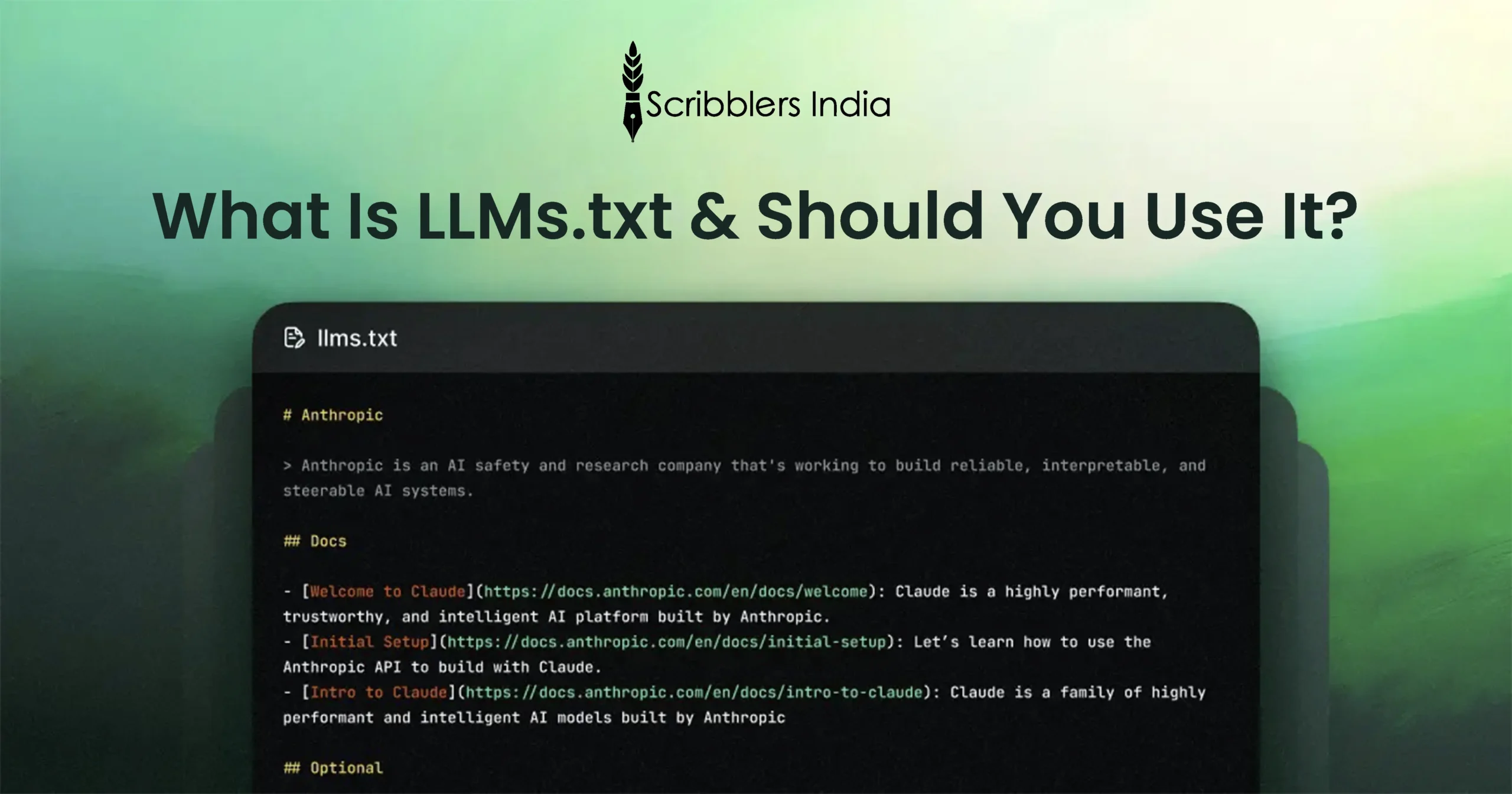
What Is llms.txt and Why It Matters for GEO
Your website was built for human visitors. Every design decision, from the navigation layout to the hero image, serves a person who sees, scrolls, and clicks through a visual experience. A different class of visitor is now reading your site, and they experience it in an entirely different way. This brings new considerations, such as managing llms.txt for GEO and how these visitors interact with website content. AI agents powering ChatGPT, Claude, Perplexity, and Gemini do not see your design. They process raw code. When an AI crawler visits a modern website, it must parse through kilobytes of JavaScript and CSS, navigation menus, and footer content before it reaches the required information. This friction in the processing creates a barrier to accurate retrieval, which is precisely the problem that llms.txt for GEO is designed to solve. Understanding what this file does and how to implement it correctly is becoming a crucial step in any serious Generative Engine Optimization strategy for 2026. TL;DR llms.txt is a Markdown file at your website’s root directory. It gives AI crawlers a clean, structured map of your content. The file was proposed by Jeremy Howard on September 3, 2024. It is fundamentally different from robots.txt in purpose and format. llms.txt for GEO reduces AI hallucinations about your brand content. Early adopters include Anthropic, Vercel, Stripe, and Hugging Face. Creating the file takes under 60 minutes and costs nothing. The file works best alongside strong schema markup and content authority. Update the file quarterly to maintain AI retrieval accuracy over time. What Is llms.txt and Why Does It Matter for GEO? LLMs.txt is a simple Markdown-formatted file placed at the root of your website. It gives AI language models a clean and curated summary of your most important content. It tells AI systems what your site is, who it serves, and where to find its most relevant pages without parsing through HTML noise. llms.txt for GEO matters because Generative Engine Optimization targets citations in AI-generated answers rather than ranking positions in traditional search results. AI crawlers reading cluttered HTML pages face significant computational friction. A well-structured llms.txt file removes that friction. It improves the probability that the AI accurately retrieves and cites your content. AI crawlers now play a measurable role in how websites are discovered and accessed. Latest report from Cloudflare found that AI bots accounted for 4.2% of HTML request traffic in 2025, while Googlebot alone accounted for 4.5%. For brands investing in AI visibility, llms.txt is a simple technical addition that can help AI systems better understand website content. It costs nothing to implement and can usually be created in less than an hour. How llms.txt Supports AI Search Visibility A detailed llms.txt file gives brands greater control over how their information is discovered, interpreted, and surfaced across AI-generated answers. As AI search platforms increasingly rely on structured retrieval methods, a well-maintained llms.txt file can improve content accessibility and strengthen citation opportunities. Functions as a sitemap for AI language models: XML sitemaps help search engines like Googlebot find and understand important website pages. An llms.txt file plays a similar role for AI models. It directs them to your most reliable and citation-worthy pages without requiring them to scan the complete website. Establishes a machine-readable brand identity: The file explains what your company does, who it serves, and how AI systems should understand your content. This clarity helps AI platforms describe your business accurately in generated answers. It also reduces the chances of incorrect or misleading descriptions of your services. Gives you content control in the AI retrieval environment: You can choose which pages to include in the llms.txt file. This helps you guide AI systems toward your strongest and most reliable content. It also keeps them away from duplicate, outdated, or less useful pages that may misrepresent your brand. How Is llms.txt Different from robots.txt on Your Website? llms.txt and robots.txt are both text files located at your site’s root. They both communicate with automated systems visiting your domain. They serve opposite purposes and use different formats to achieve desired outcomes for varied audiences. Understanding the distinction between these two files is crucial. It will help you seamlessly implement llms.txt for GEO as part of your broader AI crawler optimization website strategy. robots.txt controls access by telling crawlers where to avoid: It uses directives like User-agent, Allow, and Disallow to manage crawler access to specific URL paths. It acts as a gatekeeper, indicating to search crawlers which pages they can access or avoid. AI crawlers like GPTBot, ClaudeBot, and PerplexityBot may also follow robots.txt when configured correctly. llms.txt provides context by showing AI models your best content: It uses Markdown formatting instead of directive syntax and focuses on guidance rather than restriction. It does not block access to any page. Instead, it creates a curated list of important and authoritative pages that AI systems can retrieve and cite when generating answers about your brand or category. The two files work together rather than against each other: Your robots.txt file should allow the AI crawlers you want to access your content. Your llms.txt for GEO then guides those permitted crawlers to the pages that best represent your brand. Using both correctly creates a stronger technical foundation for websites optimizing for AI search visibility. robots.txt is established, while llms.txt is still emerging: Every major search engine recognizes robots.txt as a long-standing web standard. llms.txt for GEO is newer, voluntary, and still gaining adoption. Tech-forward companies such as Anthropic, Vercel, Stripe, and Hugging Face have already added it to their website infrastructure. How Does llms.txt for GEO Work with AI Crawlers in Practice? AI crawlers process websites under strict token limitations, making full-site parsing inefficient and often inaccurate for content retrieval. An llms.txt file simplifies this process by presenting clean, structured Markdown content without unnecessary scripts or navigation clutter. This improves retrieval efficiency and reduces parsing overhead. It helps AI systems represent brands accurately across GEO and AI-driven search experiences. Reduced
Your website was built for human visitors. Every design decision, from the navigation layout to the hero image, serves a person who sees, scrolls, and clicks through a visual experience. A different class of visitor is now reading your site, and they experience it in an entirely different way. This brings new considerations, such as managing llms.txt for GEO and how these visitors interact with website content. AI agents powering ChatGPT, Claude, Perplexity, and Gemini do not see your design. They process raw code. When an AI crawler visits a modern website, it must parse through kilobytes of JavaScript and CSS, navigation menus, and footer content before it reaches the required information. This friction in the processing creates a barrier to accurate retrieval, which is precisely the problem that llms.txt for GEO is designed to solve. Understanding what this file does and how to implement it correctly is becoming a crucial step in any serious Generative Engine Optimization strategy for 2026. TL;DR llms.txt is a Markdown file at your website’s root directory. It gives AI crawlers a clean, structured map of your content. The file was proposed by Jeremy Howard on September 3, 2024. It is fundamentally different from robots.txt in purpose and format. llms.txt for GEO reduces AI hallucinations about your brand content. Early adopters include Anthropic, Vercel, Stripe, and Hugging Face. Creating the file takes under 60 minutes and costs nothing. The file works best alongside strong schema markup and content authority. Update the file quarterly to maintain AI retrieval accuracy over time. What Is llms.txt and Why Does It Matter for GEO? LLMs.txt is a simple Markdown-formatted file placed at the root of your website. It gives AI language models a clean and curated summary of your most important content. It tells AI systems what your site is, who it serves, and where to find its most relevant pages without parsing through HTML noise. llms.txt for GEO matters because Generative Engine Optimization targets citations in AI-generated answers rather than ranking positions in traditional search results. AI crawlers reading cluttered HTML pages face significant computational friction. A well-structured llms.txt file removes that friction. It improves the probability that the AI accurately retrieves and cites your content. AI crawlers now play a measurable role in how websites are discovered and accessed. Latest report from Cloudflare found that AI bots accounted for 4.2% of HTML request traffic in 2025, while Googlebot alone accounted for 4.5%. For brands investing in AI visibility, llms.txt is a simple technical addition that can help AI systems better understand website content. It costs nothing to implement and can usually be created in less than an hour. How llms.txt Supports AI Search Visibility A detailed llms.txt file gives brands greater control over how their information is discovered, interpreted, and surfaced across AI-generated answers. As AI search platforms increasingly rely on structured retrieval methods, a well-maintained llms.txt file can improve content accessibility and strengthen citation opportunities. Functions as a sitemap for AI language models: XML sitemaps help search engines like Googlebot find and understand important website pages. An llms.txt file plays a similar role for AI models. It directs them to your most reliable and citation-worthy pages without requiring them to scan the complete website. Establishes a machine-readable brand identity: The file explains what your company does, who it serves, and how AI systems should understand your content. This clarity helps AI platforms describe your business accurately in generated answers. It also reduces the chances of incorrect or misleading descriptions of your services. Gives you content control in the AI retrieval environment: You can choose which pages to include in the llms.txt file. This helps you guide AI systems toward your strongest and most reliable content. It also keeps them away from duplicate, outdated, or less useful pages that may misrepresent your brand. How Is llms.txt Different from robots.txt on Your Website? llms.txt and robots.txt are both text files located at your site’s root. They both communicate with automated systems visiting your domain. They serve opposite purposes and use different formats to achieve desired outcomes for varied audiences. Understanding the distinction between these two files is crucial. It will help you seamlessly implement llms.txt for GEO as part of your broader AI crawler optimization website strategy. robots.txt controls access by telling crawlers where to avoid: It uses directives like User-agent, Allow, and Disallow to manage crawler access to specific URL paths. It acts as a gatekeeper, indicating to search crawlers which pages they can access or avoid. AI crawlers like GPTBot, ClaudeBot, and PerplexityBot may also follow robots.txt when configured correctly. llms.txt provides context by showing AI models your best content: It uses Markdown formatting instead of directive syntax and focuses on guidance rather than restriction. It does not block access to any page. Instead, it creates a curated list of important and authoritative pages that AI systems can retrieve and cite when generating answers about your brand or category. The two files work together rather than against each other: Your robots.txt file should allow the AI crawlers you want to access your content. Your llms.txt for GEO then guides those permitted crawlers to the pages that best represent your brand. Using both correctly creates a stronger technical foundation for websites optimizing for AI search visibility. robots.txt is established, while llms.txt is still emerging: Every major search engine recognizes robots.txt as a long-standing web standard. llms.txt for GEO is newer, voluntary, and still gaining adoption. Tech-forward companies such as Anthropic, Vercel, Stripe, and Hugging Face have already added it to their website infrastructure. How Does llms.txt for GEO Work with AI Crawlers in Practice? AI crawlers process websites under strict token limitations, making full-site parsing inefficient and often inaccurate for content retrieval. An llms.txt file simplifies this process by presenting clean, structured Markdown content without unnecessary scripts or navigation clutter. This improves retrieval efficiency and reduces parsing overhead. It helps AI systems represent brands accurately across GEO and AI-driven search experiences. Reduced
How Are AEO and GEO Changing Content Marketing in the Zero-Click Search Era?
AEO and GEO are becoming essential for brands that want to stay visible as search moves away from traditional clicks. Your content may rank on the first page, your keyword tracking tool may show steady impressions, yet your traffic report may tell a completely different story. This scenario is playing out across industries, and the cause has a specific name: Zero-click search. Zero-click search occurs when users find the answer directly in the search results without visiting a website. Google AI Overviews, featured snippets, knowledge panels, and direct answer widgets now resolve more queries directly in the search interface. A recent industry analysis found that nearly 80% of searches triggering AI Overview results end without a click, showing how AI-led search is accelerating zero-click behavior. For marketers, this changes how search visibility works. Traffic alone no longer reflects content performance. Brands now need AEO and GEO strategies that earn citations, answer visibility, and authority across AI-led search experiences. TL;DR: How AEO and GEO are Leading Transition to Zero-Click Search? Search visibility now extends beyond website clicks. AI answers reshape how audiences discover brands. AEO helps content earn answer-layer visibility. GEO improves citations across generative AI platforms. Question-led headings support direct content extraction. Original insights make content more citation-worthy. Brand mentions now matter alongside organic traffic. A strong content strategy must serve AI search. Why Do AEO and GEO Matter as Zero-Click Search Grows Zero-click search occurs when users get the answer directly in the search results without visiting a website. This no-click search method is becoming popular as search engines now resolve more queries through AI Overviews, featured snippets, knowledge panels, and direct answer boxes before users reach any organic results. Earlier, zero-click behavior was limited to simple queries such as weather updates, currency conversions, definitions, and sports scores. The shift became more disruptive when AI search started handling layered questions. Users can now compare options, understand concepts, review summaries, and gather recommendations directly in the search interface. This changes the value of ranking on page one. A page can still earn impressions, appear below an AI-generated answer, and lose the click because the user already has enough information. According to a 2025 study, AI Overviews reduced clicks to top-ranking pages by 34.5% for informational keywords. For content teams, the real issue is no longer visibility alone. The challenge is earning a place inside the answer layer. Content now needs clear questions, direct answers, expert-backed insights, and original value that search engines can cite rather than summarize without attribution. How Does Zero-Click Search Affect Content Marketing Performance? Zero-click search affects content marketing by separating search exposure from website visits. Your brand may appear in AI Overviews, featured snippets, answer boxes, and People Also Ask results while analytics records fewer sessions. This means performance must be judged through citations, branded demand, assisted conversions, and answer visibility. A focused AEO and GEO strategy helps content teams respond to this shift by treating search visibility as a citation, extraction, and brand recall challenge rather than a traffic-only goal. Traffic Metrics No Longer Capture Full Visibility Most content dashboards still measure what happens after the click. They track sessions, rankings, conversions, and pageviews. Zero-click search shifts much of audience exposure to the search results page, where standard analytics tools capture limited evidence of brand discovery. This creates a measurement blind spot for content teams. A user may read your cited answer, remember your brand, compare you later, and convert through another channel. Search visibility now needs impression analysis, branded search growth, assisted pipeline tracking, and citation monitoring alongside organic traffic. Informational Content Faces the Highest Disruption Risk Informational content carries the highest zero-click risk because it often answers questions that AI systems can summarise inside the results page. Definitions, comparisons, process guides, basic explainers, and FAQ-led pages are easier to compress. Experts found that keywords with AI Overviews had a zero-click rate between 35% and 46%, depending on whether an AI Overview appeared. This does not mean informational content has lost value. It means generic information has become easier to replace. Content needs sharper experience, original examples, practical frameworks, expert input, and brand-owned viewpoints. This is something that AI systems can cite rather than blending into a single summary. Citation Visibility Becomes the New Performance Indicator Citation visibility measures whether your brand appears inside the answer layer, not only below it. This matters because users increasingly treat AI-generated summaries as the first layer of trust. Seer Interactive found that brands cited in AI Overviews earned 35% higher organic CTR than uncited brands. The deeper insight is behavioral. A citation serves as a pre-click trust signal, even when the user does not visit immediately. Content teams should monitor which pages, authors, brand entities, and expert profiles AI systems cite across priority topics. Audience Discovery Shifts to Multi-Platform Behavior Google is still important, yet discovery now happens across ChatGPT, Perplexity, Gemini, Claude, LinkedIn, YouTube, and industry communities. Each platform uses different signals to decide which brands deserve visibility. Traditional rankings alone cannot explain why one brand appears in AI answers while another disappears. This shift changes the content strategy. Publishing on your website is no longer enough for modern search visibility. Brands need consistent entity signals across owned content, expert profiles, third-party publications, social conversations, and digital PR so AI systems can connect the brand with specific areas of authority. How Does AEO Address Zero-Click Search for Content Teams? AEO helps content teams win visibility where users now get answers without clicking. Answer Engine Optimization structures content so search engines can identify, extract, and display the most useful response inside AI Overviews, featured snippets, People Also Ask results, and voice-led search surfaces. In a zero-click environment, the goal is not limited to ranking below the answer. The stronger goal is to become part of the answer itself. When Google cites a brand inside an AI Overview or featured result, that brand earns authority before the user reaches any website. This
AEO and GEO are becoming essential for brands that want to stay visible as search moves away from traditional clicks. Your content may rank on the first page, your keyword tracking tool may show steady impressions, yet your traffic report may tell a completely different story. This scenario is playing out across industries, and the cause has a specific name: Zero-click search. Zero-click search occurs when users find the answer directly in the search results without visiting a website. Google AI Overviews, featured snippets, knowledge panels, and direct answer widgets now resolve more queries directly in the search interface. A recent industry analysis found that nearly 80% of searches triggering AI Overview results end without a click, showing how AI-led search is accelerating zero-click behavior. For marketers, this changes how search visibility works. Traffic alone no longer reflects content performance. Brands now need AEO and GEO strategies that earn citations, answer visibility, and authority across AI-led search experiences. TL;DR: How AEO and GEO are Leading Transition to Zero-Click Search? Search visibility now extends beyond website clicks. AI answers reshape how audiences discover brands. AEO helps content earn answer-layer visibility. GEO improves citations across generative AI platforms. Question-led headings support direct content extraction. Original insights make content more citation-worthy. Brand mentions now matter alongside organic traffic. A strong content strategy must serve AI search. Why Do AEO and GEO Matter as Zero-Click Search Grows Zero-click search occurs when users get the answer directly in the search results without visiting a website. This no-click search method is becoming popular as search engines now resolve more queries through AI Overviews, featured snippets, knowledge panels, and direct answer boxes before users reach any organic results. Earlier, zero-click behavior was limited to simple queries such as weather updates, currency conversions, definitions, and sports scores. The shift became more disruptive when AI search started handling layered questions. Users can now compare options, understand concepts, review summaries, and gather recommendations directly in the search interface. This changes the value of ranking on page one. A page can still earn impressions, appear below an AI-generated answer, and lose the click because the user already has enough information. According to a 2025 study, AI Overviews reduced clicks to top-ranking pages by 34.5% for informational keywords. For content teams, the real issue is no longer visibility alone. The challenge is earning a place inside the answer layer. Content now needs clear questions, direct answers, expert-backed insights, and original value that search engines can cite rather than summarize without attribution. How Does Zero-Click Search Affect Content Marketing Performance? Zero-click search affects content marketing by separating search exposure from website visits. Your brand may appear in AI Overviews, featured snippets, answer boxes, and People Also Ask results while analytics records fewer sessions. This means performance must be judged through citations, branded demand, assisted conversions, and answer visibility. A focused AEO and GEO strategy helps content teams respond to this shift by treating search visibility as a citation, extraction, and brand recall challenge rather than a traffic-only goal. Traffic Metrics No Longer Capture Full Visibility Most content dashboards still measure what happens after the click. They track sessions, rankings, conversions, and pageviews. Zero-click search shifts much of audience exposure to the search results page, where standard analytics tools capture limited evidence of brand discovery. This creates a measurement blind spot for content teams. A user may read your cited answer, remember your brand, compare you later, and convert through another channel. Search visibility now needs impression analysis, branded search growth, assisted pipeline tracking, and citation monitoring alongside organic traffic. Informational Content Faces the Highest Disruption Risk Informational content carries the highest zero-click risk because it often answers questions that AI systems can summarise inside the results page. Definitions, comparisons, process guides, basic explainers, and FAQ-led pages are easier to compress. Experts found that keywords with AI Overviews had a zero-click rate between 35% and 46%, depending on whether an AI Overview appeared. This does not mean informational content has lost value. It means generic information has become easier to replace. Content needs sharper experience, original examples, practical frameworks, expert input, and brand-owned viewpoints. This is something that AI systems can cite rather than blending into a single summary. Citation Visibility Becomes the New Performance Indicator Citation visibility measures whether your brand appears inside the answer layer, not only below it. This matters because users increasingly treat AI-generated summaries as the first layer of trust. Seer Interactive found that brands cited in AI Overviews earned 35% higher organic CTR than uncited brands. The deeper insight is behavioral. A citation serves as a pre-click trust signal, even when the user does not visit immediately. Content teams should monitor which pages, authors, brand entities, and expert profiles AI systems cite across priority topics. Audience Discovery Shifts to Multi-Platform Behavior Google is still important, yet discovery now happens across ChatGPT, Perplexity, Gemini, Claude, LinkedIn, YouTube, and industry communities. Each platform uses different signals to decide which brands deserve visibility. Traditional rankings alone cannot explain why one brand appears in AI answers while another disappears. This shift changes the content strategy. Publishing on your website is no longer enough for modern search visibility. Brands need consistent entity signals across owned content, expert profiles, third-party publications, social conversations, and digital PR so AI systems can connect the brand with specific areas of authority. How Does AEO Address Zero-Click Search for Content Teams? AEO helps content teams win visibility where users now get answers without clicking. Answer Engine Optimization structures content so search engines can identify, extract, and display the most useful response inside AI Overviews, featured snippets, People Also Ask results, and voice-led search surfaces. In a zero-click environment, the goal is not limited to ranking below the answer. The stronger goal is to become part of the answer itself. When Google cites a brand inside an AI Overview or featured result, that brand earns authority before the user reaches any website. This