
Hemant Jain
Hemant Jain works on content strategy with a focus on SEO, AEO, GEO, and AI search visibility. He helps brands find content gaps, plan useful topic clusters, and create content that supports discovery across Google, AI Overviews, ChatGPT, Perplexity, and other search-led platforms. His work focuses on clear research, practical structure, and reader value. At Scribblers India, he helps businesses build content that improves visibility and supports long-term authority.
Articles by Hemant Jain

How To Safely Hire a Ghostwriter in India in 2026?
Choosing to hire a ghostwriter in India can give founders, executives, consultants, and authors access to strong writing expertise without having to manage every draft personally. The risk comes from selecting a provider based solely on a polished website, a low quote, an impressive sample, or a promise of unusually fast delivery. A safer decision requires deeper due diligence. You need to understand who will write the work, where ideas will come from, how the writer will learn your voice, which claims they will verify, how confidential material will be handled, and what happens if the relationship ends. The objective when you hire a ghostwriter in India should therefore be risk reduction rather than risk elimination. No hiring process can guarantee a perfect fit. A structured evaluation can still expose weak processes early and give both sides clearer expectations before substantial money, time, or reputation is invested in the engagement. Key Takeaways Strong ghostwriters clearly explain source capture, research, drafting, revisions, and approvals. Writing quality matters most when samples resemble your format and complexity. Small assignments can test voice alignment before larger engagements begin. Contracts should define scope, rights, revisions, confidentiality, payments, and handover. Indian law makes written copyright assignment terms particularly important. Providers should explain where AI is integrated into workflows and how sources remain protected. Milestones can reduce risk when projects involve substantial time and investment. Source files, transcripts, research, and unpublished ideas should have clear handover rules. What Should You Verify Before You Hire a Ghostwriter in India? Before you hire a ghostwriter in India, verify the provider across five areas: relevant writing ability, source-capture process, editorial judgment, commercial terms, and information handling. A strong writer should be able to explain how their raw expertise becomes finished content, rather than discussing quality solely in terms of word counts. Use the first conversation to understand how the provider works when the brief is incomplete, when facts need to be checked, when your voice is still being learned, or when the first draft misses the mark. These situations reveal far more about professional maturity than an idealized description of the standard process. Evaluation Area What to Ask What Strong Practice Looks Like Writer Fit Who will write my content? Named or clearly defined writer with relevant experience Source Capture How will you learn what I think? Interviews, notes, recordings, previous writing, or structured briefs Voice Development How will you learn how I communicate? Reference material, calibration, feedback, and evolving guidance Research How are facts and claims checked? Defined source standards and verification responsibilities Editorial Review Who reviews drafts before delivery? Writer plus editor or another quality-control layer Confidentiality Who can access my materials? Clear access boundaries and contractual restrictions AI Use Where does AI enter the workflow? Specific, explainable use with human control over consequential content Handover What happens when the project ends? Defined return, transfer, retention, or deletion rules Do not expect every provider to use the same operating model. A book project requires a more in-depth process than four monthly LinkedIn posts. The important question is whether the workflow matches the complexity, sensitivity, and professional consequences of your specific assignment. How Should You Evaluate Samples Before You Hire a Ghostwriter in India? Writing samples are useful only when they demonstrate the skills your project requires. Before you hire a ghostwriter in India, compare each sample’s format, audience, subject complexity, argument quality, evidence, and editorial depth with the work you expect the writer to produce consistently across the engagement from the beginning. Confidentiality can limit what experienced ghostwriters are permitted to show publicly. A credible provider may therefore share permission-based work, anonymized excerpts, credited projects, original samples, or another suitable evaluation method. The objective is to verify relevant capabilities without requiring the writer to disclose confidential client relationships or restricted assignments unnecessarily. Evaluating the Relevance and Quality of Writing Samples Look beyond grammar, polish, and surface-level style when reviewing a ghostwriting sample. Check whether the piece develops a clear argument, uses credible evidence, includes specific examples, and maintains logical flow. For executive work, the writing should feel informed by genuine expertise rather than generic public information. Relevance is crucial as different formats require different capabilities. A writer handling executive LinkedIn content needs to extract ideas quickly and maintain voice across recurring posts, while a business-book ghostwriter must sustain structure, narrative continuity, evidence, and author perspective across a much longer manuscript and greater complexity. Compare the sample with your intended project before judging overall quality. A polished social post proves little about long-form writing, just as a strong book chapter may not demonstrate concise platform writing. Our book ghostwriting process explains the additional discovery, outlining, interviews, and staged reviews longer projects require. Using a Paid Trial to Test Working Fit A paid trial can reduce uncertainty when the planned engagement is recurring, high-value, or highly voice-sensitive. The trial should reproduce a realistic part of the working process, including the kind of source material, briefing, review, and feedback the writer would handle during the full engagement. For example, a founder-content trial could begin with a short interview and end with one draft plus a revision round. This gives you evidence of the writer’s questioning, interpretation, voice alignment, responsiveness, factual care, and ability to turn specific feedback into a stronger second version. A provider declining a trial is not automatically a warning sign. Experienced ghostwriters may use minimum engagements, existing client references, or other qualification methods instead. What matters is whether they offer a credible way to assess process and fit before you make a substantial commercial commitment. What Should a Ghostwriting Contract Include in India? A ghostwriting contract should explain the work both sides have agreed to perform. When you hire a ghostwriter in India, written terms should cover deliverables, timelines, payment stages, revision limits, confidentiality, intellectual property rights, attribution, source materials, cancellation, AI use where relevant, and post-engagement handover. The agreement does not need to become unnecessarily complicated, although vague commercial terms create avoidable disputes.
Choosing to hire a ghostwriter in India can give founders, executives, consultants, and authors access to strong writing expertise without having to manage every draft personally. The risk comes from selecting a provider based solely on a polished website, a low quote, an impressive sample, or a promise of unusually fast delivery. A safer decision requires deeper due diligence. You need to understand who will write the work, where ideas will come from, how the writer will learn your voice, which claims they will verify, how confidential material will be handled, and what happens if the relationship ends. The objective when you hire a ghostwriter in India should therefore be risk reduction rather than risk elimination. No hiring process can guarantee a perfect fit. A structured evaluation can still expose weak processes early and give both sides clearer expectations before substantial money, time, or reputation is invested in the engagement. Key Takeaways Strong ghostwriters clearly explain source capture, research, drafting, revisions, and approvals. Writing quality matters most when samples resemble your format and complexity. Small assignments can test voice alignment before larger engagements begin. Contracts should define scope, rights, revisions, confidentiality, payments, and handover. Indian law makes written copyright assignment terms particularly important. Providers should explain where AI is integrated into workflows and how sources remain protected. Milestones can reduce risk when projects involve substantial time and investment. Source files, transcripts, research, and unpublished ideas should have clear handover rules. What Should You Verify Before You Hire a Ghostwriter in India? Before you hire a ghostwriter in India, verify the provider across five areas: relevant writing ability, source-capture process, editorial judgment, commercial terms, and information handling. A strong writer should be able to explain how their raw expertise becomes finished content, rather than discussing quality solely in terms of word counts. Use the first conversation to understand how the provider works when the brief is incomplete, when facts need to be checked, when your voice is still being learned, or when the first draft misses the mark. These situations reveal far more about professional maturity than an idealized description of the standard process. Evaluation Area What to Ask What Strong Practice Looks Like Writer Fit Who will write my content? Named or clearly defined writer with relevant experience Source Capture How will you learn what I think? Interviews, notes, recordings, previous writing, or structured briefs Voice Development How will you learn how I communicate? Reference material, calibration, feedback, and evolving guidance Research How are facts and claims checked? Defined source standards and verification responsibilities Editorial Review Who reviews drafts before delivery? Writer plus editor or another quality-control layer Confidentiality Who can access my materials? Clear access boundaries and contractual restrictions AI Use Where does AI enter the workflow? Specific, explainable use with human control over consequential content Handover What happens when the project ends? Defined return, transfer, retention, or deletion rules Do not expect every provider to use the same operating model. A book project requires a more in-depth process than four monthly LinkedIn posts. The important question is whether the workflow matches the complexity, sensitivity, and professional consequences of your specific assignment. How Should You Evaluate Samples Before You Hire a Ghostwriter in India? Writing samples are useful only when they demonstrate the skills your project requires. Before you hire a ghostwriter in India, compare each sample’s format, audience, subject complexity, argument quality, evidence, and editorial depth with the work you expect the writer to produce consistently across the engagement from the beginning. Confidentiality can limit what experienced ghostwriters are permitted to show publicly. A credible provider may therefore share permission-based work, anonymized excerpts, credited projects, original samples, or another suitable evaluation method. The objective is to verify relevant capabilities without requiring the writer to disclose confidential client relationships or restricted assignments unnecessarily. Evaluating the Relevance and Quality of Writing Samples Look beyond grammar, polish, and surface-level style when reviewing a ghostwriting sample. Check whether the piece develops a clear argument, uses credible evidence, includes specific examples, and maintains logical flow. For executive work, the writing should feel informed by genuine expertise rather than generic public information. Relevance is crucial as different formats require different capabilities. A writer handling executive LinkedIn content needs to extract ideas quickly and maintain voice across recurring posts, while a business-book ghostwriter must sustain structure, narrative continuity, evidence, and author perspective across a much longer manuscript and greater complexity. Compare the sample with your intended project before judging overall quality. A polished social post proves little about long-form writing, just as a strong book chapter may not demonstrate concise platform writing. Our book ghostwriting process explains the additional discovery, outlining, interviews, and staged reviews longer projects require. Using a Paid Trial to Test Working Fit A paid trial can reduce uncertainty when the planned engagement is recurring, high-value, or highly voice-sensitive. The trial should reproduce a realistic part of the working process, including the kind of source material, briefing, review, and feedback the writer would handle during the full engagement. For example, a founder-content trial could begin with a short interview and end with one draft plus a revision round. This gives you evidence of the writer’s questioning, interpretation, voice alignment, responsiveness, factual care, and ability to turn specific feedback into a stronger second version. A provider declining a trial is not automatically a warning sign. Experienced ghostwriters may use minimum engagements, existing client references, or other qualification methods instead. What matters is whether they offer a credible way to assess process and fit before you make a substantial commercial commitment. What Should a Ghostwriting Contract Include in India? A ghostwriting contract should explain the work both sides have agreed to perform. When you hire a ghostwriter in India, written terms should cover deliverables, timelines, payment stages, revision limits, confidentiality, intellectual property rights, attribution, source materials, cancellation, AI use where relevant, and post-engagement handover. The agreement does not need to become unnecessarily complicated, although vague commercial terms create avoidable disputes.
Personal Brand Positioning
Personal brand positioning helps professionals shape the association they want audiences to make with their name. Instead of being remembered for a long list of roles or skills, a clear position connects the person to a specific audience, problem, area of expertise, and perspective that others can recognize and trust. That position then guides profiles, content, speaking opportunities, media contributions, and professional proof. A strong personal branding strategy keeps these signals aligned so the same authority territory appears across search, social platforms, external references, and AI-led discovery. Over time, this consistency can make professional expertise easier to understand, verify, and remember. Key Takeaways: Personal brand positioning defines the association professionals want audiences to remember. Clear positioning connects audience needs with relevant expertise and credible differentiation. Strong proof makes a chosen authority position easier to trust. Content should repeatedly reinforce the same core expertise across public channels. Search and AI discovery improve when public signals remain consistent. Repositioning helps when professional goals, audiences, or market context changes. Personal brand audits reveal gaps between intended and current perception. Scribblers India connects positioning with content, authority, and discovery measurement. What Is Personal Brand Positioning? Personal brand positioning is the strategic process of defining how a professional should be understood within their field. It identifies the audience, expertise territory, differentiated perspective, and evidence that should become associated with the person’s name across search, social platforms, professional content, and industry conversations. Positioning is deeper than a tagline or biography. It answers three essential questions: Who should remember this professional? What should they remember them for? Why should they believe that association? Those answers become the filter for future profiles, content topics, speaking opportunities, media contributions, and professional proof. Strong positioning also requires selection. Trying to become known for every skill usually creates a vague identity. A clearer authority territory gives audiences one strong reason to remember the person while leaving room for related expertise. How Is Personal Brand Positioning Different From a Personal Brand Statement? Personal brand positioning defines the professional association a person wants to build. A personal brand statement expresses part of that position concisely and can appear in biographies, profiles, websites, presentations, or professional introductions. The distinction is important because a strong statement cannot repair weak positioning. Element Personal brand positioning Personal brand statement Purpose Defines the desired professional association Communicates that position concisely Scope Covers audience, expertise, differentiation, proof, and goals Condenses the position into a short message Role Guides content and wider visibility Supports introductions and profile communication Longevity Changes when professional direction changes Can adapt across different contexts Core question What should I become known for? How should I describe that clearly? For example, someone may want to become known for helping SaaS companies improve customer retention. That is positioning. The sentence used to communicate that expertise on LinkedIn becomes the personal brand statement. The statement therefore works best after the positioning decisions are settled. To make those decisions well, professionals need to clearly define the audience, expertise territory, differentiating perspective, supporting proof, and future direction behind the brand. What Are the Core Elements of Personal Brand Positioning? Personal brand positioning requires a clear audience, relevant expertise, credible differentiation, supporting proof, and alignment with future goals. These elements ensure the chosen position reflects real capability while giving the intended audience a specific reason to recognize and remember the professional. Here are some key questions that help define the position: Who Is the Priority Audience? Positioning becomes weak when it tries to appeal to everyone equally. Buyers, investors, employers, industry peers, and potential partners may value different experiences. The position should reflect the audience most connected with the professional’s next goals. Which Problem Should the Person Own? Job titles rarely create enough differentiation. Stronger positioning connects the person with a recurring problem or area of expertise that audiences already consider important. What Makes Their Perspective Different? Two professionals can understand the same problem while approaching it differently. First-hand experience, operating philosophy, methodology, or informed market interpretation can create a more recognizable point of view. What Evidence Supports the Position? Cases, outcomes, published research, media recognition, original frameworks, and relevant professional experience make positioning believable. Without proof, even well-written positioning remains a claim. Where Should the Position Lead Next? A founder building category authority requires different emphasis from an executive seeking board opportunities. The position should support future opportunities rather than merely describe experience. These elements create a practical filter for choosing what deserves attention. The next step is deciding which expertise to prioritize, especially when a professional has several credible skills, experiences, or future opportunities. How Do You Decide What You Want to Be Known For? Deciding what to be known for requires an overlap among proven expertise, audience demand, future goals, and available evidence. The strongest position usually comes from work the professional understands deeply and can explain with greater authority than people repeating commonly available industry advice. Start by reviewing the following areas: Repeated Problems: Which questions do clients or colleagues repeatedly ask you to solve? Strongest Evidence: Where can you show direct experience or measurable outcomes? Audience Relevance: Which problems are important enough to influence decisions? Future Direction: Which expertise should support your next professional opportunities? The final position should be specific without becoming restrictive. For example, “technology leader” is difficult to remember. “Enterprise AI governance leader” provides more clarity while still allowing content around implementation, regulation, risk, organizational readiness, and operational lessons. A clear choice makes later content planning much easier because every topic can be tested against the desired association. That creates the bridge from positioning strategy into content strategy, where authority becomes visible through repeated public evidence. How Does Personal Brand Positioning Shape Content Strategy? Personal brand positioning gives content a clear purpose. Once the authority territory is defined, every topic can be assessed against one question: does this strengthen the association the professional wants to own? That filter prevents frequent publishing from creating a scattered or contradictory public
Personal brand positioning helps professionals shape the association they want audiences to make with their name. Instead of being remembered for a long list of roles or skills, a clear position connects the person to a specific audience, problem, area of expertise, and perspective that others can recognize and trust. That position then guides profiles, content, speaking opportunities, media contributions, and professional proof. A strong personal branding strategy keeps these signals aligned so the same authority territory appears across search, social platforms, external references, and AI-led discovery. Over time, this consistency can make professional expertise easier to understand, verify, and remember. Key Takeaways: Personal brand positioning defines the association professionals want audiences to remember. Clear positioning connects audience needs with relevant expertise and credible differentiation. Strong proof makes a chosen authority position easier to trust. Content should repeatedly reinforce the same core expertise across public channels. Search and AI discovery improve when public signals remain consistent. Repositioning helps when professional goals, audiences, or market context changes. Personal brand audits reveal gaps between intended and current perception. Scribblers India connects positioning with content, authority, and discovery measurement. What Is Personal Brand Positioning? Personal brand positioning is the strategic process of defining how a professional should be understood within their field. It identifies the audience, expertise territory, differentiated perspective, and evidence that should become associated with the person’s name across search, social platforms, professional content, and industry conversations. Positioning is deeper than a tagline or biography. It answers three essential questions: Who should remember this professional? What should they remember them for? Why should they believe that association? Those answers become the filter for future profiles, content topics, speaking opportunities, media contributions, and professional proof. Strong positioning also requires selection. Trying to become known for every skill usually creates a vague identity. A clearer authority territory gives audiences one strong reason to remember the person while leaving room for related expertise. How Is Personal Brand Positioning Different From a Personal Brand Statement? Personal brand positioning defines the professional association a person wants to build. A personal brand statement expresses part of that position concisely and can appear in biographies, profiles, websites, presentations, or professional introductions. The distinction is important because a strong statement cannot repair weak positioning. Element Personal brand positioning Personal brand statement Purpose Defines the desired professional association Communicates that position concisely Scope Covers audience, expertise, differentiation, proof, and goals Condenses the position into a short message Role Guides content and wider visibility Supports introductions and profile communication Longevity Changes when professional direction changes Can adapt across different contexts Core question What should I become known for? How should I describe that clearly? For example, someone may want to become known for helping SaaS companies improve customer retention. That is positioning. The sentence used to communicate that expertise on LinkedIn becomes the personal brand statement. The statement therefore works best after the positioning decisions are settled. To make those decisions well, professionals need to clearly define the audience, expertise territory, differentiating perspective, supporting proof, and future direction behind the brand. What Are the Core Elements of Personal Brand Positioning? Personal brand positioning requires a clear audience, relevant expertise, credible differentiation, supporting proof, and alignment with future goals. These elements ensure the chosen position reflects real capability while giving the intended audience a specific reason to recognize and remember the professional. Here are some key questions that help define the position: Who Is the Priority Audience? Positioning becomes weak when it tries to appeal to everyone equally. Buyers, investors, employers, industry peers, and potential partners may value different experiences. The position should reflect the audience most connected with the professional’s next goals. Which Problem Should the Person Own? Job titles rarely create enough differentiation. Stronger positioning connects the person with a recurring problem or area of expertise that audiences already consider important. What Makes Their Perspective Different? Two professionals can understand the same problem while approaching it differently. First-hand experience, operating philosophy, methodology, or informed market interpretation can create a more recognizable point of view. What Evidence Supports the Position? Cases, outcomes, published research, media recognition, original frameworks, and relevant professional experience make positioning believable. Without proof, even well-written positioning remains a claim. Where Should the Position Lead Next? A founder building category authority requires different emphasis from an executive seeking board opportunities. The position should support future opportunities rather than merely describe experience. These elements create a practical filter for choosing what deserves attention. The next step is deciding which expertise to prioritize, especially when a professional has several credible skills, experiences, or future opportunities. How Do You Decide What You Want to Be Known For? Deciding what to be known for requires an overlap among proven expertise, audience demand, future goals, and available evidence. The strongest position usually comes from work the professional understands deeply and can explain with greater authority than people repeating commonly available industry advice. Start by reviewing the following areas: Repeated Problems: Which questions do clients or colleagues repeatedly ask you to solve? Strongest Evidence: Where can you show direct experience or measurable outcomes? Audience Relevance: Which problems are important enough to influence decisions? Future Direction: Which expertise should support your next professional opportunities? The final position should be specific without becoming restrictive. For example, “technology leader” is difficult to remember. “Enterprise AI governance leader” provides more clarity while still allowing content around implementation, regulation, risk, organizational readiness, and operational lessons. A clear choice makes later content planning much easier because every topic can be tested against the desired association. That creates the bridge from positioning strategy into content strategy, where authority becomes visible through repeated public evidence. How Does Personal Brand Positioning Shape Content Strategy? Personal brand positioning gives content a clear purpose. Once the authority territory is defined, every topic can be assessed against one question: does this strengthen the association the professional wants to own? That filter prevents frequent publishing from creating a scattered or contradictory public
What is AI Citation?
AI citations are becoming an important part of how brands appear inside AI-generated search results. When platforms such as Google AI features, ChatGPT Search, and Perplexity reference a source, that citation can influence brand discovery, perceived authority, and how users verify information before visiting another page. For brands, AI citation visibility depends on more than publishing large volumes of content. Pages need relevant answers, credible evidence, clear source signals, and accurate brand information. Tracking where citations appear, what they support, and how consistently they return helps teams connect content quality with wider AEO, GEO, and AI search visibility goals. Key Takeaways: AI citations connect generated answers with visible supporting source references. Citation visibility does not automatically mean a brand receives a recommendation. Different citation types support definitions, evidence, comparisons, and recommendations. Strong relevance and credible evidence improve potential citation eligibility. Citation quality matters more than counting every visible source link. Repeated testing helps separate stable citations from normal answer variation. AEO improves content structure for clearer retrieval and source extraction. GEO strengthens external authority signals that can support citation visibility. What Does an AI Citation Mean in Search? An AI citation is a visible source reference connected with a generated answer. It helps users verify information and explore supporting pages. For brands, citations create source visibility before users reach conventional search listings or visit the company website directly. A citation may support one definition, statistic, comparison, or procedural step within the answer. It does not confirm that the platform endorses the publisher or recommends its services. Teams must review the surrounding wording to determine whether the source provides evidence, context, or support for recommendations during each buyer interaction today. AI citations differ from organic rankings because the platform filters sources before presenting a synthesized response. This shift makes citation tracking part of wider AI search visibility measurement. Brands should review source ownership, answer accuracy, citation stability, and repeated inclusion across valuable prompts before reporting a durable performance gain. Which Types of AI Citations Should Brands Track? AI citations can support several answer functions across research and evaluation. Each type creates a different visibility outcome. Teams should classify citations before comparing value, stability, source ownership, or business influence across prompts in every reporting cycle to ensure reliable analysis. Citation Type What It Supports What Brands Should Review Definitional citation A term or category explanation Accuracy and topical association Factual citation A statistic, date, or verified claim Currency and source fidelity Explanatory citation A concept, framework, or detailed answer Context and meaning preservation Procedural citation Steps, methods, or implementation guidance Completeness and practical usefulness Comparison citation Differences between providers or approaches Fairness and decision criteria Recommendation citation A shortlist or suggested provider Position and qualifying language Product citation Features, integrations, or service details Description accuracy Evidence citation Research findings, case results, or proof Methodology and claim support Third-party citation Independent coverage about the brand Credibility and message consistency Supporting citation Background context without brand emphasis Repeated use and later visibility Citation classification prevents teams from treating every source link as equal. A recommendation citation may influence shortlisting, while a factual citation strengthens topic authority. Our AI visibility measurement framework reports these roles separately across selected platforms and priority prompts. What Factors Influence AI Citation Selection? AI citation selection depends on relevance, accessibility, evidence quality, and source context for each prompt during retrieval cycles. Formatting alone cannot secure inclusion because answer engines need useful, retrievable evidence across platforms. Brands should create pages that answer questions, support claims, and help users evaluate information across changing search environments. Strong topical alignment improves selection when the page answers the prompt and supporting questions with focused, useful detail today. Indexed and accessible pages remain eligible for retrieval, whereas blocked or unavailable content cannot be used to generate search answers. Original evidence creates distinct value through research, expert experience, verified examples, or practical frameworks that competitors cannot easily replicate. Current information supports trustworthy answers when dates, service details, evidence, and examples accurately reflect present market conditions. Clear passages improve source usability by consistently placing concise definitions, comparisons, procedures, and numerical evidence near relevant headings. Our AEO services integrate these factors into a single editorial system. We strengthen direct answers, evidence blocks, section structure, and source clarity. This approach helps priority pages support readers while making it easier for answer engines to retrieve, interpret, and cite them. How Should Brands Judge AI Citation Quality? Citation counts show source selection, yet they do not reveal how much the page shaped the generated answer. Measurement must assess source influence. Teams should review whether the citation contributes evidence, structure, wording, or factual support within the final response. A 2026 research framework distinguishes between citation selection and citation absorption. Selection records whether a platform chooses the source for an answer. Absorption measures whether the page contributes language, evidence, structure, or factual support across ChatGPT, Google AI Overviews, Gemini, and Perplexity. Marketing teams can assess both outcomes during structured reviews. A separate 2026 Google AI Overviews study found that 11.0% of the examined claims lacked support from the cited pages. Brands should compare each generated claim with the cited passage. This check reveals whether a visible citation preserves context, supports the statement, or creates an accuracy risk around the brand for users. How Should Brands Measure AI Citation Performance? Brands should measure citations across fixed prompts, repeated tests, selected platforms, and defined reporting periods. One observation cannot establish durable performance. A useful review combines source presence with answer context, stability, accuracy, and later commercial signals across priority buyer journeys. Citation rate: Track the percentage of observed answers that cite an owned page or approved external source. Separate platform results so the metric shows source inclusion across the fixed prompt library without hiding channel differences. Cited-page mix: Record which service pages, reports, blogs, case studies, or expert assets receive links. This distribution shows whether citation visibility depends on a single page or consistently extends across the wider content system
AI citations are becoming an important part of how brands appear inside AI-generated search results. When platforms such as Google AI features, ChatGPT Search, and Perplexity reference a source, that citation can influence brand discovery, perceived authority, and how users verify information before visiting another page. For brands, AI citation visibility depends on more than publishing large volumes of content. Pages need relevant answers, credible evidence, clear source signals, and accurate brand information. Tracking where citations appear, what they support, and how consistently they return helps teams connect content quality with wider AEO, GEO, and AI search visibility goals. Key Takeaways: AI citations connect generated answers with visible supporting source references. Citation visibility does not automatically mean a brand receives a recommendation. Different citation types support definitions, evidence, comparisons, and recommendations. Strong relevance and credible evidence improve potential citation eligibility. Citation quality matters more than counting every visible source link. Repeated testing helps separate stable citations from normal answer variation. AEO improves content structure for clearer retrieval and source extraction. GEO strengthens external authority signals that can support citation visibility. What Does an AI Citation Mean in Search? An AI citation is a visible source reference connected with a generated answer. It helps users verify information and explore supporting pages. For brands, citations create source visibility before users reach conventional search listings or visit the company website directly. A citation may support one definition, statistic, comparison, or procedural step within the answer. It does not confirm that the platform endorses the publisher or recommends its services. Teams must review the surrounding wording to determine whether the source provides evidence, context, or support for recommendations during each buyer interaction today. AI citations differ from organic rankings because the platform filters sources before presenting a synthesized response. This shift makes citation tracking part of wider AI search visibility measurement. Brands should review source ownership, answer accuracy, citation stability, and repeated inclusion across valuable prompts before reporting a durable performance gain. Which Types of AI Citations Should Brands Track? AI citations can support several answer functions across research and evaluation. Each type creates a different visibility outcome. Teams should classify citations before comparing value, stability, source ownership, or business influence across prompts in every reporting cycle to ensure reliable analysis. Citation Type What It Supports What Brands Should Review Definitional citation A term or category explanation Accuracy and topical association Factual citation A statistic, date, or verified claim Currency and source fidelity Explanatory citation A concept, framework, or detailed answer Context and meaning preservation Procedural citation Steps, methods, or implementation guidance Completeness and practical usefulness Comparison citation Differences between providers or approaches Fairness and decision criteria Recommendation citation A shortlist or suggested provider Position and qualifying language Product citation Features, integrations, or service details Description accuracy Evidence citation Research findings, case results, or proof Methodology and claim support Third-party citation Independent coverage about the brand Credibility and message consistency Supporting citation Background context without brand emphasis Repeated use and later visibility Citation classification prevents teams from treating every source link as equal. A recommendation citation may influence shortlisting, while a factual citation strengthens topic authority. Our AI visibility measurement framework reports these roles separately across selected platforms and priority prompts. What Factors Influence AI Citation Selection? AI citation selection depends on relevance, accessibility, evidence quality, and source context for each prompt during retrieval cycles. Formatting alone cannot secure inclusion because answer engines need useful, retrievable evidence across platforms. Brands should create pages that answer questions, support claims, and help users evaluate information across changing search environments. Strong topical alignment improves selection when the page answers the prompt and supporting questions with focused, useful detail today. Indexed and accessible pages remain eligible for retrieval, whereas blocked or unavailable content cannot be used to generate search answers. Original evidence creates distinct value through research, expert experience, verified examples, or practical frameworks that competitors cannot easily replicate. Current information supports trustworthy answers when dates, service details, evidence, and examples accurately reflect present market conditions. Clear passages improve source usability by consistently placing concise definitions, comparisons, procedures, and numerical evidence near relevant headings. Our AEO services integrate these factors into a single editorial system. We strengthen direct answers, evidence blocks, section structure, and source clarity. This approach helps priority pages support readers while making it easier for answer engines to retrieve, interpret, and cite them. How Should Brands Judge AI Citation Quality? Citation counts show source selection, yet they do not reveal how much the page shaped the generated answer. Measurement must assess source influence. Teams should review whether the citation contributes evidence, structure, wording, or factual support within the final response. A 2026 research framework distinguishes between citation selection and citation absorption. Selection records whether a platform chooses the source for an answer. Absorption measures whether the page contributes language, evidence, structure, or factual support across ChatGPT, Google AI Overviews, Gemini, and Perplexity. Marketing teams can assess both outcomes during structured reviews. A separate 2026 Google AI Overviews study found that 11.0% of the examined claims lacked support from the cited pages. Brands should compare each generated claim with the cited passage. This check reveals whether a visible citation preserves context, supports the statement, or creates an accuracy risk around the brand for users. How Should Brands Measure AI Citation Performance? Brands should measure citations across fixed prompts, repeated tests, selected platforms, and defined reporting periods. One observation cannot establish durable performance. A useful review combines source presence with answer context, stability, accuracy, and later commercial signals across priority buyer journeys. Citation rate: Track the percentage of observed answers that cite an owned page or approved external source. Separate platform results so the metric shows source inclusion across the fixed prompt library without hiding channel differences. Cited-page mix: Record which service pages, reports, blogs, case studies, or expert assets receive links. This distribution shows whether citation visibility depends on a single page or consistently extends across the wider content system
How Can GEO for Local Business Improve Multi-Location AI Visibility?
A customer looking for a nearby business no longer needs to search with a short phrase. They can ask for an accountant experienced with startups near Indiranagar or a dentist who is open on Saturdays with strong recent reviews. AI search can interpret several conditions before suggesting businesses. This trend redefines the importance of GEO for local business. Visibility now depends on whether search systems can connect a company with the right location and service. Accurate business information and useful local evidence become important parts of that matching process. Multi-location businesses face an additional challenge. Every branch needs sufficient distinct information to accurately represent its location without fragmenting the wider brand. This blog explains how local businesses can build that information system and measure whether AI-led discovery improves. Key Takeaways Local GEO depends on accurate location facts across every public business source. AI recommendations today combine local relevance with reviews and broader web evidence. Google Business Profiles remain essential inputs for Search and Maps discovery today. Multi-location brands need unique pages without duplicating generic location template content everywhere. Reviews strengthen local trust when they stay recent and location-specific consistently over time. Service-area clarity helps AI systems match businesses to geographically specific customer needs. Local GEO measurement consistently requires repeated prompts across locations and commercial scenarios. Central governance prevents profile inconsistencies from quickly multiplying across large location networks. What Is GEO for Local Business? GEO for local business improves how a company appears inside AI-generated recommendations tied to a geographic need. It connects accurate location information with useful website content and credible external evidence. The goal is to help AI systems understand which location best fits a specific customer question and why. Traditional local SEO remains the foundation. Google still uses local information to match businesses with nearby users across Search and Maps. GEO adds another layer, allowing people to describe complete situations rather than entering short service-plus-city keywords. For example, a user may ask for a coworking space near Koramangala that supports day passes and late-evening access. Another may ask which physiotherapy clinic near Powai specializes in sports rehabilitation and has weekend appointments. Those prompts require more than basic category relevance. Scribblers India’s Generative Engine Optimization services examine this wider discovery environment. Local GEO narrows that work around geographic relevance and location-level accuracy while keeping the brand understandable across every branch. This distinction becomes more important as local discovery begins to span several search experiences. Why Does AI Search Matter for Local Businesses in 2026? AI search matters because consumers increasingly use AI tools in their local business research. Google has also integrated conversational AI directly into Search and Maps-related journeys. Local businesses therefore need accurate information across the sources people use before they decide which company deserves further consideration. An industry study found that 84% of consumers searched online for a local business in the previous three months, according to its 2026 research. The same study found AI tools appeared during 23% of consumers’ most recent local search journeys. Google’s behavior is changing as well. AI Mode supports complex local recommendation questions, while Google says early AI Mode queries were two to three times longer than traditional searches. Longer prompts create more opportunities for customers to specify location and service needs together. The implication of GEO for local businesses is functional: brands now compete in richer recommendation contexts, where incomplete information can remove them before a customer reaches their website. How Do AI Search Systems Find Information About Local Businesses? AI search systems can combine official business information with website content and wider public sources. Google explicitly states that Local Business Profiles draw information from business owners and public web content. Licensed third-party data and user contributions can provide additional details about real-world businesses. Google explains that its Business Profiles may combine company-submitted details with information from official websites and external providers. Customer photos or reviews can also contribute to the profile users eventually see. ChatGPT can also use location information when answering requests that benefit from local results. OpenAI states that ChatGPT search can find local results and use location context where available. It may use third-party providers to help return relevant nearby information. This creates an important GEO principle. Your website is one source within a wider local information environment rather than the only source defining the business. A strong GEO strategy for local business must therefore make the same essential facts understandable across owned pages and important public profiles. Once those facts align, content can provide the additional evidence needed for recommendation. How Is GEO for Local Business Different From Traditional Local SEO? Local SEO improves visibility across geographically relevant Search and Maps results, while GEO adds AI-generated recommendations and conversational discovery. The two approaches share important foundations. GEO for local business places additional emphasis on detailed prompt matching, information consistency, recommendation context, external evidence, and location-level measurement across generative experiences. Google says conventional local results mainly depend on relevance and distance, with prominence providing another major factor. Complete Business Profile information helps Google understand how closely a business matches what someone needs. Reviews and links can contribute to prominence. GEO for local business builds on those fundamentals rather than replacing them. Local SEO Focus GEO for Local Business Focus Local pack and Maps rankings Inclusion inside AI-generated recommendations Service plus location queries Detailed conversational local questions Google Business Profile optimization Cross-source location understanding Local landing-page rankings Location-level answer and recommendation readiness Review quantity and rating Review themes, recency, and recommendation evidence Organic calls and visits AI mentions, referrals, and assisted actions The strongest strategy therefore avoids choosing between local SEO and GEO. Businesses need a reliable local search foundation before expecting generative platforms to interpret their locations consistently. Which Signals Matter Most for Local AI Search Visibility? Local AI search visibility depends on a connected set of signals rather than on a single optimization tactic. Accurate Business Profiles establish core facts, while location pages explain individual branches. Reviews and
A customer looking for a nearby business no longer needs to search with a short phrase. They can ask for an accountant experienced with startups near Indiranagar or a dentist who is open on Saturdays with strong recent reviews. AI search can interpret several conditions before suggesting businesses. This trend redefines the importance of GEO for local business. Visibility now depends on whether search systems can connect a company with the right location and service. Accurate business information and useful local evidence become important parts of that matching process. Multi-location businesses face an additional challenge. Every branch needs sufficient distinct information to accurately represent its location without fragmenting the wider brand. This blog explains how local businesses can build that information system and measure whether AI-led discovery improves. Key Takeaways Local GEO depends on accurate location facts across every public business source. AI recommendations today combine local relevance with reviews and broader web evidence. Google Business Profiles remain essential inputs for Search and Maps discovery today. Multi-location brands need unique pages without duplicating generic location template content everywhere. Reviews strengthen local trust when they stay recent and location-specific consistently over time. Service-area clarity helps AI systems match businesses to geographically specific customer needs. Local GEO measurement consistently requires repeated prompts across locations and commercial scenarios. Central governance prevents profile inconsistencies from quickly multiplying across large location networks. What Is GEO for Local Business? GEO for local business improves how a company appears inside AI-generated recommendations tied to a geographic need. It connects accurate location information with useful website content and credible external evidence. The goal is to help AI systems understand which location best fits a specific customer question and why. Traditional local SEO remains the foundation. Google still uses local information to match businesses with nearby users across Search and Maps. GEO adds another layer, allowing people to describe complete situations rather than entering short service-plus-city keywords. For example, a user may ask for a coworking space near Koramangala that supports day passes and late-evening access. Another may ask which physiotherapy clinic near Powai specializes in sports rehabilitation and has weekend appointments. Those prompts require more than basic category relevance. Scribblers India’s Generative Engine Optimization services examine this wider discovery environment. Local GEO narrows that work around geographic relevance and location-level accuracy while keeping the brand understandable across every branch. This distinction becomes more important as local discovery begins to span several search experiences. Why Does AI Search Matter for Local Businesses in 2026? AI search matters because consumers increasingly use AI tools in their local business research. Google has also integrated conversational AI directly into Search and Maps-related journeys. Local businesses therefore need accurate information across the sources people use before they decide which company deserves further consideration. An industry study found that 84% of consumers searched online for a local business in the previous three months, according to its 2026 research. The same study found AI tools appeared during 23% of consumers’ most recent local search journeys. Google’s behavior is changing as well. AI Mode supports complex local recommendation questions, while Google says early AI Mode queries were two to three times longer than traditional searches. Longer prompts create more opportunities for customers to specify location and service needs together. The implication of GEO for local businesses is functional: brands now compete in richer recommendation contexts, where incomplete information can remove them before a customer reaches their website. How Do AI Search Systems Find Information About Local Businesses? AI search systems can combine official business information with website content and wider public sources. Google explicitly states that Local Business Profiles draw information from business owners and public web content. Licensed third-party data and user contributions can provide additional details about real-world businesses. Google explains that its Business Profiles may combine company-submitted details with information from official websites and external providers. Customer photos or reviews can also contribute to the profile users eventually see. ChatGPT can also use location information when answering requests that benefit from local results. OpenAI states that ChatGPT search can find local results and use location context where available. It may use third-party providers to help return relevant nearby information. This creates an important GEO principle. Your website is one source within a wider local information environment rather than the only source defining the business. A strong GEO strategy for local business must therefore make the same essential facts understandable across owned pages and important public profiles. Once those facts align, content can provide the additional evidence needed for recommendation. How Is GEO for Local Business Different From Traditional Local SEO? Local SEO improves visibility across geographically relevant Search and Maps results, while GEO adds AI-generated recommendations and conversational discovery. The two approaches share important foundations. GEO for local business places additional emphasis on detailed prompt matching, information consistency, recommendation context, external evidence, and location-level measurement across generative experiences. Google says conventional local results mainly depend on relevance and distance, with prominence providing another major factor. Complete Business Profile information helps Google understand how closely a business matches what someone needs. Reviews and links can contribute to prominence. GEO for local business builds on those fundamentals rather than replacing them. Local SEO Focus GEO for Local Business Focus Local pack and Maps rankings Inclusion inside AI-generated recommendations Service plus location queries Detailed conversational local questions Google Business Profile optimization Cross-source location understanding Local landing-page rankings Location-level answer and recommendation readiness Review quantity and rating Review themes, recency, and recommendation evidence Organic calls and visits AI mentions, referrals, and assisted actions The strongest strategy therefore avoids choosing between local SEO and GEO. Businesses need a reliable local search foundation before expecting generative platforms to interpret their locations consistently. Which Signals Matter Most for Local AI Search Visibility? Local AI search visibility depends on a connected set of signals rather than on a single optimization tactic. Accurate Business Profiles establish core facts, while location pages explain individual branches. Reviews and
Prompt Coverage in AI Search
AI search visibility rarely depends on appearing for one high-value question. Brands need to surface across the prompts buyers use to discover a category, compare providers, assess concerns, and validate decisions. Prompt coverage measures how broadly a brand appears across that defined set of AI search queries and buyer conversations. Tracking prompt coverage helps teams see whether visibility extends across the research journey or remains concentrated around prompts. It reveals missing topics, buyer-stage support, and content gaps that may limit AI search visibility. Used consistently, the metric gives brands a basis for prioritizing content, authority, and measurement efforts more effectively. Key Takeaways Prompt coverage measures brand visibility across a defined set of AI prompts. Stable prompt libraries make performance comparisons more reliable over time. Coverage measures the breadth of visibility, while frequency tracks repeated brand appearances. Buyer-stage weighting keeps prompt coverage aligned with commercial priorities. Different AI platforms require separate testing because visibility can vary. Coverage gaps reveal missing topics, weak authority, or unsupported buyer questions. Declining coverage may reflect source changes, prompt drift, or testing inconsistency. AEO and GEO strategies can strengthen visibility across weak prompt clusters. What Does Prompt Coverage Mean For AI Search Visibility? Prompt coverage measures the percentage of tracked prompts in which a brand appears in AI-generated answers. It shows breadth of visibility across buyer questions. The metric helps teams identify missing conversations before planning content, authority, or measurement improvements around those gaps today. If a brand appears in 40 of 100 tracked prompts, its prompt coverage equals 40%. The calculation uses prompt inclusion instead of total mention volume across repeated tests. Teams must define an appearance before testing, such as a mention, recommendation, citation, or approved signal for each platform and review cycle. Coverage becomes useful when the prompt library reflects buyer research across education, comparisons, use cases, objections, and decisions. Our content strategy services connect missing prompt groups with suitable pages, expert assets, refresh priorities, and measurable visibility goals at each buyer stage to drive sustained growth. How Is Prompt Coverage Different From Mention Frequency? Prompt coverage measures the breadth across the tracked prompt library, while mention frequency measures how often a term appears within individual prompts. Both support AI visibility reporting. However, each reveals a different weakness and requires a different content or authority response from marketing teams. Metric focus: Coverage counts prompts where the brand appears at least once during testing. Frequency counts repeated appearances for the same prompt under comparable conditions. This difference separates visibility breadth from repeat inclusion within the chosen measurement framework. Question answered: Coverage asks whether the brand appears across the wider category journey. Frequency asks whether the brand maintains visibility when teams repeat prompts that already include it. Both questions need consistent testing throughout every planned reporting period. Content signal: Low coverage points toward missing topics, weak buyer-stage support, or absent use cases. Low frequency suggests fragile authority within topics the brand already addresses. Teams should examine existing content and external references across the complete buyer journey. Improvement approach: Coverage improves through new pages, cluster expansion, comparison assets, and objection content. Frequency improves through stronger evidence, clearer positioning, content refreshes, and external validation. These actions should follow confirmed gaps across future review cycles and markets. Review cadence: Teams can assess full coverage quarterly after preserving a stable prompt library. They should review frequency monthly for priority questions where recommendations or citations change often. This cadence supports stronger decisions across platforms and competitive categories. Both metrics belong inside a complete AI visibility program. Our AEO services improve coverage through broader question support. They strengthen frequency through clearer answers, structured pages, stronger evidence, and reliable authority signals across priority buyer topics. How Should Brands Build a Prompt List for Coverage Tracking? Brands should build prompt lists around buyer language, research stages, market context, and commercial priorities. The list should include branded and nonbranded questions. It must remain stable for comparisons while allowing separate tests for emerging language and new buyer concerns. Prompt source Example prompt Coverage purpose Category education What is generative engine optimization? Tests foundational topic visibility Problem discovery How can brands appear in AI answers? Measures unaided brand discovery Use-case research Which agencies support B2B AI visibility? Tests contextual service relevance Feature evaluation Which agencies offer AEO services in India? Checks capability recognition Vendor comparison Best agencies for AI search content Measures competitive presence Alternative research Alternatives to traditional SEO agencies Tests adjacent category visibility Objection handling Is AI search worth investing in? Measures trust and category confidence Implementation planning How should brands start AI optimization? Tests process authority Founder research Who leads Scribblers India? Checks founder entity recognition Decision validation Which AI visibility agency should I choose? Measures shortlist inclusion Google explains that AI features may use query fan-out across related subtopics and data sources. This behavior supports prompt libraries that cover connected questions. Our content strategy services map those questions to suitable pages and authority assets for future measurement. How Should Brands Weight Prompts by Business Value? Prompt weighting gives greater influence to questions that matter more for qualified discovery or buyer decisions. It prevents broad educational prompts from dominating the score. Teams should document every weight before reporting results or comparing performance across future review periods. Start by grouping prompts according to buyer stage and expected commercial value. A vendor recommendation may deserve more influence than a broad definition. However, education prompts still matter because they shape awareness and category understanding before buyers compare providers across the complete research journey. Report unweighted coverage beside weighted coverage so leaders can see both breadth and business relevance. Document every rule before testing begins. Review weights when services or buyer behavior change, then preserve them throughout the next reporting period across quarterly and annual reviews. Our AI search benchmarking process documents prompt groups and scoring rules before testing begins. This discipline prevents changing business priorities or internal preferences from distorting historical comparisons. How Can Brands Accurately Calculate Prompt Coverage? Brands calculate
AI search visibility rarely depends on appearing for one high-value question. Brands need to surface across the prompts buyers use to discover a category, compare providers, assess concerns, and validate decisions. Prompt coverage measures how broadly a brand appears across that defined set of AI search queries and buyer conversations. Tracking prompt coverage helps teams see whether visibility extends across the research journey or remains concentrated around prompts. It reveals missing topics, buyer-stage support, and content gaps that may limit AI search visibility. Used consistently, the metric gives brands a basis for prioritizing content, authority, and measurement efforts more effectively. Key Takeaways Prompt coverage measures brand visibility across a defined set of AI prompts. Stable prompt libraries make performance comparisons more reliable over time. Coverage measures the breadth of visibility, while frequency tracks repeated brand appearances. Buyer-stage weighting keeps prompt coverage aligned with commercial priorities. Different AI platforms require separate testing because visibility can vary. Coverage gaps reveal missing topics, weak authority, or unsupported buyer questions. Declining coverage may reflect source changes, prompt drift, or testing inconsistency. AEO and GEO strategies can strengthen visibility across weak prompt clusters. What Does Prompt Coverage Mean For AI Search Visibility? Prompt coverage measures the percentage of tracked prompts in which a brand appears in AI-generated answers. It shows breadth of visibility across buyer questions. The metric helps teams identify missing conversations before planning content, authority, or measurement improvements around those gaps today. If a brand appears in 40 of 100 tracked prompts, its prompt coverage equals 40%. The calculation uses prompt inclusion instead of total mention volume across repeated tests. Teams must define an appearance before testing, such as a mention, recommendation, citation, or approved signal for each platform and review cycle. Coverage becomes useful when the prompt library reflects buyer research across education, comparisons, use cases, objections, and decisions. Our content strategy services connect missing prompt groups with suitable pages, expert assets, refresh priorities, and measurable visibility goals at each buyer stage to drive sustained growth. How Is Prompt Coverage Different From Mention Frequency? Prompt coverage measures the breadth across the tracked prompt library, while mention frequency measures how often a term appears within individual prompts. Both support AI visibility reporting. However, each reveals a different weakness and requires a different content or authority response from marketing teams. Metric focus: Coverage counts prompts where the brand appears at least once during testing. Frequency counts repeated appearances for the same prompt under comparable conditions. This difference separates visibility breadth from repeat inclusion within the chosen measurement framework. Question answered: Coverage asks whether the brand appears across the wider category journey. Frequency asks whether the brand maintains visibility when teams repeat prompts that already include it. Both questions need consistent testing throughout every planned reporting period. Content signal: Low coverage points toward missing topics, weak buyer-stage support, or absent use cases. Low frequency suggests fragile authority within topics the brand already addresses. Teams should examine existing content and external references across the complete buyer journey. Improvement approach: Coverage improves through new pages, cluster expansion, comparison assets, and objection content. Frequency improves through stronger evidence, clearer positioning, content refreshes, and external validation. These actions should follow confirmed gaps across future review cycles and markets. Review cadence: Teams can assess full coverage quarterly after preserving a stable prompt library. They should review frequency monthly for priority questions where recommendations or citations change often. This cadence supports stronger decisions across platforms and competitive categories. Both metrics belong inside a complete AI visibility program. Our AEO services improve coverage through broader question support. They strengthen frequency through clearer answers, structured pages, stronger evidence, and reliable authority signals across priority buyer topics. How Should Brands Build a Prompt List for Coverage Tracking? Brands should build prompt lists around buyer language, research stages, market context, and commercial priorities. The list should include branded and nonbranded questions. It must remain stable for comparisons while allowing separate tests for emerging language and new buyer concerns. Prompt source Example prompt Coverage purpose Category education What is generative engine optimization? Tests foundational topic visibility Problem discovery How can brands appear in AI answers? Measures unaided brand discovery Use-case research Which agencies support B2B AI visibility? Tests contextual service relevance Feature evaluation Which agencies offer AEO services in India? Checks capability recognition Vendor comparison Best agencies for AI search content Measures competitive presence Alternative research Alternatives to traditional SEO agencies Tests adjacent category visibility Objection handling Is AI search worth investing in? Measures trust and category confidence Implementation planning How should brands start AI optimization? Tests process authority Founder research Who leads Scribblers India? Checks founder entity recognition Decision validation Which AI visibility agency should I choose? Measures shortlist inclusion Google explains that AI features may use query fan-out across related subtopics and data sources. This behavior supports prompt libraries that cover connected questions. Our content strategy services map those questions to suitable pages and authority assets for future measurement. How Should Brands Weight Prompts by Business Value? Prompt weighting gives greater influence to questions that matter more for qualified discovery or buyer decisions. It prevents broad educational prompts from dominating the score. Teams should document every weight before reporting results or comparing performance across future review periods. Start by grouping prompts according to buyer stage and expected commercial value. A vendor recommendation may deserve more influence than a broad definition. However, education prompts still matter because they shape awareness and category understanding before buyers compare providers across the complete research journey. Report unweighted coverage beside weighted coverage so leaders can see both breadth and business relevance. Document every rule before testing begins. Review weights when services or buyer behavior change, then preserve them throughout the next reporting period across quarterly and annual reviews. Our AI search benchmarking process documents prompt groups and scoring rules before testing begins. This discipline prevents changing business priorities or internal preferences from distorting historical comparisons. How Can Brands Accurately Calculate Prompt Coverage? Brands calculate
How Does AEO Pricing in India Work in 2026?
Businesses researching AEO pricing in India quickly encounter numbers that appear difficult to reconcile. One agency may advertise services below ₹30,000 per month, while another positions itself as offering serious answer engine optimization at above ₹1 lakh. Both offers may use the same AEO label despite covering very different workloads. The difference usually sits inside the scope. Some packages focus on audits and content restructuring. Broader programs may include query research, new content, technical support, competitive analysis, recurring optimization, and visibility measurement across several answer-led search experiences. That makes the headline AEO pricing in India a poor starting point for comparison. A better approach is to understand what AEO must improve, then decide how much execution your existing content requires. Key Takeaways AEO pricing varies because agencies package very different answer optimization workloads today. Entry-level AEO packages often cover audits, restructuring, and limited monthly tracking support. Higher retainers fund deeper content production, technical support, and wider query coverage. Google still treats strong SEO foundations as essential for generative search visibility. Commercial AI Overviews make answer-ready content relevant beyond informational search alone today. Buyers should compare optimized pages, content outputs, and measurement before monthly fees. Schema helps structure content, yet Google requires no special AI-specific markup today. AEO returns should connect answer visibility with qualified discovery and conversions over time. How Much Do AEO Services Cost in India in 2026? AEO pricing in India can start at ₹20,000–₹50,000 per month for limited optimization programs. Broader retainers typically range from ₹50,000 to ₹1.5 lakh, while scaled programs may exceed ₹1.5–₹2.75 lakh monthly. One-time audits can cost less when businesses retain implementation internally. Current public offers illustrate this spread. Digipuush offers its AEO and GEO packages from ₹25,000 per month, while its broader search package starts at a higher price. Nico Digital publishes AEO tiers ranging from ₹50,000–₹75,000 monthly through ₹2.75 lakh-plus enterprise engagements. These AEO pricing estimates in India become more useful when grouped by likely engagement depth rather than by provider terminology. AEO Engagement Indicative India Budget Typical Scope Suitable For Focused AEO audit ₹15,000–₹50,000 one-time Query gaps, page review, answer structure, roadmap First-time buyers Entry-level retainer ₹20,000–₹50,000 monthly Limited pages, basic answer optimization, reporting Smaller websites Growth AEO program ₹50,000–₹1.5 lakh monthly Page refreshes, new content, query research, wider measurement Growing brands Scaled AEO program ₹1.5–₹2.75 lakh+ monthly Larger content estate, technical support, authority assets, deeper tracking Competitive categories Enterprise engagement Custom Complex sites, multiple markets, governance, extensive content operations Larger organizations These ranges are planning benchmarks rather than fixed market rates. The next step is understanding why seemingly similar AEO packages can carry very different prices. What Services Does AEO Pricing in India Cover for Brands? AEO pricing in India should fund the work required to identify valuable questions and improve the content answering them. The scope can include research, page restructuring, new content, technical checks, internal linking, and recurring measurement. Strong programs connect these activities rather than selling answer formatting alone. Businesses unfamiliar with the discipline can first review how Answer Engine Optimization works. The key objective is to make useful information clearer and easier to retrieve across answer-led search experiences, while maintaining the depth readers need. An essential monthly engagement normally distributes effort across several areas: Answer-intent research identifies commercially useful questions across the customer journey. Research should include definitions, comparisons, requirements, objections, implementation issues, and decision questions, rather than mechanically converting existing keywords into question-format headings. Content audits reveal pages that already have authority yet answer questions poorly. These pages often offer faster opportunities because rankings, backlinks, topical relevance, or traffic already exist and do not need to be rebuilt from scratch. Page restructuring improves the clarity of important answers without making content shallow. This may involve stronger headings, concise opening responses, clearer tables, useful definitions, supporting evidence, and more logical progression between related questions. New content closes gaps that existing pages cannot answer without becoming unfocused. New assets may include comparison guides, glossaries, frameworks, service explainers, research articles, or decision content addressing separate stages of buyer research. Measurement shows whether answer visibility and commercial discovery change after implementation. Reporting should examine relevant queries consistently rather than celebrating isolated appearances that may disappear when wording, timing, location, or platform conditions change. This work explains why meaningful AEO services cost more than adding FAQs to existing articles. The exact price then depends on how much of this work your content estate needs. Why Does AEO Pricing in India Vary Between Agencies? AEO pricing in India varies because agencies differ substantially in what they optimize and deliver. Page volume, content maturity, question coverage, research depth, technical requirements, and reporting effort can each increase the workload. Bundling traditional SEO or GEO services can widen pricing differences further. A five-page professional services website presents a very different problem from a SaaS platform with hundreds of informational pages. The smaller site may require stronger foundational coverage, while the larger site may need extensive auditing before the team can determine which pages warrant intervention. The following variables usually explain most pricing differences: Cost Driver Lower-Complexity Scope Higher-Complexity Scope Pages requiring work Small priority set Large existing content library Question coverage Narrow service area Multiple products or buyer journeys Existing content quality Strong pages needing restructuring Thin or outdated content Research requirement Established topic with clear sources Technical category requiring expert input New content production Occasional supporting pages Continuous new asset creation Technical involvement Healthy search setup Indexing or architecture problems Measurement depth Selected query monitoring Larger recurring answer portfolio This distinction is important because AI content gap analysis can uncover very different problems between two similar businesses. One may lack direct answers, while another may already answer the questions yet lack sufficient depth or useful comparative content. Once those gaps are understood, businesses can separate the cost of diagnosis from the cost of fixing them. What is the Actual Cost of an AEO Audit in India? An AEO audit should cost less than an
Businesses researching AEO pricing in India quickly encounter numbers that appear difficult to reconcile. One agency may advertise services below ₹30,000 per month, while another positions itself as offering serious answer engine optimization at above ₹1 lakh. Both offers may use the same AEO label despite covering very different workloads. The difference usually sits inside the scope. Some packages focus on audits and content restructuring. Broader programs may include query research, new content, technical support, competitive analysis, recurring optimization, and visibility measurement across several answer-led search experiences. That makes the headline AEO pricing in India a poor starting point for comparison. A better approach is to understand what AEO must improve, then decide how much execution your existing content requires. Key Takeaways AEO pricing varies because agencies package very different answer optimization workloads today. Entry-level AEO packages often cover audits, restructuring, and limited monthly tracking support. Higher retainers fund deeper content production, technical support, and wider query coverage. Google still treats strong SEO foundations as essential for generative search visibility. Commercial AI Overviews make answer-ready content relevant beyond informational search alone today. Buyers should compare optimized pages, content outputs, and measurement before monthly fees. Schema helps structure content, yet Google requires no special AI-specific markup today. AEO returns should connect answer visibility with qualified discovery and conversions over time. How Much Do AEO Services Cost in India in 2026? AEO pricing in India can start at ₹20,000–₹50,000 per month for limited optimization programs. Broader retainers typically range from ₹50,000 to ₹1.5 lakh, while scaled programs may exceed ₹1.5–₹2.75 lakh monthly. One-time audits can cost less when businesses retain implementation internally. Current public offers illustrate this spread. Digipuush offers its AEO and GEO packages from ₹25,000 per month, while its broader search package starts at a higher price. Nico Digital publishes AEO tiers ranging from ₹50,000–₹75,000 monthly through ₹2.75 lakh-plus enterprise engagements. These AEO pricing estimates in India become more useful when grouped by likely engagement depth rather than by provider terminology. AEO Engagement Indicative India Budget Typical Scope Suitable For Focused AEO audit ₹15,000–₹50,000 one-time Query gaps, page review, answer structure, roadmap First-time buyers Entry-level retainer ₹20,000–₹50,000 monthly Limited pages, basic answer optimization, reporting Smaller websites Growth AEO program ₹50,000–₹1.5 lakh monthly Page refreshes, new content, query research, wider measurement Growing brands Scaled AEO program ₹1.5–₹2.75 lakh+ monthly Larger content estate, technical support, authority assets, deeper tracking Competitive categories Enterprise engagement Custom Complex sites, multiple markets, governance, extensive content operations Larger organizations These ranges are planning benchmarks rather than fixed market rates. The next step is understanding why seemingly similar AEO packages can carry very different prices. What Services Does AEO Pricing in India Cover for Brands? AEO pricing in India should fund the work required to identify valuable questions and improve the content answering them. The scope can include research, page restructuring, new content, technical checks, internal linking, and recurring measurement. Strong programs connect these activities rather than selling answer formatting alone. Businesses unfamiliar with the discipline can first review how Answer Engine Optimization works. The key objective is to make useful information clearer and easier to retrieve across answer-led search experiences, while maintaining the depth readers need. An essential monthly engagement normally distributes effort across several areas: Answer-intent research identifies commercially useful questions across the customer journey. Research should include definitions, comparisons, requirements, objections, implementation issues, and decision questions, rather than mechanically converting existing keywords into question-format headings. Content audits reveal pages that already have authority yet answer questions poorly. These pages often offer faster opportunities because rankings, backlinks, topical relevance, or traffic already exist and do not need to be rebuilt from scratch. Page restructuring improves the clarity of important answers without making content shallow. This may involve stronger headings, concise opening responses, clearer tables, useful definitions, supporting evidence, and more logical progression between related questions. New content closes gaps that existing pages cannot answer without becoming unfocused. New assets may include comparison guides, glossaries, frameworks, service explainers, research articles, or decision content addressing separate stages of buyer research. Measurement shows whether answer visibility and commercial discovery change after implementation. Reporting should examine relevant queries consistently rather than celebrating isolated appearances that may disappear when wording, timing, location, or platform conditions change. This work explains why meaningful AEO services cost more than adding FAQs to existing articles. The exact price then depends on how much of this work your content estate needs. Why Does AEO Pricing in India Vary Between Agencies? AEO pricing in India varies because agencies differ substantially in what they optimize and deliver. Page volume, content maturity, question coverage, research depth, technical requirements, and reporting effort can each increase the workload. Bundling traditional SEO or GEO services can widen pricing differences further. A five-page professional services website presents a very different problem from a SaaS platform with hundreds of informational pages. The smaller site may require stronger foundational coverage, while the larger site may need extensive auditing before the team can determine which pages warrant intervention. The following variables usually explain most pricing differences: Cost Driver Lower-Complexity Scope Higher-Complexity Scope Pages requiring work Small priority set Large existing content library Question coverage Narrow service area Multiple products or buyer journeys Existing content quality Strong pages needing restructuring Thin or outdated content Research requirement Established topic with clear sources Technical category requiring expert input New content production Occasional supporting pages Continuous new asset creation Technical involvement Healthy search setup Indexing or architecture problems Measurement depth Selected query monitoring Larger recurring answer portfolio This distinction is important because AI content gap analysis can uncover very different problems between two similar businesses. One may lack direct answers, while another may already answer the questions yet lack sufficient depth or useful comparative content. Once those gaps are understood, businesses can separate the cost of diagnosis from the cost of fixing them. What is the Actual Cost of an AEO Audit in India? An AEO audit should cost less than an
How to Build a Strong Personal Brand to Support Your Online Reputation?
Founders and executives must build a strong personal brand that provides clients, investors, partners, and employees with sufficient evidence to understand their professional value before meeting them. It also shapes what appears when they search your name. Without that evidence, outdated profiles or irrelevant results may carry more influence than your actual work. Building that presence requires more than regular social posting. You need a clear authority position, an owned website, consistent thought leadership, independent proof, and technical search foundations. Each layer provides audiences with another credible source while reducing dependence on a single profile, article, directory, or platform. This guide outlines the complete architecture that Scribblers India uses to build strong personal brands for founders and business leaders. It explains how to structure your website, optimize your LinkedIn presence, choose content pillars, earn third-party mentions, support AI discovery, and measure whether your reputation is strengthening over time. Key Takeaways: A clear authority position gives every digital asset one purpose. Your personal website is the key to building a strong personal brand online. LinkedIn creates discovery while owned content provides deeper, lasting proof. Thought leadership pillars turn experience into recognizable, searchable professional expertise. Third-party features confirm authority beyond claims published under your name. Search resilience grows when several credible assets represent your expertise. Consistent identity signals help search and AI understand your profile. Strong measurement tracks authority, discovery, relevance, and qualified business outcomes. Personal branding cannot guarantee suppression, rankings, or permanent online credibility. Why You Need to Build a Strong Personal Brand Online? By building a strong personal brand online, you create a clear, evidence-based association between your name and a valuable area of expertise. People quickly understand whom you help and what you know. They can also find sufficient credible information to verify that impression across several digital sources. The following signals show whether your current personal branding strategy has that strength and useful depth. Your name becomes associated with a single clear professional problem across all important profiles and publications. Public claims link your name to cases, results, credentials, research, and firsthand professional experience. The content shows how you think, rather than repeating advice available across generic industry blogs. Your website and social profiles carry consistent role descriptions, biographies, topics, and professional photographs. Independent sources confirm your expertise through interviews, event pages, media quotes, and credible references. The personal branding content helps the intended audience make decisions instead of generating broad, irrelevant social engagement. Search results provide several useful ways to understand your work, values, experience, and current professional focus. A large following can improve reach. It cannot create authority without relevance and proof. Understanding the core elements of a personal brand is crucial to learn how positioning, voice, credibility, and consistency create this foundation. What Is the Difference Between a Strong Personal Brand and a Large Following? When you build a strong personal brand online, it establishes trust through defined expertise, while a large following primarily indicates audience reach. Followers can increase content distribution without proving authority or relevance. A credible personal brand connects clear positioning with useful insight, visible evidence, and qualified opportunities across owned platforms and professional networks. The comparison below shows why follower count offers an incomplete measure of professional influence and authority. Comparison area Strong personal brand Large following Why the difference matters Core association Connected with defined expertise Known by many platform users Recognition becomes more useful when audiences remember specific value Audience quality Attracts relevant buyers and industry peers May include broad or unrelated audiences Relevant attention creates stronger business opportunities Content depth Shares original insight and first-hand lessons May depend on frequent, accessible content Depth helps audiences assess professional judgment Supporting proof Includes cases, outcomes, credentials, and external validation Engagement numbers may provide the main proof Business claims need evidence beyond popularity Platform ownership Uses websites, newsletters, articles, and social profiles Often depends heavily on one social platform Owned assets preserve authority beyond algorithm changes Search visibility Builds clear associations around professional expertise May rank mainly through social profiles Searchers need detailed context beyond follower counts AI discovery Creates consistent information across credible sources High engagement may offer limited expertise context AI platforms need accessible evidence related to specific questions Business influence Supports qualified inquiries, referrals, and speaking opportunities Produces reach with variable commercial value Commercial relevance carries greater value than broad visibility A relevant audience creates stronger authority than broad attention. This distinction becomes critical when AI platforms select sources and connect professionals with the right professionals for specific questions during user research journeys. How Do You Build a Strong Personal Brand From Scratch? To build a strong personal brand, start by auditing what already appears around your name and defining the authority you want to build. Publishing should begin after those two views become clear. Otherwise, new content may reinforce outdated positioning, attract the wrong audience, or create another disconnected version of your professional identity. The Scribblers India ANCHOR framework organizes this work into the following foundation layers: Authority Position: Define the specific problem, audience, experience, and viewpoint you want associated with your name. Your position should reflect current business priorities and genuine expertise. The personal branding strategy guide from Scrubblers India provides a deeper process for translating that direction into content. Name-Owned Website: Create a central digital property that presents current facts, original ideas, proof, and contact information. This website becomes the controlled reference point for professional discovery. It should connect every major external profile with your deeper body of work. Content Pillars: Select four or five themes where your experience intersects with audience demand. Each theme should support several recurring questions. This structure helps search systems and readers form stronger associations between your name and a defined professional territory. High-Trust Proof: Build cases, frameworks, testimonials, credentials, research, and documented professional lessons. Every important claim needs suitable evidence. High-trust proof separates genuine authority from polished self-description and gives future content more substance. Optimization Layer: Make important pages crawlable, clearly structured, internally connected, and
Founders and executives must build a strong personal brand that provides clients, investors, partners, and employees with sufficient evidence to understand their professional value before meeting them. It also shapes what appears when they search your name. Without that evidence, outdated profiles or irrelevant results may carry more influence than your actual work. Building that presence requires more than regular social posting. You need a clear authority position, an owned website, consistent thought leadership, independent proof, and technical search foundations. Each layer provides audiences with another credible source while reducing dependence on a single profile, article, directory, or platform. This guide outlines the complete architecture that Scribblers India uses to build strong personal brands for founders and business leaders. It explains how to structure your website, optimize your LinkedIn presence, choose content pillars, earn third-party mentions, support AI discovery, and measure whether your reputation is strengthening over time. Key Takeaways: A clear authority position gives every digital asset one purpose. Your personal website is the key to building a strong personal brand online. LinkedIn creates discovery while owned content provides deeper, lasting proof. Thought leadership pillars turn experience into recognizable, searchable professional expertise. Third-party features confirm authority beyond claims published under your name. Search resilience grows when several credible assets represent your expertise. Consistent identity signals help search and AI understand your profile. Strong measurement tracks authority, discovery, relevance, and qualified business outcomes. Personal branding cannot guarantee suppression, rankings, or permanent online credibility. Why You Need to Build a Strong Personal Brand Online? By building a strong personal brand online, you create a clear, evidence-based association between your name and a valuable area of expertise. People quickly understand whom you help and what you know. They can also find sufficient credible information to verify that impression across several digital sources. The following signals show whether your current personal branding strategy has that strength and useful depth. Your name becomes associated with a single clear professional problem across all important profiles and publications. Public claims link your name to cases, results, credentials, research, and firsthand professional experience. The content shows how you think, rather than repeating advice available across generic industry blogs. Your website and social profiles carry consistent role descriptions, biographies, topics, and professional photographs. Independent sources confirm your expertise through interviews, event pages, media quotes, and credible references. The personal branding content helps the intended audience make decisions instead of generating broad, irrelevant social engagement. Search results provide several useful ways to understand your work, values, experience, and current professional focus. A large following can improve reach. It cannot create authority without relevance and proof. Understanding the core elements of a personal brand is crucial to learn how positioning, voice, credibility, and consistency create this foundation. What Is the Difference Between a Strong Personal Brand and a Large Following? When you build a strong personal brand online, it establishes trust through defined expertise, while a large following primarily indicates audience reach. Followers can increase content distribution without proving authority or relevance. A credible personal brand connects clear positioning with useful insight, visible evidence, and qualified opportunities across owned platforms and professional networks. The comparison below shows why follower count offers an incomplete measure of professional influence and authority. Comparison area Strong personal brand Large following Why the difference matters Core association Connected with defined expertise Known by many platform users Recognition becomes more useful when audiences remember specific value Audience quality Attracts relevant buyers and industry peers May include broad or unrelated audiences Relevant attention creates stronger business opportunities Content depth Shares original insight and first-hand lessons May depend on frequent, accessible content Depth helps audiences assess professional judgment Supporting proof Includes cases, outcomes, credentials, and external validation Engagement numbers may provide the main proof Business claims need evidence beyond popularity Platform ownership Uses websites, newsletters, articles, and social profiles Often depends heavily on one social platform Owned assets preserve authority beyond algorithm changes Search visibility Builds clear associations around professional expertise May rank mainly through social profiles Searchers need detailed context beyond follower counts AI discovery Creates consistent information across credible sources High engagement may offer limited expertise context AI platforms need accessible evidence related to specific questions Business influence Supports qualified inquiries, referrals, and speaking opportunities Produces reach with variable commercial value Commercial relevance carries greater value than broad visibility A relevant audience creates stronger authority than broad attention. This distinction becomes critical when AI platforms select sources and connect professionals with the right professionals for specific questions during user research journeys. How Do You Build a Strong Personal Brand From Scratch? To build a strong personal brand, start by auditing what already appears around your name and defining the authority you want to build. Publishing should begin after those two views become clear. Otherwise, new content may reinforce outdated positioning, attract the wrong audience, or create another disconnected version of your professional identity. The Scribblers India ANCHOR framework organizes this work into the following foundation layers: Authority Position: Define the specific problem, audience, experience, and viewpoint you want associated with your name. Your position should reflect current business priorities and genuine expertise. The personal branding strategy guide from Scrubblers India provides a deeper process for translating that direction into content. Name-Owned Website: Create a central digital property that presents current facts, original ideas, proof, and contact information. This website becomes the controlled reference point for professional discovery. It should connect every major external profile with your deeper body of work. Content Pillars: Select four or five themes where your experience intersects with audience demand. Each theme should support several recurring questions. This structure helps search systems and readers form stronger associations between your name and a defined professional territory. High-Trust Proof: Build cases, frameworks, testimonials, credentials, research, and documented professional lessons. Every important claim needs suitable evidence. High-trust proof separates genuine authority from polished self-description and gives future content more substance. Optimization Layer: Make important pages crawlable, clearly structured, internally connected, and
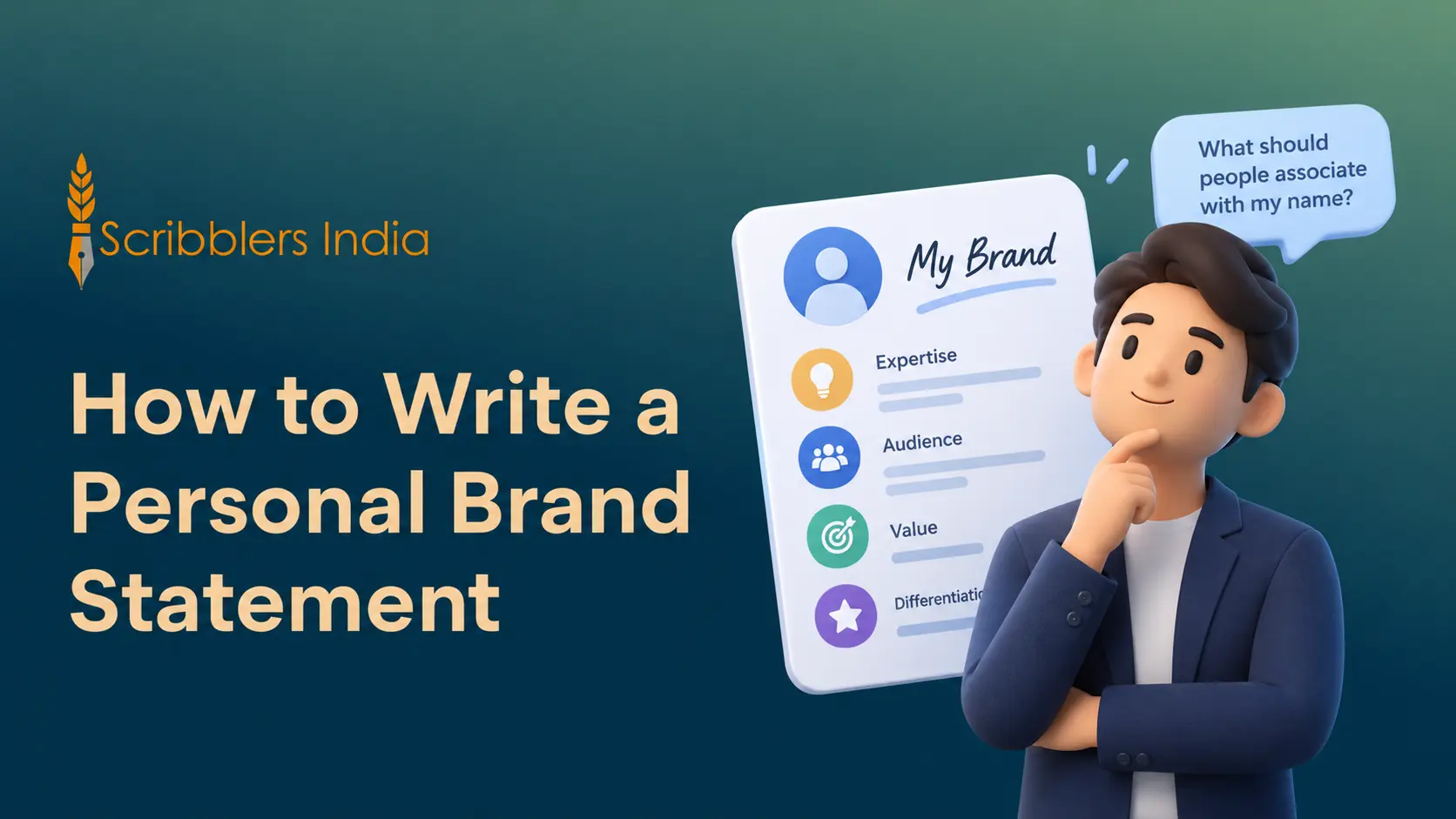
How Do You Write a Personal Brand Statement That Works (15+ Examples)
A personal brand statement explains the professional association you want people to make with your name. It can guide your positioning internally, while shorter versions can shape LinkedIn profiles, websites, portfolios, resumes, speaker materials, and other places where people encounter your professional identity. One sentence rarely performs all those jobs equally well. An internal positioning statement can provide more context about your audience, expertise, and contribution, while a LinkedIn headline needs to be clearer more quickly. The underlying professional position should remain consistent even when the wording changes. This guide starts with that core position and then explains how to build it on evidence rather than adjectives. You will also find role-specific formulas, practical personal brand statement examples, weak-to-strong rewrites, channel adaptations, and a simple framework for testing whether the statement communicates what you intend. Key Takeaways Define what people should professionally associate with your name first. Build recognition around a clear area of professional expertise. Show where your expertise becomes useful for specific audiences. Build differentiation from experience, outcomes, research, or perspective. Keep positioning stable while changing language for each platform. Use structures to guide thinking rather than copy templates. Check whether intended audiences understand your professional position correctly. Update positioning when your career direction or audience changes materially. What Is a Personal Brand Statement? A personal brand statement is a concise expression of the professional position you want associated with your name. It can communicate your expertise, intended audience, contribution, perspective, or relevant differentiation. Its exact length depends on whether it guides internal positioning or appears publicly. Different personal branding frameworks interpret the statement differently. William Arruda, writing in Forbes, treats it primarily as an internal positioning guide, while Shopify recognizes its role across both strategic positioning and outward professional communication. A useful way to reconcile these approaches is to separate the core position from its public expression: Layer Main Question Purpose Core Positioning What should people associate with your name? Guides the wider personal brand Channel Expression How should that idea appear here? Adapts positioning to the context Your core statement becomes the source of truth. A LinkedIn profile, a website, a speaker biography, a portfolio, or an email introduction can then express that position differently without forcing one sentence to carry every communication requirement. How Is a Personal Brand Statement Different From a Bio or Tagline? A personal brand statement defines your professional position within your broader communication. A headline conveys the position quickly, while a professional bio provides evidence and context. A tagline focuses more heavily on memorability, and a value proposition emphasizes usefulness for a defined audience. These assets should reinforce the same professional association without repeating identical wording. When the underlying position shifts with every format change, the problem usually runs deeper than copywriting. The professional identity itself still needs a clearer strategic center. Asset Primary Job Typical Expression Personal Brand Statement Defines professional positioning One or several short sentences LinkedIn Headline Communicates relevance quickly Short searchable profile field Professional Bio Adds evidence and context Short or long paragraph Tagline Improves memorability Very short phrase Elevator Introduction Explains relevance conversationally Short spoken explanation Value Proposition Shows value for an audience Audience and outcome focused Senior leaders often need an even broader positioning system because their reputation can influence employees, customers, investors, and industry peers simultaneously. Our personal branding vs executive branding analysis explains how those stakeholder expectations change the branding approach. What Are the Five Components of a Strong Personal Brand Statement? A strong personal brand statement usually reflects five foundations: audience, expertise territory, professional contribution, credible differentiation, and natural voice. Every element does not need to appear literally in the final sentence, although each should be clear before you start refining the wording. 1. Who Is the Relevant Audience for Your Personal Brand? Start with the people whose decisions your reputation needs to influence. “Business leaders” creates limited direction, while “CFOs at growth-stage SaaS companies” creates a useful boundary. Executives may need several audiences, while consultants can often define their commercial audience more narrowly. 2. What Expertise Should People Associate With Your Name? Choose an expertise territory rather than compiling a list of skills. “Marketing” covers too much, while “B2B category positioning for enterprise software” provides a clearer association. Ask which professional subject you want someone to connect with your name six months from now. 3. Where Does Your Expertise Create Professional Value? Expertise becomes more meaningful when people understand where it applies. Instead of describing yourself as an experienced organizational consultant, explain the context you understand, such as helping scaling leadership teams clarify decision ownership when rapid growth makes coordination increasingly difficult. 4. What Makes Your Personal Positioning Credible? Differentiation does not require claiming that nobody else performs similar work. Credibility can come from specialized industry exposure, repeated experience with one difficult problem, documented outcomes, original research, cross-functional experience, or a professional perspective your career can genuinely support. 5. Does the Personal Brand Statement Sound Like You? Avoid depending on adjectives such as “visionary,” “dynamic,” or “results-driven” to create authority. Specific professional language carries more information. Read the statement aloud and ask whether you could use similar language when someone asks what you do in a real conversation. Which Personal Brand Statement Formula Should You Use? The right formula depends on your role and the professional decision your reputation needs to support. Consultants can lead with an audience problem, while founders may express a market belief. Executives usually need an expertise territory that avoids sounding like a sales proposition. Use these formulas as scaffolds rather than finished templates: Role Formula Example Consultant I help [audience] address [problem] through [expertise]. I help B2B SaaS teams clarify category positioning when product complexity makes enterprise value difficult to explain. Executive I work at the intersection of [expertise] and [business problem]. I work at the intersection of enterprise AI governance and product adoption, helping organizations introduce AI with clearer accountability. Founder I am building [company/category] around the belief that [market
A personal brand statement explains the professional association you want people to make with your name. It can guide your positioning internally, while shorter versions can shape LinkedIn profiles, websites, portfolios, resumes, speaker materials, and other places where people encounter your professional identity. One sentence rarely performs all those jobs equally well. An internal positioning statement can provide more context about your audience, expertise, and contribution, while a LinkedIn headline needs to be clearer more quickly. The underlying professional position should remain consistent even when the wording changes. This guide starts with that core position and then explains how to build it on evidence rather than adjectives. You will also find role-specific formulas, practical personal brand statement examples, weak-to-strong rewrites, channel adaptations, and a simple framework for testing whether the statement communicates what you intend. Key Takeaways Define what people should professionally associate with your name first. Build recognition around a clear area of professional expertise. Show where your expertise becomes useful for specific audiences. Build differentiation from experience, outcomes, research, or perspective. Keep positioning stable while changing language for each platform. Use structures to guide thinking rather than copy templates. Check whether intended audiences understand your professional position correctly. Update positioning when your career direction or audience changes materially. What Is a Personal Brand Statement? A personal brand statement is a concise expression of the professional position you want associated with your name. It can communicate your expertise, intended audience, contribution, perspective, or relevant differentiation. Its exact length depends on whether it guides internal positioning or appears publicly. Different personal branding frameworks interpret the statement differently. William Arruda, writing in Forbes, treats it primarily as an internal positioning guide, while Shopify recognizes its role across both strategic positioning and outward professional communication. A useful way to reconcile these approaches is to separate the core position from its public expression: Layer Main Question Purpose Core Positioning What should people associate with your name? Guides the wider personal brand Channel Expression How should that idea appear here? Adapts positioning to the context Your core statement becomes the source of truth. A LinkedIn profile, a website, a speaker biography, a portfolio, or an email introduction can then express that position differently without forcing one sentence to carry every communication requirement. How Is a Personal Brand Statement Different From a Bio or Tagline? A personal brand statement defines your professional position within your broader communication. A headline conveys the position quickly, while a professional bio provides evidence and context. A tagline focuses more heavily on memorability, and a value proposition emphasizes usefulness for a defined audience. These assets should reinforce the same professional association without repeating identical wording. When the underlying position shifts with every format change, the problem usually runs deeper than copywriting. The professional identity itself still needs a clearer strategic center. Asset Primary Job Typical Expression Personal Brand Statement Defines professional positioning One or several short sentences LinkedIn Headline Communicates relevance quickly Short searchable profile field Professional Bio Adds evidence and context Short or long paragraph Tagline Improves memorability Very short phrase Elevator Introduction Explains relevance conversationally Short spoken explanation Value Proposition Shows value for an audience Audience and outcome focused Senior leaders often need an even broader positioning system because their reputation can influence employees, customers, investors, and industry peers simultaneously. Our personal branding vs executive branding analysis explains how those stakeholder expectations change the branding approach. What Are the Five Components of a Strong Personal Brand Statement? A strong personal brand statement usually reflects five foundations: audience, expertise territory, professional contribution, credible differentiation, and natural voice. Every element does not need to appear literally in the final sentence, although each should be clear before you start refining the wording. 1. Who Is the Relevant Audience for Your Personal Brand? Start with the people whose decisions your reputation needs to influence. “Business leaders” creates limited direction, while “CFOs at growth-stage SaaS companies” creates a useful boundary. Executives may need several audiences, while consultants can often define their commercial audience more narrowly. 2. What Expertise Should People Associate With Your Name? Choose an expertise territory rather than compiling a list of skills. “Marketing” covers too much, while “B2B category positioning for enterprise software” provides a clearer association. Ask which professional subject you want someone to connect with your name six months from now. 3. Where Does Your Expertise Create Professional Value? Expertise becomes more meaningful when people understand where it applies. Instead of describing yourself as an experienced organizational consultant, explain the context you understand, such as helping scaling leadership teams clarify decision ownership when rapid growth makes coordination increasingly difficult. 4. What Makes Your Personal Positioning Credible? Differentiation does not require claiming that nobody else performs similar work. Credibility can come from specialized industry exposure, repeated experience with one difficult problem, documented outcomes, original research, cross-functional experience, or a professional perspective your career can genuinely support. 5. Does the Personal Brand Statement Sound Like You? Avoid depending on adjectives such as “visionary,” “dynamic,” or “results-driven” to create authority. Specific professional language carries more information. Read the statement aloud and ask whether you could use similar language when someone asks what you do in a real conversation. Which Personal Brand Statement Formula Should You Use? The right formula depends on your role and the professional decision your reputation needs to support. Consultants can lead with an audience problem, while founders may express a market belief. Executives usually need an expertise territory that avoids sounding like a sales proposition. Use these formulas as scaffolds rather than finished templates: Role Formula Example Consultant I help [audience] address [problem] through [expertise]. I help B2B SaaS teams clarify category positioning when product complexity makes enterprise value difficult to explain. Executive I work at the intersection of [expertise] and [business problem]. I work at the intersection of enterprise AI governance and product adoption, helping organizations introduce AI with clearer accountability. Founder I am building [company/category] around the belief that [market

What Should Businesses Expect From a GEO Agency Retainer in 2026?
A GEO retainer can describe very different agency engagements. One proposal may combine prompt tracking, page refreshes, technical reviews, content development, external-source analysis, and recurring measurement. Another may provide a monthly dashboard with limited explanation of what the team will change once new findings emerge. That difference matters as AI-assisted discovery becomes a larger part of search behavior. Google says AI Overviews now reach more than 2.5 billion monthly active users, while AI Mode has surpassed one billion. These search experiences create new discovery opportunities while making measurement more complex. A useful engagement should therefore connect diagnosis with execution and repeat measurement. This guide explains what businesses should receive during the first 90 days, which services fall within the ongoing scope, how reporting and SLAs should work, and when a recurring arrangement warrants continued investment. Key Takeaways GEO retainers should establish measurable visibility before recommending large content changes. Early work should identify priority gaps before expanding monthly publishing volume. Core prompt sets make visibility changes easier to compare across reporting periods. Monthly reports should connect observed movement with specific implementation decisions and owners. Agencies should guarantee controllable work rather than citations or recommendation positions. Retainer costs change with markets, prompts, content needs, and implementation depth. Monthly priorities should evolve when evidence reveals stronger or weaker opportunities. What Is a GEO Retainer? A GEO retainer is an ongoing engagement focused on improving and measuring how a brand appears across AI-assisted discovery. The work can include prompt monitoring, content updates, technical checks, source analysis, authority development, and reporting, with priorities changing as new evidence emerges. The important distinction is recurrence. AI-generated answers can change as public information, competing content, platform behavior, and buyer questions evolve. A recurring engagement gives the team a structured way to observe those changes, implement improvements, and test whether the resulting AI visibility pattern changes afterward. That does not mean every company needs monthly support. Some businesses need a baseline first, while others already know which pages or information gaps require attention. The engagement model should therefore follow the problem’s maturity rather than immediately default to a retainer. Engagement Model Primary Purpose Best Fit GEO Audit Diagnose current visibility and information gaps Brands without a reliable baseline Fixed Sprint Address a defined group of priorities Teams with known implementation needs Ongoing Engagement Measure and improve recurring visibility Brands with sustained AI-search opportunity Internal Program Build and manage capability in-house Mature teams with adequate expertise Teams that are still assessing overall readiness can use Scribblers India’s AI Search Visibility Scorecard to identify broad weaknesses before deciding whether deeper diagnosis or recurring implementation is justified. The next question is whether the visibility environment changes enough to warrant continuing work. Why Does GEO Require Ongoing Work in 2026? Ongoing GEO work is useful because AI search visibility can change over time. A brand may appear for one prompt and disappear for another, while cited sources and recommendation context can also shift. Repeated testing helps businesses identify consistent patterns instead of reacting to individual responses. The wider environment is changing quickly too. After a May 2026 update to the ChatGPT interface that made brand links more prominent, total referral traffic increased by 157.7% week over week. Changes like this can quickly affect how users discover and visit brands through AI platforms. A recurring GEO program should therefore monitor both the information a brand controls and changes happening outside its website. Content quality, factual accuracy, technical access, and published evidence can be improved directly, while competitor activity, platform updates, cited sources, and evolving buyer questions require ongoing monitoring. What Services Should a GEO Services Retainer Include? A GEO retainer should connect measurement with practical improvements across priority content and supporting public evidence. The exact mix should follow the baseline findings. Strong programs avoid treating monthly content volume as the objective when existing pages or source gaps create the larger visibility problem. 1. Commercial Prompt Mapping and AI Visibility Monitoring Prompt Mapping defines the category, recommendation, comparison, alternative, and validation questions to monitor. Each prompt should have a clear business reason for inclusion, while the baseline should record brand appearances, relevant competitors, description accuracy, and cited sources using consistent testing rules. 2. Prompt-to-Page Content Mapping Content Mapping connects commercially important questions with the strongest existing destination pages. Some prompts reveal missing assets, while others expose incomplete service pages or comparisons. Scribblers India’s AI content gap analysis explains why many visibility gaps can be solved by strengthening existing pages rather than adding another URL. 3. Technical Search and Crawler Review Technical Review checks whether priority information remains accessible to relevant search systems. Google says existing SEO fundamentals remain relevant for AI Overviews and AI Mode, with no special AI-specific technical requirements. OpenAI separately recommends allowing OAI-SearchBot when publishers want their public content to be discoverable in ChatGPT Search. 4. Priority Page Refreshes Page Refreshes improve existing commercial assets when they already serve the right search job. Updates can strengthen direct answers, product or service detail, comparison depth, evidence, freshness, internal pathways, and factual consistency without creating unnecessary content overlap across the site. 5. New Authority Assets Authority Assets become useful when no existing page can answer an important question properly. These may include research reports, buyer guides, comparison resources, case studies, glossaries, or expert-led thought leadership that provides buyers with deeper evidence on a category or decision. 6. External Source and Brand Evidence Review Source Review examines how credible third-party pages describe the company and its expertise. Relevant publications, review platforms, partner profiles, directories, customer evidence, or expert pages can reveal inconsistencies that website-only analysis misses and may influence how buyers validate AI-generated recommendations. 7. Measurement and Monthly Reprioritization Recurring Measurement repeats the stable prompt panel and connects observed movement with the next implementation cycle. Scribblers India’s GEO services apply the same connected approach, linking search foundations, answer-led content, authority development, and visibility measurement to documented business gaps. What Should Happen During GEO Onboarding? GEO onboarding should establish business
A GEO retainer can describe very different agency engagements. One proposal may combine prompt tracking, page refreshes, technical reviews, content development, external-source analysis, and recurring measurement. Another may provide a monthly dashboard with limited explanation of what the team will change once new findings emerge. That difference matters as AI-assisted discovery becomes a larger part of search behavior. Google says AI Overviews now reach more than 2.5 billion monthly active users, while AI Mode has surpassed one billion. These search experiences create new discovery opportunities while making measurement more complex. A useful engagement should therefore connect diagnosis with execution and repeat measurement. This guide explains what businesses should receive during the first 90 days, which services fall within the ongoing scope, how reporting and SLAs should work, and when a recurring arrangement warrants continued investment. Key Takeaways GEO retainers should establish measurable visibility before recommending large content changes. Early work should identify priority gaps before expanding monthly publishing volume. Core prompt sets make visibility changes easier to compare across reporting periods. Monthly reports should connect observed movement with specific implementation decisions and owners. Agencies should guarantee controllable work rather than citations or recommendation positions. Retainer costs change with markets, prompts, content needs, and implementation depth. Monthly priorities should evolve when evidence reveals stronger or weaker opportunities. What Is a GEO Retainer? A GEO retainer is an ongoing engagement focused on improving and measuring how a brand appears across AI-assisted discovery. The work can include prompt monitoring, content updates, technical checks, source analysis, authority development, and reporting, with priorities changing as new evidence emerges. The important distinction is recurrence. AI-generated answers can change as public information, competing content, platform behavior, and buyer questions evolve. A recurring engagement gives the team a structured way to observe those changes, implement improvements, and test whether the resulting AI visibility pattern changes afterward. That does not mean every company needs monthly support. Some businesses need a baseline first, while others already know which pages or information gaps require attention. The engagement model should therefore follow the problem’s maturity rather than immediately default to a retainer. Engagement Model Primary Purpose Best Fit GEO Audit Diagnose current visibility and information gaps Brands without a reliable baseline Fixed Sprint Address a defined group of priorities Teams with known implementation needs Ongoing Engagement Measure and improve recurring visibility Brands with sustained AI-search opportunity Internal Program Build and manage capability in-house Mature teams with adequate expertise Teams that are still assessing overall readiness can use Scribblers India’s AI Search Visibility Scorecard to identify broad weaknesses before deciding whether deeper diagnosis or recurring implementation is justified. The next question is whether the visibility environment changes enough to warrant continuing work. Why Does GEO Require Ongoing Work in 2026? Ongoing GEO work is useful because AI search visibility can change over time. A brand may appear for one prompt and disappear for another, while cited sources and recommendation context can also shift. Repeated testing helps businesses identify consistent patterns instead of reacting to individual responses. The wider environment is changing quickly too. After a May 2026 update to the ChatGPT interface that made brand links more prominent, total referral traffic increased by 157.7% week over week. Changes like this can quickly affect how users discover and visit brands through AI platforms. A recurring GEO program should therefore monitor both the information a brand controls and changes happening outside its website. Content quality, factual accuracy, technical access, and published evidence can be improved directly, while competitor activity, platform updates, cited sources, and evolving buyer questions require ongoing monitoring. What Services Should a GEO Services Retainer Include? A GEO retainer should connect measurement with practical improvements across priority content and supporting public evidence. The exact mix should follow the baseline findings. Strong programs avoid treating monthly content volume as the objective when existing pages or source gaps create the larger visibility problem. 1. Commercial Prompt Mapping and AI Visibility Monitoring Prompt Mapping defines the category, recommendation, comparison, alternative, and validation questions to monitor. Each prompt should have a clear business reason for inclusion, while the baseline should record brand appearances, relevant competitors, description accuracy, and cited sources using consistent testing rules. 2. Prompt-to-Page Content Mapping Content Mapping connects commercially important questions with the strongest existing destination pages. Some prompts reveal missing assets, while others expose incomplete service pages or comparisons. Scribblers India’s AI content gap analysis explains why many visibility gaps can be solved by strengthening existing pages rather than adding another URL. 3. Technical Search and Crawler Review Technical Review checks whether priority information remains accessible to relevant search systems. Google says existing SEO fundamentals remain relevant for AI Overviews and AI Mode, with no special AI-specific technical requirements. OpenAI separately recommends allowing OAI-SearchBot when publishers want their public content to be discoverable in ChatGPT Search. 4. Priority Page Refreshes Page Refreshes improve existing commercial assets when they already serve the right search job. Updates can strengthen direct answers, product or service detail, comparison depth, evidence, freshness, internal pathways, and factual consistency without creating unnecessary content overlap across the site. 5. New Authority Assets Authority Assets become useful when no existing page can answer an important question properly. These may include research reports, buyer guides, comparison resources, case studies, glossaries, or expert-led thought leadership that provides buyers with deeper evidence on a category or decision. 6. External Source and Brand Evidence Review Source Review examines how credible third-party pages describe the company and its expertise. Relevant publications, review platforms, partner profiles, directories, customer evidence, or expert pages can reveal inconsistencies that website-only analysis misses and may influence how buyers validate AI-generated recommendations. 7. Measurement and Monthly Reprioritization Recurring Measurement repeats the stable prompt panel and connects observed movement with the next implementation cycle. Scribblers India’s GEO services apply the same connected approach, linking search foundations, answer-led content, authority development, and visibility measurement to documented business gaps. What Should Happen During GEO Onboarding? GEO onboarding should establish business